

The immediate crisis is one of security. The deeper crisis is political. The Kuki-Zo movement has yet to turn collective suffering into collective purpose. Until it does, its principal demands risk remaining empty slogans rather than achievable goals.
By Navin Upadhyay
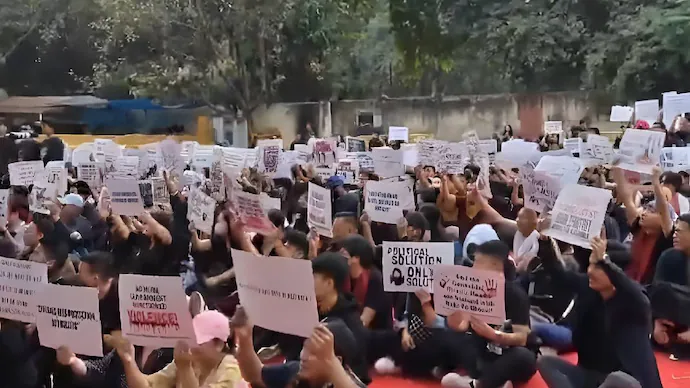
October 22: Kuki-Zo organisations demanded the reimposition of President’s Rule in Manipur at a press conference in Delhi on October 21. They cited 32 deaths and around 55 houses burnt since the Yumnam Khemchand Singh government took office in February. They accused the government of failing to protect Kuki-Zo civilians and reiterated their demand for a separate Union Territory with a legislature.
Ginza Vualzong of the Kuki-Zo Council said 32 members of the community had been killed under the present government. He claimed no such deaths occurred during the preceding period of President’s Rule under Governor Ajay Kumar Bhalla. The figures indeed raise serious questions about the state government’s ability to protect civilians.
But the demand also exposes a contradiction that borders on hypocrisy.
Nemcha Kipgen, the Kuki-Zo MLA from Kangpokpi, is Deputy Chief Minister. She also holds portfolios that include Tribal Affairs and Hills. She is part of the very government accused of failing to protect Kuki-Zo civilians.
Remaining in government can provide political access and leverage. But it must deliver results. If Kipgen’s participation has failed to prevent killings, secure accountability or advance the community’s main demand, its purpose must be questioned. Kuki-Zo organisations cannot demand the government’s removal while leaving their own representative’s role largely unchallenged.
There are also questions about Kipgen’s decision to remain in office despite the community’s grievances. Her husband, S.T. Thangboi Kipgen, heads the Kuki National Front (President), an armed organisation covered by a Suspension of Operations (SoO) agreement. Allegations have surfaced that she joined the government to protect her husband’s interests and shield his outfit from a crackdown.
These claims are unverified, and yet Kipgen must answer the broader question: what has her position in government delivered for the community? At the same time, the Kuki-Zo leadership must confront this contradiction between participation in the state government and demands for its dismissal. Until it does, its appeal to New Delhi will lack a clear political line.
Three demands, little progress
Since the violence began on May 3, 2023, nearly 250 Kuki-Zo people have reportedly been killed. The movement pursued three broad objectives: separation from the Imphal Valley through buffer arrangements, restrictions on free movement along highways, and a separate Union Territory with a legislature.
It has conceded ground on the first two. The third has made little visible progress.
Movement along the highways is being restored. Kuki-Zo civil society organisations may insist that they never obstructed free movement. But that claim must be reconciled with the protests in May 2025, following Union Home Minister Amit Shah’s announcement that free movement would be restored from March 8. The violent protests in Kangpokpi left one young man dead and several others injured. If the groups did not oppose free movement, what prompted the protests?
Kipgen’s expected return to working from Imphal presents another test. Some Kuki-Zo groups may seek to justify the move. But it raises a basic question: how can the movement demand separation from the valley while its own Deputy Chief Minister works from the state capital?
Neither development necessarily means the community has abandoned its security concerns. Together, however, they expose the absence of a clear strategy. The movement has not explained how it intends to reconcile physical separation, participation in the state government and its demand for a separate political arrangement.
The Union Territory demand has also stalled. The Union Home Ministry has held no meeting with Kuki-Zo groups on their political demands in recent months, according to available information. The SoO agreement expired in September and has yet to be renewed. SoO cadres are also reportedly owed 34 months of stipend payments.
These unresolved issues raise questions about the effectiveness of the movement’s leadership. It has neither secured progress on its main political demand nor demonstrated a clear plan for resolving the problems surrounding the SoO framework.
Kuki-Zo Civil society, MLAs and armed groups pull in different directions
The Kuki-Zo movement includes elected representatives, civil society organisations, student bodies and armed groups under the SoO framework. Their interests may overlap, but they have not followed a common strategy.
Civil society organisations announce deadlines and issue ultimatums, only to extend them when the government applies pressure or offers limited concessions. MLAs have failed miserably in mountin any campaign for justice, accountability or a Union Territory. Armed groups have yet to show that the SoO framework has delivered meaningful progress towards the community’s political goals.
This fragmentation weakens the movement’s bargaining power. New Delhi can engage individual delegations and consider administrative arrangements without securing agreement across the wider Kuki-Zo constituency.
A meeting between a Kuki-Zo Council delegation and Union Home Ministry interlocutors, including A.K. Mishra, illustrated the problem. The meeting took place in Delhi more than three months ago. The delegation was reportedly offered an arrangement resembling a Hill Council. Its representatives did not reject the proposal outright. They later called off wider consultations after pressure from SoO groups.
The episode exposed a gap between the movement’s public demand for a Union Territory and its willingness to consider a lesser arrangement in negotiations.
There is nothing wrong with exploring alternatives. Negotiations require flexibility, and an interim arrangement may offer practical benefits. But leaders must explain their position to their constituents and secure support for it. Otherwise, flexibility becomes confusion.
A movement that cannot decide who negotiates, what can be negotiated and who has the final say will struggle to convince the Centre that its commitments are credible.
READ: “Islamists”, “Immigrants” : Macron Calls Trump’s Claims “Stupid”
Kuki-Zo leadership crisis
The movement’s central weakness is the absence of leadership capable of bringing its competing groups together and taking responsibility for decisions.
The leadership vacuum also complicates efforts to end clashes with Tangkhul Naga groups. These clashes have added to the insecurity faced by Kuki-Zo communities. A lasting settlement requires dialogue with Naga leaders, credible security assurances, and a way to address competing territorial and political claims.
Kuki-Zo representatives have accused Meitei political actors of encouraging divisions between the Kuki-Zo and Naga communities. Such allegations require may be true to certain extent. But blaming outside actors cannot replace direct engagement with Naga leaders. Even if political interference has aggravated tensions, leaders on both sides must work to end the violence.
The fact that many Kuki-Zo and Tangkhul Naga people share the Christian faith has not prevented violence. Religious ties cannot resolve political disputes. That requires dialogue, restraint and practical steps to prevent further bloodshed.
Divisions within the Kuki-Zo community pose another challenge. Differences among Kuki-Zo, Zomi and Hmar groups have complicated efforts to build a common front. Some groups are unwilling to accept Kuki-Zo dominance. A movement seeking a separate political arrangement cannot afford to leave these differences unresolved.
Without credible leadership, the movement will struggle to negotiate with the Centre, engage neighbouring communities or hold its own representatives accountable.
President’s Rule cannot replace political strategy
The demand for President’s Rule may reflect genuine fears about civilian safety. If the figures cited by Kuki-Zo organisations are accurate, the reported killings and destruction of homes warrant serious scrutiny. The state has a duty to protect civilians, and its response must be examined.
The Kuki-Zo community has endured violence, insecurity and displacement since May 2023. Its grievances deserve attention. But its political leadership must also be judged by what it has achieved.
The Kuki-Zo movement has failed to turn the suffering of its people into a coherent political strategy. Infighting, divided leadership, weak civil society organisations and competing interests have eroded its leverage. Its leaders issue hollow threats, but struggle to deliver results. Outside Manipur, few are paying attention to what is being said in Churachandpur and Kangpokpi.
The failure is not that the movement has demanded too much. It is that it has not built the unity, negotiating authority and accountability needed to secure its demands.
Elected representatives, civil society organisations and armed groups must agree on a common strategy. They must hold their own leaders accountable and engage seriously with neighbouring communities. Without that, the Union Territory demand will remain trapped in a cycle of declarations, internal disputes and stalled negotiations.
The immediate crisis is one of security. The deeper crisis is political. The movement has yet to turn collective suffering into collective purpose. Until it does, its principal demands risk remaining empty slogans rather than achievable goals.