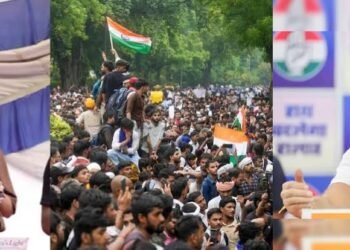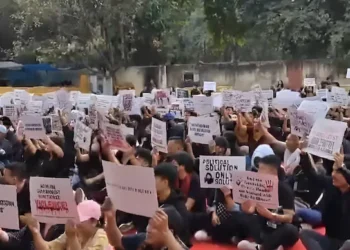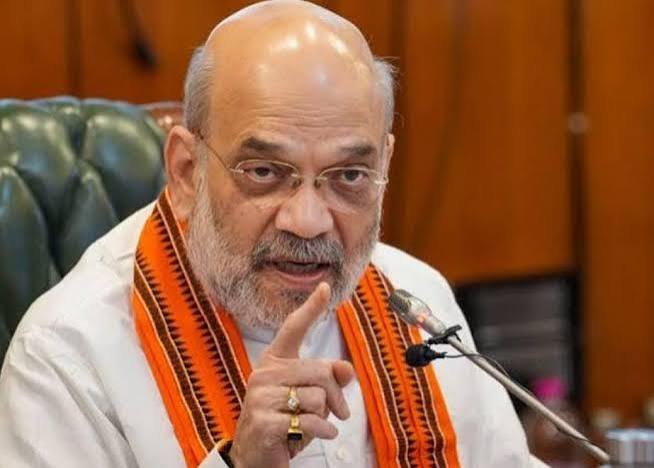
Calling the opposition’s protests “political jugglery and mobocracy”, Shah argued that parties should focus on governance and public welfare instead of questioning the electoral process after defeats. He also predicted that the BJP would remain in power for 30 years.
BY PC Bureau
New Delhi, October 22: Union Home Minister Amit Shah on Thursday accused the Congress and the Aam Aadmi Party (AAP) of using protests and allegations of “vote chori” to challenge electoral verdicts, framing the opposition’s campaign against alleged electoral irregularities as an attempt to undermine the people’s mandate.
Addressing an event in outer Delhi to launch and inaugurate 33 Delhi Jal Board projects worth ₹8,941 crore, Shah said opposition parties should focus on governance and public welfare rather than street demonstrations after electoral defeats.
“You cannot use political jugglery and mobocracy to defy the mandate of the people,” Shah said. He urged opposition parties to reach out to voters, understand their problems and deliver welfare schemes in states where they hold power. Otherwise, he warned, they risk losing support in the remaining states.
Shah’s remarks came as allegations of “vote chori” and disputes over electoral rolls have become a political flashpoint, with opposition parties questioning the conduct of elections and the role of the Election Commission. The BJP has rejected these allegations, portraying the protests as an effort to discredit electoral outcomes.
READ: Gen Z Phobia? Delhi Police Denies Nod to Diljit Dosanjh Concert
Calling the controversy a “new game” in Delhi, Shah alleged that opposition parties questioned the electoral process whenever the BJP won. He argued that the same electronic voting machines and Election Commission had been in place when the Congress and other opposition parties won elections in states such as Kerala, Himachal Pradesh and Telangana.
“Whenever you lose, you criticise the Election Commission. When courts rule in your favour, they are good; otherwise, they are bad,” he said.
Shah also claimed that the “vote chori” campaign was intended to protect the votes of infiltrators, linking the opposition’s electoral-roll concerns to the BJP’s longstanding campaign against illegal immigration. He did not, in the remarks cited, provide specific evidence establishing that opposition protests over alleged electoral irregularities were intended to protect such voters.
The Home Minister invoked the Congress’s electoral record to argue that its defeats predated the BJP’s rise to power at the Centre in 2014. He also predicted that the BJP would remain in power for 30 years, attributing the forecast to what he described as the opposition’s negative politics.
“I am saying you won’t form government for 30 years, based on your negative politics,” he said. Shah also took a personal swipe at the opposition, saying he was born in India, lived there and would die there, and did not need to travel abroad every six months.
“जब मैं कहता हूं कि 30 साल तक भाजपा की सरकार रहेगी तो ये जनता को कहते हैं कि देखो वोट चोरी है वरना अमित शाह जी को कैसे मालूम पड़ा।
अमित शाह तो यहां जन्मा है, यहां रहता है और यहीं मरेगा; मुझे हर 6 महीने में विदेश नहीं जाना पड़ता है। मैं तो देश की जनता के बीच में रहता हूं।
आप जिस तरह से नाकारात्मक राजनीति कर रहे है, उसके आधार पर मैं कहता हूं कि 2014 से 30 तक आपकी सरकार कभी नहीं बनने वाली है…”
– केंद्रीय गृह मंत्री श्री अमित शाह जी
— Nikhil Mani Tiwari (@NikhilManiBJP) October 22, 2026
Yamuna clean-up becomes a political battleground
Although the event centred on Delhi’s water infrastructure, Shah used the platform to target successive Congress and AAP governments over the condition of the Yamuna. He accused them of allowing sewage and industrial waste to flow into the river and said the Centre and the governments of Delhi, Haryana and Uttar Pradesh were now working on a coordinated plan to clean it.
Shah said the government aimed to present a clean Yamuna to the public by May 2029. He also outlined a three-year action plan involving sewer connections and improvements in clean-water supply.
The announcement gave the BJP an opportunity to contrast its promises with the records of its political rivals in Delhi. The extent to which the proposed measures improve water quality, however, will depend on their implementation and measurable progress in reducing pollution.
Shah also targeted the AAP government in Punjab over drug abuse, accusing it of failing to contain the problem. He predicted that the NDA would form the government in the state by 2029, extending his attack on the opposition beyond Delhi.
The speech thus combined the inauguration of public infrastructure projects with a broader political message: the BJP is seeking to frame opposition protests over electoral integrity as a rejection of voters’ verdict, while challenging Congress and AAP to defend their governance records.
For the opposition, the central issue remains whether allegations concerning electoral rolls and the conduct of elections receive a substantive response from the authorities. Shah’s remarks made clear that the BJP intends to contest those allegations politically, presenting them as an excuse for electoral defeats rather than a legitimate basis for questioning the process.