


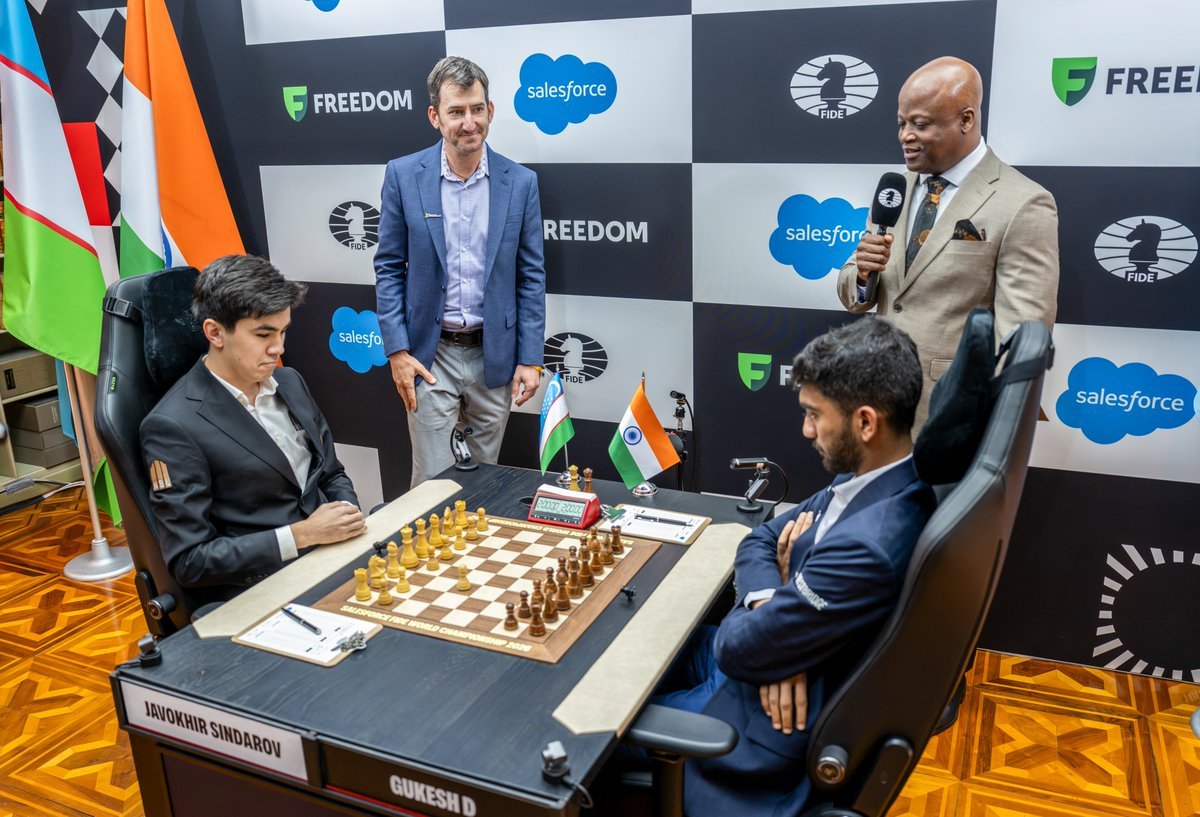
The Indian champion had fought back from early opening difficulties, but a rushed queen exchange cost him the fifth game. Gukesh’s 31…Qd2 proved decisive as the Uzbek challenger took a 3–2 lead in the world championship match.
BY PC Bureau
November 30: A costly decision under time pressure handed Javokhir Sindarov his first victory in the 2026 FIDE World Chess Championship on Sunday, as the Uzbek challenger defeated defending champion D. Gukesh in Game 5 to take a 3–2 lead in the 14-game match.
Playing White, Sindarov won in 47 moves after Gukesh, struggling against the clock, made a decisive error on move 31. The result ended a run of four consecutive draws and gave the challenger the first lead of the contest.
The match between the two 20-year-olds is the youngest world championship contest in chess history. Until Sunday, both had produced largely accurate and cautious chess, with neither managing to convert an advantage into a full point.
Gukesh loses time in the opening
Sindarov opened with 1.Nf3, followed by 2.g3 and 3.Bg2, adopting a Réti setup that developed into a King’s Indian Attack structure.
Gukesh was forced into lengthy calculations almost from the beginning. He spent around 10 minutes on his second move, 25 minutes and 40 seconds on 10…Rd8, and nearly 33 minutes on 13…Nd5 after Sindarov advanced his central pawn with 13.e5.
Those long pauses put the Indian champion under considerable clock pressure. He eventually managed to stabilise the position, however, and appeared to have dealt with the opening difficulties.
Sindarov gradually gained space on the kingside, advancing his h-pawn to h6 by move 25. The players exchanged several pieces, but the position remained competitive. Gukesh later felt that he had equalised after playing 28…Rd5.
READ: Four Bears Escape Aizawl Zoo, Kill Keeper; All Shot Dead
Match Score: 3–2 in favour of Sindarov.
A crucial victory that puts the challenger in the lead! The battle for the crown just got more intense. ♟️
Credit @fide_chess
Who will win Game 6?
#GukeshSindarov #FIDEWorldChampionship2026 #Salesforce #Chess #Chessveda https://t.co/Ul3cTImJnX
— Chessveda (@chess_veda) November 29, 2026
The decisive mistake on move 31
The critical moment came as the players approached the first time control of 40 moves in two hours.
With only 7 minutes and 57 seconds remaining to make nine moves, Gukesh played 31…Qd2, offering a queen exchange. Sindarov accepted with 32.Qxd2, and after 32…Rxd2, the game entered a rook endgame that favoured White decisively.
The problem was not simply the exchange of queens. The resulting position gave Sindarov’s advanced h-pawn and central pawn structure dangerous potential. His rook became active, while Gukesh had little scope for counterplay.
Grandmaster Peter Svidler, commenting on the official broadcast, described the resulting rook ending as objectively winning for Sindarov.
The challenger later said he was certain the position was winning once Gukesh offered the exchange. He also believed the Indian would have avoided the decision had he had more time to calculate.
Was Game 5 harder for Gukesh? Yes.
Per our complexity model, his positions averaged 52.7/100 to Sindarov’s 45.2. In games 1–4, the gap never topped 2.
He coped: minus 31…Qd2, he lost 5.7 centipawns a move to Sindarov’s 5.3. One move decided it. https://t.co/azXIk2nPQD
— Pawnalyze (@pawnalyze) November 29, 2026
Sindarov converts without giving Gukesh a chance
Sindarov handled the technical phase with patience. He used his rook actively, first checking the black king and then moving across to capture the h7-pawn.
The resulting passed h-pawn became a major threat. Gukesh tried to organise counterplay, but Sindarov continued to improve his position and eventually created a second passed pawn on the e-file.
Gukesh crossed the 40-move time control, receiving the additional 30 minutes, but the position was already beyond saving. Sindarov pushed his e-pawn to e7 on move 47, leaving it one step from promotion. With the h-pawn also threatening, Gukesh resigned after four hours and 13 minutes.
What the players said
Sindarov was clear about the importance of the queen exchange.
“After …Qd2, I was like 100% sure it was winning because I calculated everything there,” he said after the game. “It was really a big mistake because of time trouble. If he had time, he would think about it, of course. He just played the move very fast, and that was a big mistake.”
Gukesh acknowledged that his opening preparation had taken longer than expected and that he had misjudged the endgame.
“It was a pretty challenging game. I spent a lot of time in the opening. I couldn’t really recall my prep, but I thought I equalised, and probably around the time trouble I blundered somewhere,” he said.
Referring to his 28…Rd5, Gukesh added that he had believed he was completely fine, but the position had become unexpectedly difficult.
The defeat was a setback for the Indian, who had appeared to be heading towards another draw before the critical decision. After the game, he was seen sitting in the players’ lounge with his head bowed.
Gukesh faces an important response
The score now stands at Sindarov 3–2 Gukesh. The first player to reach 7.5 points in the 14-game match will retain or win the world title. If the contest finishes 7–7, the championship will be decided through faster time-control tiebreaks.
Game 6 is scheduled for Monday, November 30, with Gukesh playing White. The Indian will need to respond quickly to avoid allowing Sindarov to extend his advantage.
The fifth game also offered a reminder of how time management can decide a contest at the highest level. Gukesh’s difficulties began in the opening, but it was a single decision under pressure that ultimately cost him the game.
Game 5 – Sindarov (White) vs Gukesh (Black)
FIDE World Chess Championship 2026 | Geneva | 29 November 2026
Opening: King’s Indian Attack (A05) | Result: 1–0 (47 moves)
Key moment: With roughly 7–8 minutes left for the next 9 moves before time control, Gukesh played 31…Qd2??, forcing a queen trade that left him in a lost rook endgame. Sindarov converted cleanly with the passed e- and h-pawns