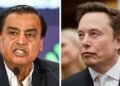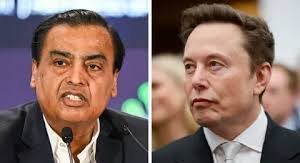
SpaceX chief shares investigations into political advertising and electoral-bond donations involving companies described as linked to Reliance, hours after sarcastically addressing Mukesh Ambani as ‘Prime Minister Ambani’ and accusing him of seeking to protect a monopoly.
BY PC Bureau
October 10: Elon Musk on Saturday escalated his public confrontation with Reliance Industries chairman Mukesh Ambani by sharing screenshots of two media reports examining alleged links between Reliance-associated companies and political support for the ruling Bharatiya Janata Party (BJP).
The screenshots featured a March 2022 Al Jazeera investigation into political advertisements run by New Emerging World of Journalism Limited (NEWJ) and a March 2024 Indian Express report on electoral-bond donations by Qwik Supply Chain Private Limited. Musk added no accompanying comment, but the posts came amid his increasingly pointed criticism of delays in launching his Starlink satellite broadband service in India.
The move followed a series of posts in which Musk accused powerful business interests of obstructing Starlink’s entry into the Indian market to protect established telecom operators. He specifically targeted Ambani, questioning whether the Reliance chairman wielded disproportionate influence over India’s economic decisions.
https://t.co/DJYynAyO0W
— Elon Musk (@elonmusk) October 10, 2026
Musk addresses Ambani as ‘Prime Minister’
On October 9, Musk sarcastically addressed Ambani as “Prime Minister Ambani” in a post on X, accusing him of preferring to maintain what he described as a monopoly over India’s internet market.
“Dear Prime Minister Ambani,” Musk began, before offering what he called his “humble apologies” for failing to recognise Ambani as “the real boss of India”.
He then wrote: “Naturally, you would prefer to maintain your monopolistic exploitation of the great people of India, but would you nonetheless consider allowing Starlink to compete?”
Musk argued that Starlink could bring internet access to underserved parts of India, expanding educational opportunities for children and enabling small businesses to sell their products to global markets.
In a follow-up post minutes later, he said Starlink had proved essential in saving lives during natural disasters when other communications systems failed. Allowing the service in India, he argued, could help save lives there too.
The remarks were part of Musk’s broader campaign to press the Indian government to complete the approvals needed for Starlink to begin commercial operations. His description of Ambani as the country’s “real boss” was sarcastic rhetoric, not a factual claim about the Reliance chairman’s constitutional position.
Musk questions Starlink’s regulatory delay
The confrontation intensified on October 8, when Musk questioned why Starlink had not yet been cleared to begin operations in India, despite operating in more than 165 countries.
He asked: “Is Ambani the real boss of India?”
A day earlier, Musk had accused unnamed “certain oligarchs” of attempting to block Starlink to maintain what he called a “monopolistic chokehold on the Indian people”. He described such conduct as “a crime against the people of India”.
The Indian government has rejected allegations of discriminatory treatment. The Ministry of Communications has maintained that the regulatory framework for satellite communications is fair and non-discriminatory, adding that Starlink, Reliance Jio’s satellite venture and Bharti-backed Eutelsat OneWeb are at broadly the same stage of the approval process.
The companies must complete the required security assessments before proceeding towards spectrum assignment and commercial service.
Communications Minister Jyotiraditya Scindia has also reiterated that India does not permit monopolies in the satellite communications sector.
An important distinction is that Starlink has received the relevant operating licence but has yet to obtain all the clearances required to begin commercial services. The government attributes the delay to outstanding regulatory and security requirements, rather than an attempt to protect domestic competitors.
READ: Seven Dead in 24 Hours as Naga-Kuki Violence Rocks Manipur Hills
What the Al Jazeera investigation found
The first report shared by Musk was an Al Jazeera investigation published in March 2022, based on work by The Reporters’ Collective and ad.watch.
The investigation examined New Emerging World of Journalism Limited (NEWJ), described in the report as a company funded by Reliance and associated with Jio Platforms.
According to the investigation, NEWJ ran 718 political advertisements on Facebook between February 2019 and November 2020, covering 10 elections. The advertisements reportedly generated more than 290 million views and cost approximately ₹52 lakh.
The report found that some advertisements promoted the BJP and Prime Minister Narendra Modi while attacking political opponents. Some were presented in a news-like format, raising questions about whether political messaging was being disguised as independent news content.
The investigation cited examples of advertisements that allegedly circulated misleading claims involving BJP candidate Pragya Singh Thakur and Congress leader Rahul Gandhi. It also argued that gaps in Facebook’s enforcement of political-advertising rules had allowed such campaigns to operate as a form of surrogate political promotion.
These findings were reported by the investigators and should be understood in that context. They do not establish that every advertisement was misleading or that Ambani personally directed the campaigns.
The Indian Express report on electoral-bond donations
The second report, published by The Indian Express in March 2024, examined political donations made by Qwik Supply Chain Private Limited through India’s now-defunct electoral-bond scheme.
The company, registered at Dhirubhai Ambani Knowledge City in Navi Mumbai and described in the report as having links to Reliance, purchased electoral bonds worth ₹410 crore between the 2021-22 and 2023-24 financial years.
According to the newspaper, Qwik Supply Chain donated ₹385 crore to the BJP and ₹25 crore to the Shiv Sena, making it the third-largest donor through the scheme.
Reliance has previously stated that Qwik Supply Chain is not a subsidiary of any Reliance entity. The company’s registration address and reported links to the group do not, by themselves, establish that Reliance owned or controlled it.
The donations became public following disclosures of electoral-bond transactions after the Supreme Court struck down the scheme in February 2024. The court held that the anonymous political-funding mechanism violated the constitutional right to information.
The disclosures prompted extensive scrutiny of corporate contributions to political parties and the concentration of electoral-bond funding among major recipients.
However, neither the donation figures nor the advertising investigation establishes that Reliance or the companies named in the reports intervened in the government’s regulatory decisions on Starlink.