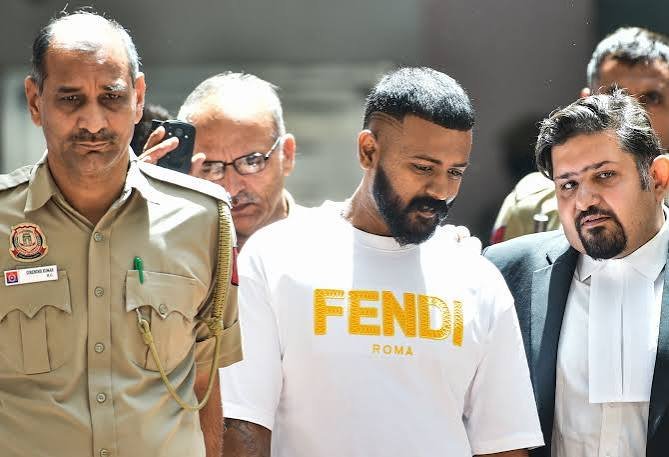
The court imposed consecutive sentences for impersonating a public servant, threatening a public servant and anonymous criminal intimidation after Chandrasekhar allegedly used a constable’s phone to call the judge in 2017.
BY PC Bureau
NEW DELHI: Sukesh Chandrasekhar’s attempt to impersonate a Supreme Court judge and pressure a Delhi trial judge into granting him bail has cost him eight years in prison, with a Tis Hazari court imposing consecutive sentences for impersonation, threats and anonymous criminal intimidation.
Chief Judicial Magistrate Harshita Mishra sentenced Chandrasekhar to a total of eight years’ rigorous imprisonment and imposed three fines of Rs 5,000 each. He was awarded two years’ rigorous imprisonment under IPC Section 170 for impersonating a public servant, two years under Section 189 for threatening a public servant, and four years under Section 507 for criminal intimidation through anonymous communication.
The sentences will run consecutively. Failure to pay the fines will result in an additional month in prison. The court also directed that the period Chandrasekhar has already spent in custody be set off against the sentence.
The conviction was recorded on August 20, while the sentencing order was passed on August 29 and made public on Sunday.
The court said the punishment needed to distinguish an isolated illegal act from a calculated attempt to manipulate or intimidate public officials and interfere with the functioning of public institutions.
The case dates back to April 28, 2017, when Chandrasekhar was in police custody. According to the court, he used a constable’s mobile phone to make several calls to then Special Judge Poonam Choudhary.
During the calls, he initially claimed to be the private secretary of a sitting Supreme Court judge from South India. He later posed as the judge himself, even adopting what the court described as a regional accent.
Chandrasekhar allegedly demanded that the judge grant him immediate bail and warned her of professional consequences if she refused.
The court found that the choice to impersonate a Supreme Court judge was not accidental but a deliberate attempt to exploit the authority associated with a constitutional office.
The fact that Chandrasekhar ultimately failed to secure bail did not reduce the seriousness of the offence, the court said.
The magistrate also took note of what she described as a lack of genuine remorse. Rather than acknowledging wrongdoing, Chandrasekhar had sought to question the credibility of the judge who complained about the incident.
The court said such conduct was particularly serious because attempts to intimidate judges strike at the independence and credibility of the judicial system.
The sentencing order also highlighted the growing dangers posed by deepfakes, cloned voices and spoofed communications, noting that advances in technology can make impersonation increasingly difficult to detect.
Against that backdrop, the court said the punishment should serve as a deterrent and reinforce public confidence in institutions of justice.
READ: Manipur: Toll Rises To Three In Attack On Kuki-Zo Village In Kangpokpi
The court did not rely on Chandrasekhar’s other pending criminal cases to increase his punishment, noting that those matters remain sub judice.
The case adds another chapter to the long-running legal troubles surrounding Chandrasekhar, who has faced multiple criminal proceedings.
In the present matter, however, the court focused specifically on his conduct in 2017 and the threat it posed to the judicial process.
By impersonating a Supreme Court judge, the court observed, Chandrasekhar was not merely attempting to deceive an individual. He was seeking to manufacture the appearance of institutional authority in order to influence a judicial decision.
That distinction formed a central part of the court’s reasoning in imposing consecutive sentences.
The judgment also comes at a time when courts and law-enforcement agencies are increasingly confronting sophisticated forms of impersonation involving technology, fake identities, manipulated audio and fraudulent communications.
The court’s warning over deepfakes and voice cloning gives the case significance beyond Chandrasekhar himself, particularly as such technology makes it possible to imitate the identity and voice of senior public officials with increasing precision.
For Chandrasekhar, the immediate consequence is an eight-year prison sentence for an attempted intervention in the justice system that began with a borrowed mobile phone and a fabricated judicial identity.
The court made clear that impersonating the authority of a constitutional office and using it to threaten a judge cannot be treated as an ordinary act of deception.