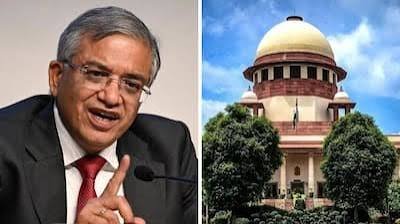
The clock is ticking for Chief Election Commissioner Gyanesh Kumar after the Supreme Court made it clear that it never approved the modified Form 6 used during the SIR process, contradicting an earlier Election Commission claim.
BY PC Bureau
New Delhi/ October 5:: Chief Election Commissioner Gyanesh Kumar came under fresh pressure on Monday after the Supreme Court made it clear that it had never approved the Election Commission’s modified Form 6 for the Special Intensive Revision, directly contradicting a September 26 statement issued by the poll panel.
The court’s clarification gave fresh ammunition to the Opposition and activists who have been questioning the manner in which the Form 6 declaration was introduced and demanding accountability from the Election Commission.
On September 26, the Commission had said in a press note that the declaration attached to Form 6 for the SIR “has been upheld by the Hon’ble Supreme Court”. It also said that the statutory Form 6 prescribed under the Registration of Electors Rules, 1960, would continue to be used during non-SIR periods.
The statement came a day after The Indian Express reported that the other two Election Commissioners, Sukhbir Singh Sandhu and Vivek Joshi, had objected to the modification. According to the report, they had argued that such a change could not be made without amending the relevant rules and had raised concerns about harassment of new voters, particularly first-time Gen Z applicants seeking registration.
On Monday, while hearing petitions seeking action against Kumar over alleged unilateral decisions relating to the SIR, Chief Justice of India Surya Kant directly addressed the issue.
“Any modified Form 6 has not been approved by us. Let’s be clear. When the record is produced, we would like to see who has modified,” the CJI said.
The distinction is significant. The Supreme Court’s May judgment had upheld the SIR framework, but the additional declaration subsequently incorporated into the online Form 6 was not before the court when that judgment was delivered.
The bench also stressed that the Election Commission is a multi-member constitutional body and that decisions must be taken unanimously or, where unanimity is not possible, by majority. “One person does not constitute the Commission,” the court observed.
The CJI further said that if a violation was established, “we will undo” it.
Justice Joymalya Bagchi said that if the record established that a particular decision had not been taken unanimously or in accordance with the Commission’s decision-making process, the court could injunct such a decision as ultra vires.
The court, however, stopped short of suspending Kumar. It issued notice to the Election Commission, Kumar, the other two Election Commissioners and other respondents. It also left open two crucial questions: who authorised the modification of Form 6 and whether decisions relating to the SIR that are being attributed to the Commission were actually decisions of the Commission as a whole.
READ: Hardeep Puri Left Out as BJP Announces UP Rajya Sabha List
READ: SC Says It May Injunct ECI Decisions If Found Ultra Vires
Rahul Gandhi steps up attack
Leader of the Opposition Rahul Gandhi seized on the court’s observation, describing it as confirmation of his earlier allegations.
Sharing the Election Commission’s September 26 press note, Gandhi wrote that it was “now established beyond doubt” that Kumar had changed Form 6 “illegally and unilaterally”. He alleged that the move was intended to benefit the BJP and said those responsible would be held accountable.
Gandhi also referred to a post from October 1 in which he had alleged that the online Form 6 had been changed illegally and had pointed to the reported objections of the other two Election Commissioners.
He had also questioned who within the Election Commission had ordered Tata Consultancy Services to make the change, who at TCS had approved it and whether anyone had been pressured to do so.
The Congress subsequently amplified the allegation on its official social-media accounts.
It is now established beyond doubt that Gyanesh Kumar changed Form 6 illegally and unilaterally.
This is just one more proof of him abusing his position to help the BJP.
He and everyone else involved in this criminal assault on our democracy will be held accountable. https://t.co/a33eJdPetu
— Rahul Gandhi (@RahulGandhi) October 5, 2026
Congress alleges CEC misled public
Congress general secretary Jairam Ramesh went further, alleging that the CEC had misrepresented the Supreme Court’s position.
Ramesh said it was “obvious and very clear” that Kumar had lied and alleged that the Form 6 had been deliberately modified to exclude young voters. He described the move as an example of “underhanded” conduct and accused the CEC of violating the law and Constitution.
Karnataka minister Priyank Kharge also accused Kumar of misrepresenting what had transpired before the Supreme Court, while Congress leader Priyanka Gandhi Vadra described the modification as illegal and a threat to democracy.
Those remain political allegations. The Supreme Court has not, at this stage, ruled that Kumar illegally altered Form 6, nor has it established that the modification was intended to delete or disenfranchise Gen Z voters.
Saurav Das: ‘Clock is ticking’
Saurav Das, co-convenor of the Cockroach Janta Party and an investigative journalist campaigning against aspects of the SIR process, described Monday’s hearing as a significant setback to the Commission’s position.
Das said the Supreme Court had “distanced itself from one of Gyanesh Kumar’s illegalities” and pointed to the reported objections of Election Commissioners Sandhu and Joshi, who had questioned the legality of modifying the form without changing the relevant law and rules.
He also highlighted the timing of the Election Commission’s September 26 statement, which came a day after The Indian Express report on the internal objections.
The Commission had said in that statement that the Form 6 declaration “has been upheld by the SC”. Das contrasted that claim with Monday’s observation by CJI Surya Kant that the court had not approved the modified form.
“The Court that gave legal cover to Gyanu’s SIR process has put its hands up and said that they had nothing to do with Gyanu’s illegal action!” Das wrote, adding that the “clock is ticking” for Kumar.
Das has previously argued that accountability for the CEC should not be left entirely to court proceedings and that political and public scrutiny would continue alongside the legal challenges.
For now, however, the Supreme Court has made only one point unequivocally clear: it did not approve the modified Form 6. It has not yet determined who ordered the change, whether the decision was properly taken by the Election Commission as a constitutional body, or whether any law was violated.
Those questions are now at the centre of the proceedings — and could determine whether the controversy over Form 6 becomes a much wider challenge to the manner in which the SIR has been conducted.