

In his status report on Karthigai Deepam row, the Madurai Collector detailed efforts to secure authorisation, meetings, police deployment, and last-minute High Court reminders, but said the trustees never cleared a team.
BY PC Bureau
NEW DELHI/ November 25: The Madurai district administration has told the Supreme Court that the Karthigai Deepam lamp could not be lit at the Deepathoon stone pillar atop Thirupparankundram hill on November 24 because the temple’s Board of Trustees declined to authorise a team for the ritual. Instead, the trustees decided to retain the traditional arrangement of lighting the ceremonial lamp at the Deepa Mandapam near the Uchipillaiyar Temple.
In a preliminary status report submitted to the Supreme Court, Madurai District Collector Nishant Krishna expressed unconditional regret over the failure to implement the court’s directions. He maintained that the lapse was not deliberate or wilful, arguing that neither the revenue authorities nor the police had the legal power to authorise a team in place of the temple management.
The development follows the Supreme Court’s November 20 order allowing the ceremonial Deepam (lamp) to be lit at the Deepathoon as a one-time arrangement between 6 pm and 6.30 pm on November 24.
The court had specifically directed that the ritual be conducted by a team authorised exclusively by the Devasthanam. It had also appointed the district collector as the nodal officer responsible for coordinating arrangements and security with the temple’s executive officer, the Archaeological Survey of India (ASI) and the police.
Virudhunagar, Tamil Nadu: Congress State Committee President and MP Manickam Tagore, on the Thiruparankundram Deepam issue, says, “The DMK and BJP are silent after the TVK government led by Chief Minister Vijay implemented the Supreme Court order and authorised the Devasthanam to decide on lighting the lamp, as directed by the court. The BJP and RSS attempted to create trouble by mobilising around 300 people from different parts of Tamil Nadu, but police detained them. Devotees were allowed to offer prayers to Lord Muruga, and the Deepam was lit.”
— IANS (@ians_india) November 25, 2026
Collector Offers Unconditional Apology, Denies Deliberate Disobedience
In his report, Krishna said he held the Supreme Court’s directions in the highest regard and had made efforts to ensure that the ceremonial lighting took place at the designated location.
“There has been no wilful deliberate disobedience on my part of any directions of this Hon’ble Court. I hold the orders of the Hon’ble Court in highest respect and remain committed to comply with every direction this Hon’ble Court may issue. I sincerely apologise for the lamp not being lit at the Deepathoon,” he stated.
The Collector further explained that the district administration had repeatedly approached the temple authorities to obtain the necessary approval to lit the Deepam.
However, the Board of Trustees passed a resolution on November 24 deciding to conduct the ritual at its customary location instead.
“The District Administration made every effort to secure the authorisation of the Devasthanam and the lighting of the lamp at the Deepathoon. However, the Board of Trustees, by its resolution dated 24.11.2026, resolved to light the deepam (lamp) at the customary place,” the report stated.
Meetings Held, Security Arrangements Put in Place
The status report also outlined the administrative preparations undertaken ahead of the November 24 ceremony.
According to the Collector, three coordination meetings were conducted involving the police, revenue officials, the Hindu Religious and Charitable Endowments (HR&CE) Department and ASI representatives to finalise the arrangements.
On November 22, the temple’s executive officer submitted a proposal for a 27-member preparatory team. The group was to include scaffolding workers and two Deepam specialists from Thiruvannamalai, who would begin preparations at 6 am on the day of the festival.
A separate 10-member team, led by two temple priests, was subsequently expected to perform the actual lighting ceremony.
Extensive security arrangements were also made, with more than 5,000 police personnel deployed in and around the hill. The arrangements included 20 executive magistrates, medical teams and fire and rescue personnel.
Authorities also imposed prohibitory restrictions under Section 163 of the Bharatiya Nagarik Suraksha Sanhita (BNSS) from the night of November 23 until the morning of November 25. The restrictions prohibited public gatherings and climbing the hill.
READ: SC Scraps HC Order to Rope In CBI, ED to Probe Rahul Gandhi Assets
Preparatory Team Fails to Reach Hilltop on Festival Morning
Despite the arrangements, the preparatory team did not climb the hill on the morning of November 24 as originally scheduled.
At 10.08 am, the Collector sent an email to the temple’s executive officer asking her to dispatch the team immediately and explain the delay.
The executive officer responded at 11.30 am, informing him that formal approval had been sought from the Board of Trustees for the 10-member lighting team and that the management was awaiting the board’s decision.
Meanwhile, a division bench of the Madras High Court, sitting at Madurai, heard petitions challenging the prohibitory orders imposed by the district administration.
While disposing of the petitions, the High Court reminded the Collector, police commissioner, temple executive officer and trustees of their obligation to comply with the Supreme Court’s directions. It also observed that the pendency of a review petition could not be cited as a reason for delaying implementation.
No Authorised Team Arrives During Supreme Court’s Specified Time
As the scheduled time for the ritual approached, the Collector made another attempt to secure the temple administration’s cooperation.
At 5.03 pm, he sent an urgent email asking the temple authorities to proceed with the arrangements immediately, pointing out that observers and security personnel were already waiting at the hilltop.
He also sought intervention from the state HR&CE secretary and commissioner.
However, no team authorised by the Devasthanam reached the Deepathoon during the Supreme Court’s stipulated 6 pm to 6.30 pm window.
At approximately 8.30 pm, the temple’s executive officer forwarded a report enclosing the unanimous resolution adopted by the Board of Trustees.
Temple Trustees Cite Agama Rules, Traditional Practice
In its resolution, the Board of Trustees maintained that the Arulmigu Subramaniaswamy Temple followed ancient Agama traditions and that the Karthigai Mahadeepam had historically been lit at the Deepa Mandapam near the Uchipillaiyar Temple.
The trustees asserted that the customary location, situated above the head of the Moolavar, represented an important part of the temple’s religious identity.
The resolution stated that age-old practices, customs, rituals and Agama rules should be preserved.
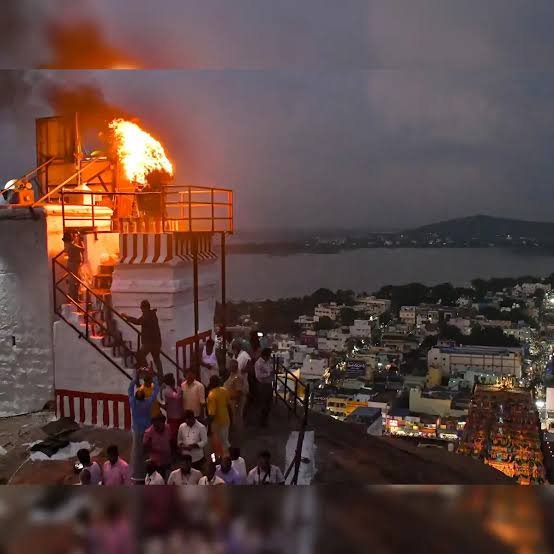
Accordingly, temple priests proceeded with the traditional ceremony and lit the Mahadeepam at the Uchipillaiyar Temple mandapam at 6 pm, rather than at the Deepathoon stone pillar.
Collector Says Administration Could Not Override Temple Trustees for th Deepam Ceremony
Explaining the district administration’s position, Krishna maintained that the Supreme Court’s order specifically required the Deepathoon ceremony to be conducted by individuals authorised by the Devasthanam.
He argued that the administration had no legal authority to appoint an alternative team or bypass the temple management’s approval.
The Collector also stated that the temple authorities had never communicated any formal authorisation for the proposed team, despite repeated efforts by the district administration to obtain it.
The report therefore seeks to establish that the failure to conduct the ritual at the Deepathoon resulted from the absence of the temple’s mandatory approval rather than any deliberate refusal by the district administration to follow the Supreme Court’s directions.
Thirupparankundram Deepam Dispute Becomes Political Flashpoint
The controversy over lighting the Karthigai Deepam at the stone pillar near a dargah on Thirupparankundram hill has developed into a major political and religious dispute in Tamil Nadu.
The issue has placed the state government led by Chief Minister C. Joseph Vijay under political scrutiny, with the BJP accusing the administration of failing to uphold Hindu religious traditions.
The state government’s decision to seek a review of the court’s directions has further intensified the controversy.
The latest status report places the role of the temple’s Board of Trustees at the centre of the dispute, with the Collector maintaining that the administration could not proceed without the authorisation specifically required under the Supreme Court’s order.