


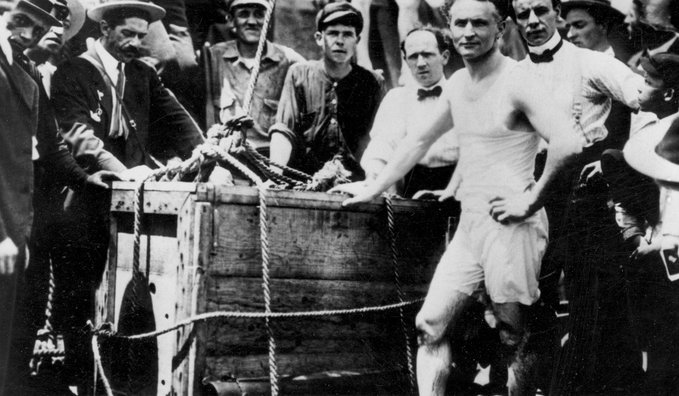
A century after Harry Houdini death, a previously unpublished essay by the legendary escape artist has surfaced, while a new book challenges the official account of his final hours, arguing that he died a day earlier than recorded.
BY PC Bureau
November 1: A hundred years after Harry Houdini died, the legendary escape artist continues to intrigue historians, magicians and admirers, with fresh discoveries and competing accounts shedding new light on his extraordinary life and mysterious death. A previously unpublished essay by Houdini on the magicians who preceded him has now surfaced, while a new book has reopened questions about whether the world-famous illusionist died on October 30 or Halloween, October 31, 1926.
The centenary of Houdini’s death is being marked with new books, archival discoveries, exhibitions, memorabilia auctions and special events across the United States and Europe. Celebrations range from a major gathering in his birthplace, Budapest, to an auction in Hollywood, California, and séances in cities he visited during his lifetime, including Chicago and Frederick, Maryland.
His grave at Machpelah Cemetery in New York has also remained a traditional gathering place for admirers around Halloween.
Despite his enduring fame, many people associate Houdini primarily with magic, spectacular escapes and the seemingly impossible, without knowing much about the man behind the legend.
“I’m not sure many of the people who know the name ‘Houdini’ could pick him out in a lineup, specify when he lived, or say what he actually did in his performances,” said Matthew Solomon, a film history professor at the University of Michigan. Yet, he noted, Houdini’s name has become synonymous with magic and the ability to escape impossible situations.
His reputation as a self-made man and immigrant success story, combined with the circumstances surrounding his reported Halloween death, has further strengthened his mystique.
One hundred years after Harry Houdini died on Halloween night, the mystery surrounding his death still refuses to stay buried.
The escape artist’s official cause of death was peritonitis from a ruptured appendix. But the real story is stranger: nine days before he died, a university student walked into his dressing room in Montreal and began punching him in the stomach before Houdini could brace himself. Historians now believe those blows didn’t kill him — but they masked the symptoms of the appendicitis that did, causing him to delay treatment until it was too late.
The punches also triggered a financial twist. Houdini was thousands of dollars in debt when he died. Because the blows were blamed for his death, his life insurance paid out double — $50,000 total, worth nearly $1 million today.
A century later, conspiracy theories persist, from murder by spirit mediums he’d been exposing as frauds to an intestinal blockage. As one Houdini historian put it: “There’s plenty of room for speculation, for conspiracy theories, and so it continues.”
Full story here https://t.co/IGRJ1rKXcN
— Fox News US (@FoxUSNews) October 31, 2026
Houdini’s fascination with forgotten magicians
A previously unpublished essay titled An Interesting Scrapbook has appeared in the latest issue of The Strand Magazine. In it, Houdini pays tribute to earlier generations of magicians and laments that their contributions had not been adequately documented.
The essay was inspired by old theatrical playbills shared with him by cartoonist Kin Hubbard. They featured popular 19th-century performers, including Robert Heller and H.J. Sargent.
Houdini argued that American magicians had long been neglected by historians and deserved a permanent place in the country’s cultural record.
Eric Colleary, curator of Theatre and Performing Arts at the Harry Ransom Center at the University of Texas at Austin, says Houdini’s interest in preserving the history of magic extended well beyond collecting documents. He visited the graves of earlier magicians and sometimes personally paid for their upkeep.
Their families, in turn, entrusted him with scrapbooks, playbills and other memorabilia so that their memories would survive.
Colleary’s book, Houdini’s Library, published in September, explores this lesser-known aspect of the escape artist’s life.
Born Erik Weisz in 1874, Houdini was the son of a rabbi whose family emigrated from Austria-Hungary to the United States, partly to escape antisemitism. He became a professional magician in his teens and an international celebrity by the age of 30.
His extraordinary ability to escape handcuffs, shackles and other restraints made him one of the most recognisable entertainers of his era. He also worked as an author, film actor and spoken-word recording artist. His audio archive was eventually purchased by magician David Copperfield.
READ: Massive Turnout at Ramlila Maidan for ‘Vote Chori’ Rally
Did Houdini really die on Halloween?
The circumstances surrounding Houdini’s death remain one of the most debated aspects of his life.
According to contemporary accounts, he died on October 31, 1926, at Detroit’s Grace Hospital from diffuse peritonitis following appendicitis. One widely circulated account suggested that his condition may have been aggravated when a college student in Montreal punched him in the stomach days earlier, after testing claims about his extraordinary physical strength.
The absence of a post-mortem examination helped fuel alternative explanations over the decades.
In her new book, Houdini: The Man Who Died Twice, forensic medical researcher Larrian Gillespie challenges the accepted account. Drawing on medical records, the death certificate and other documents, she argues that Houdini actually died on October 30, a day before the officially recorded date.
Gillespie attributes his death to an intestinal blockage, which she says resulted from a doctor’s decision to allow him to eat vegetables and sour cream while he was recovering from surgery.
She also points to discrepancies in the records. A doctor’s affidavit and other documents reportedly place his death on October 30, while the state death certificate records October 31.
According to Gillespie, members of Houdini’s inner circle wanted his death to coincide with Halloween to ensure that the date would remain inseparable from his legend.
Houdini’s great-nephew, George Hardeen, has endorsed her findings, describing the book as convincing and persuasive.
Houdini scholars dispute the new theory
Not everyone in the Houdini community is persuaded by Gillespie’s conclusions.
Houdini scholar Bruce Averbook questioned the suggestion that the family deliberately altered the date of death to coincide with Halloween. He argued that the family was grieving and unlikely to have been concerned with preserving Houdini’s public image at that moment.
Averbook also pointed to accounts written by Houdini’s personal assistant, which record October 31 as the date of death.
John Cox, a Houdini blogger and founder of the publishing imprint Wild About Harry Press, acknowledged that Gillespie’s book contains valuable new information about the magician’s career but said the claims surrounding his death require further examination.
He agreed that historical records contain inconsistencies and that a clearer account would be welcome. However, he argued that the circumstances of Houdini’s death represent only a small part of his larger legacy.
For Houdini, he said, it was his remarkable life rather than the mystery of his final hours that explained why he continues to be remembered a century later.