



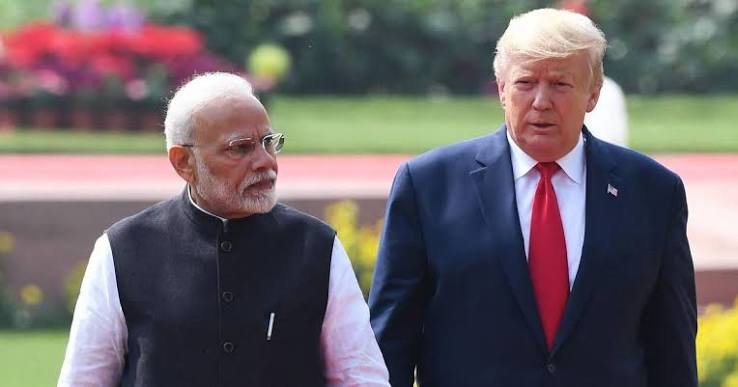
Trump and Rubio are publicly projecting an imminent breakthrough on the trade deal , but India’s guarded response raises questions about transparency, negotiating leverage and what the government is prepared to tell the country about a deal that could reshape trade relations.
BY PC Bureau
October 21: The India-US trade agreement is apparently 99 per cent complete, according to US Secretary of State Marco Rubio. President Donald Trump says the two countries are “pretty close” to a deal, while US Ambassador to India Sergio Gor has also projected confidence that an agreement is within reach.
Washington has been unusually forthcoming about the negotiations. Its political leadership is publicly discussing timelines, the status of negotiations and the handful of issues said to remain unresolved. New Delhi, by contrast, has largely confined itself to carefully worded statements welcoming progress and expressing a commitment to an early conclusion.
That raises an uncomfortable question: if the United States can publicly discuss the state of negotiations, why is the Indian government so reluctant to explain where the talks stand, what remains unresolved and what India expects to gain?
The question is not whether India should disclose confidential negotiating positions or reveal every concession under discussion. No responsible government would do that while negotiations are continuing. The issue is whether secrecy has become an excuse for avoiding public scrutiny of a potentially consequential economic agreement.
For a government that routinely presents its diplomatic engagements as evidence of India’s growing global stature, its relative silence on a major trade negotiation is difficult to reconcile with its own claims of political confidence.
READ: Epstein Files: Photos Show Hardeep Puri Seated Across Table From Sex Offender
Washington sets the narrative on the trade deal
Trump’s remarks on October 20 and Rubio’s statements during his India visit have created a public impression that the agreement is approaching completion. Rubio has described the negotiations as being about as close as they can be without an executed agreement, while cautioning that the legal language must be settled before either side announces a deal.
That caveat matters. A negotiation can be politically advanced without being commercially settled. The remaining provisions may be few in number but significant in their implications for tariffs, market access and the obligations undertaken by each side.
Nevertheless, the American statements have allowed Washington to establish the public narrative: progress is substantial, the finish line is close, and the remaining work is largely technical.
India has offered little public information to enable its citizens, exporters or industry associations to independently assess that assessment.
Commerce Minister Piyush Goyal has said that the first tranche is undergoing legal drafting and has maintained that India must secure a comparable or competitive advantage in the US market. The External Affairs Ministry has also acknowledged progress. These are not admissions of failure or evidence that India has surrendered its negotiating position.
But they do not answer the central questions either. What precisely has been agreed? Which issues remain open? What does New Delhi consider a satisfactory outcome? And does the Indian government agree with Washington’s suggestion that the negotiations are almost complete?
Silence on these questions leaves the American version of events largely uncontested.
The real question is what India has secured
The emphasis on the trade deal negotiations being nearly complete risks obscuring a more important issue: is the agreement good for India?
The interim framework announced in February 2026 envisaged an 18 per cent US reciprocal tariff rate on specified Indian goods, alongside Indian commitments to reduce or eliminate tariffs on a range of American products and expand purchases of US energy, aircraft, technology and other goods.
Those provisions cannot be assessed merely by counting the days until a signature.
For Indian exporters of textiles, garments, leather goods and footwear, access to the American market can make a substantial difference to orders, employment and investment. But the commercial benefit depends on the precise tariff treatment, the categories covered, the duration of the concessions and how Indian products compare with those of competing exporters.
If Indian goods face a tariff disadvantage against competitors such as Vietnam or Bangladesh, exporters could lose orders even if the agreement is described as a breakthrough. Conversely, a favourable and predictable tariff arrangement could strengthen labour-intensive industries and support employment.
Commerce Minister Piyush Goyal’s insistence on a competitive advantage is therefore significant. It establishes a test against which the final agreement should be evaluated. Yet the government has not publicly provided enough detail for citizens and industry to determine whether that test has been met.
The same scrutiny is necessary on the Indian side of the bargain. Any reduction in Indian tariffs on American industrial or agricultural products must be examined for its effects on domestic manufacturers, farmers and other vulnerable sectors. The implications of purchase commitments also deserve scrutiny: projected commercial purchases are not necessarily the same as legally binding obligations, and the distinction matters.
The government should explain those differences rather than leave the public to infer the terms from statements issued in Washington.
READ:
Trump says “pretty close” to a trade deal with India
Vdo source: White House https://t.co/sAk5IfvLn6
— Sidhant Sibal (@sidhant) October 21, 2026
Secrecy cannot become a substitute for accountability
There are legitimate reasons for keeping parts of a trade negotiation confidential. Revealing a government’s precise tariff offers, fallback positions or proposed compromises could weaken its bargaining power. Prematurely announcing a partially settled text could also create confusion or complicate the final stages of negotiations.
Rubio himself has warned against announcing an agreement before its technical and legal language is settled. India is entirely justified in insisting that nothing be treated as final until both governments have agreed to the text.
But there is a difference between protecting negotiations and withholding information about their broad direction.
The government can disclose its objectives without revealing its negotiating cards. It can explain the sectors it is seeking to protect, the advantages it expects for Indian exporters and the safeguards it considers essential. It can also clarify whether purchase commitments are binding, how agricultural sensitivities are being addressed and what mechanisms will exist if the promised benefits fail to materialise.
None of this requires publishing confidential draft documents.
Indeed, the larger the agreement’s potential consequences, the stronger the case for explaining its broad contours before it is presented as a diplomatic triumph.
The asymmetry is also political
There is a further dimension to the contrast. The Trump administration’s public statements allow the US president to project himself as a leader who can extract concessions and deliver deals. The eventual agreement can be presented as evidence of his negotiating prowess.
The Indian government has its own political incentives. A successful agreement would reinforce Prime Minister Narendra Modi’s image as a leader capable of managing relations with Washington while advancing India’s economic interests. A deal involving difficult compromises, however, could attract criticism from exporters, farmers, manufacturers or opposition parties.
That possibility may help explain why New Delhi is reluctant to get ahead of the final text. It is not proof that India has conceded too much, nor does the American enthusiasm establish that Washington has secured an advantage.
But if the government is confident that the outcome will benefit India, it should be prepared to explain why. If difficult choices have been made, those choices should be defended on their merits rather than shielded by diplomatic generalities.
India cannot demand credit for a successful negotiation while treating public scrutiny as an inconvenience.
There is no compelling reason why India should match every American statement or conduct negotiations through the media. Diplomatic restraint can be an asset. But restraint should not become a habit of leaving the public uninformed while a foreign government supplies most of the available narrative.
The question is not why India refuses to reveal every detail before a deal is signed. It is why a government that claims to negotiate from a position of strength has allowed Washington to dominate the public conversation about a deal whose consequences India will have to live with.







Comments 1