

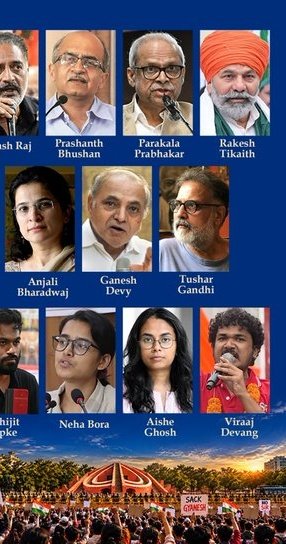
Under the slogan ‘Har Haath Mein Tiranga, Har Gali Mein Jantar Mantar’, activists, farmers, youth and civil society organisations plan coordinated protests against SIR and alleged electoral irregularities.
BY PC Bureau
New Delhi, October 21, 2026: Civil society organisations, activists, farmers’ representatives and youth groups have called for a nationwide mobilisation on Friday, October 23, under the banner of the “People’s March to Restore Democracy”, with the slogan “Har Haath Mein Tiranga, Har Gali Mein Jantar Mantar”. The campaign urges citizens to organise marches, public meetings and symbolic protest sites in their localities.
The campaign, promoted through posters and social media, seeks to take protests beyond Delhi and turn neighbourhoods, towns and villages into centres of democratic dissent.
The organisers have appealed to students, farmers, workers, Dalits, Adivasis, minorities, persons with disabilities, transgender people and other sections of society to participate. They have also called on parties in the INDIA bloc to join the mobilisation.
Among the prominent figures associated with the appeal are CJP founder Abhijit Dipke , actor Prakash Raj, lawyer Prashant Bhushan, political economist Parakala Prabhakar, farmer leader Rakesh Tikait, activists Tushar Gandhi, Yogendra Yadav, Anjali Bharadwaj and Ganesh Devy.
The campaign centres on opposition to the Election Commission of India’s Special Intensive Revision (SIR) of electoral rolls and what the organisers describe as a wider crisis of democratic accountability.
READ: Trade Deal: Washington Talks, New Delhi Keeps Mum—But Why?
Campaign seeks scrapping of SIR, removal of CEC
The platform has outlined a series of demands, including the immediate scrapping of the SIR exercise, restoration of deleted names to electoral rolls and the removal and prosecution of Chief Election Commissioner Gyanesh Kumar.
It has also called for repeal of the 2023 amendment to the Election Commissioners Act, the appointment of a new Election Commission through what it describes as an impartial process, a return to paper ballots and wider electoral reforms, alongside a fair revision of voter lists.
An open letter circulated as part of the campaign alleges that Indian democracy is facing a deep crisis and accuses the electoral process of being compromised. The document claims that voter lists have been manipulated and questions the Election Commission’s independence.
These are allegations advanced by the campaign’s organisers and remain matters of political and institutional dispute.
The appeal urges young people to take to the streets, presenting the October 23 action as a people’s movement rather than an isolated demonstration organised by political parties.
Har gali me Jantar Mantar !
Friday, 23 October, 2026
People’s March to Restore Democracy
Let’s Rise to the Challenge https://t.co/JFq3tzujsS
— Parakala Prabhakar (@parakala) October 21, 2026
Jantar Mantar becomes a flashpoint
The call comes against the backdrop of sustained protests over the SIR exercise and growing tensions over access to public spaces for demonstrations in the national capital.
Earlier protests, including mobilisations associated with the Cockroach Janta Party (CJP) and opposition supporters, have focused on alleged irregularities in electoral-roll revision and demands for accountability from the Election Commission. Demonstrations in Delhi during October have been accompanied by detentions and heavy security arrangements.
The dispute has taken on an additional dimension following the de-notification of Jantar Mantar as a designated protest site by Delhi Police. For decades, the location near Parliament has served as one of the capital’s principal venues for demonstrations.
Authorities have directed protesters towards alternative venues, including Ramlila Ground, Burari Ground and CBD Ground in east Delhi. Critics argue that shifting demonstrations away from central Delhi makes it harder for protesters to draw public attention to their demands. The costs and logistical requirements associated with some alternative venues have also attracted criticism.
Legal challenges to the de-notification are pending in the Supreme Court.
Against this backdrop, the slogan “Har Haath Mein Tiranga, Har Gali Mein Jantar Mantar” seeks to decentralise protest activity and carry the campaign into neighbourhoods across the country. Rather than relying exclusively on a single designated venue in the capital, organisers want local groups to establish their own spaces for public meetings and peaceful dissent.
Recent attempts to stage demonstrations at or reach the original Jantar Mantar site have resulted in detentions and substantial security deployments.
Nationwide mobilisation seeks to widen the campaign
The October 23 initiative marks another effort by civil society groups and activists to build a broader movement around electoral transparency, institutional independence and the right to protest.
Its success will depend on the scale of participation beyond Delhi, the ability of local groups to coordinate demonstrations and whether opposition parties translate their stated support for democratic rights into participation on the ground.
As of October 21, Delhi Police had not issued a specific public statement on the planned mobilisation, according to the information available in the campaign announcement. The authorities’ response, particularly in Delhi, is likely to be closely watched given the recent confrontations over protest venues.
The organisers have described the planned demonstrations as peaceful and urged citizens to take the initiative in their own localities.
At its core, the campaign seeks to connect two issues that its supporters regard as inseparable: the integrity of electoral rolls and the freedom of citizens to protest against institutions they believe are failing to discharge their responsibilities.
Whether the October 23 mobilisation develops into a sustained nationwide movement remains to be seen. But its central message is unmistakable: the organisers want the debate over electoral democracy to move beyond political statements and courtrooms and into public spaces across the country.