Four reported killed on joint force side and two Kuki National Army-Burma casualties; five houses burnt in fighting near Tamu along the Manipur border
BY PC Bureau
October 21: Heavy fighting was reported near Phaijang and Teijang villages, north of Tamu in Myanmar’s Sagaing Region, on or around October 20, with cadres of the Kuki National Army-Burma (KNA-B) engaging a joint force comprising the National Socialist Council of Nagalim-Isak Muivah (NSCN-IM), Valley-Based Insurgent Groups (VBIGs) from Manipur and elements of the Shanni Nationalities Army (SNA) operating alongside Myanmar junta forces.
Initial reports circulated by conflict-monitoring sources on October 21 put the casualties at four dead on the joint force side and two among KNA-B cadres. Five houses were also reportedly burnt in Phaijang. The casualty figures and other details could not be independently verified at the time of reporting.
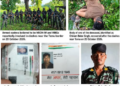
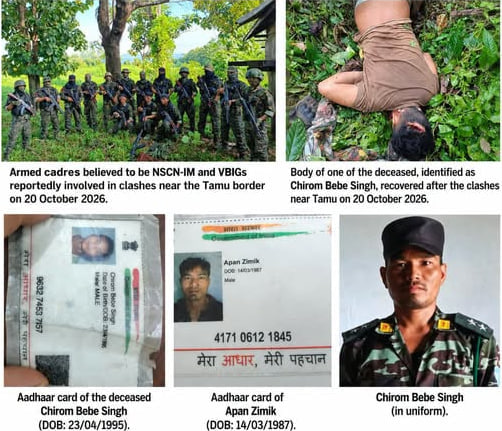
Documents reportedly recovered from the site identified one of the deceased on the joint force side as Chirom Bebe Singh, 31, from Thoubal district in Manipur, who was allegedly linked to a Meitei insurgent group. The Aadhaar credentials of Apan Zimik, 37, described in the reports as an NSCN-IM cadre, were also reportedly recovered.
The accounts have been circulated through conflict-monitoring channels. No independent confirmation from major news organisations or official statements by the groups involved was available at the time of writing.
SAGAING CORRIDOR CLASH UPDATE Heavy firefights erupted near Phaijang and Teijang villages (north of Tamu, Sagaing Region) between KNA-B cadres and a combined force of NSCN-IM, VBIGs (Meitei outfits), and SNA/Junta forces. https://t.co/jMogwSzPDm
— Mapping Conflicts NorthEast (@MappingNEast) October 21, 2026
Myanmar Border belt remains a conflict hotspot
Phaijang and Teijang lie in the Myothit sub-division area, roughly 20–25 km north of Tamu and close to the international boundary with Manipur. The surrounding belt has witnessed repeated clashes since Myanmar’s February 2021 military coup, as the country’s civil war has increasingly intersected with the activities of armed groups operating along the India-Myanmar frontier.
The KNA-B has been involved in fighting against Myanmar junta forces and has cooperated with anti-junta resistance groups, including local People’s Defence Forces. It has also clashed with Naga and Meitei armed groups operating in the Tamu–Sagaing corridor.
NSCN-IM elements and Valley-Based Insurgent Groups have been reported operating in the same border belt, where shifting alliances, competing territorial interests and the presence of junta-aligned forces have contributed to recurring confrontations.
Earlier fighting around Teijang and areas near the border has also highlighted the risks posed by the overlapping presence of Myanmar-based resistance groups and Indian insurgent organisations. However, the precise composition of the forces involved in the latest clash and the sequence of events remain to be independently established.
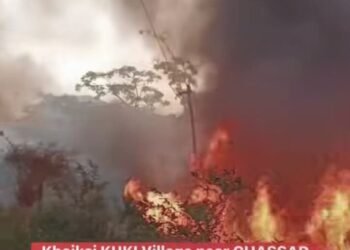
READ: Manipur: Yet another Kuki-Zo Village Set Ablaze Near Chassad
Civilian safety concerns
The reported burning of five houses in Phaijang raises fresh concerns about the safety of civilians living in villages caught between armed groups. Communities in the Sagaing Region and adjoining border areas have faced repeated displacement and insecurity as fighting between Myanmar’s military and resistance forces has spread across the region.
The Tamu corridor is strategically important because of its proximity to Manipur and its links to cross-border movement and trade routes, including the Kalay–Tamu road. Developments in the area can have implications for security and civilian movement on both sides of the international boundary.
Indian security agencies, including the Assam Rifles, maintain vigilance along the frontier amid the risk of cross-border movement by armed groups. However, no official Indian statement specifically addressing the reported October 20 clashes was available at the time of reporting.
Further confirmation is awaited on the casualties, the identities and affiliations of those involved, and the extent of damage to civilian property. Until corroborating accounts emerge, the figures and operational details circulating from the conflict zone should be treated as preliminary.