

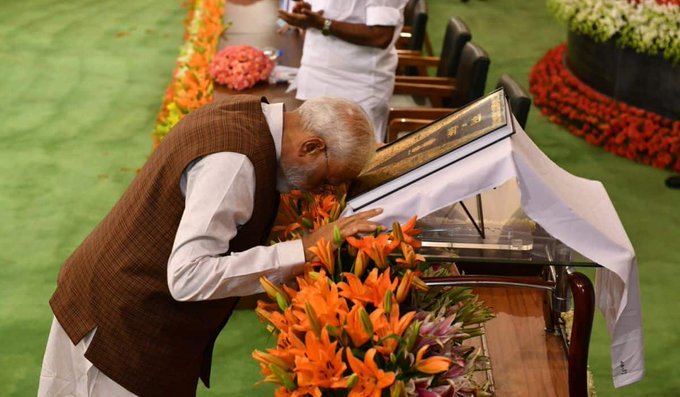
Invoking the contribution of women to the making of the Constitution, PM Modi on Thursday accused Opposition parties of denying women their rightful share in political representation by blocking legislation to fast-track the 33 per cent reservation in Parliament and state assemblies.
BY PC Bureau
NEW DELHI, November 26: Prime Minister Narendra Modi on Thursday used Constitution Day to revive the political battle over women’s reservation, accusing the Opposition of displaying a lack of commitment to constitutional values by helping defeat a Bill intended to accelerate the implementation of the 33 per cent quota for women in legislative bodies.
Modi said India’s constitutional journey would remain incomplete without due recognition of the women who played an important role in framing the Constitution. He, however, said the events earlier this year, when the proposed legislation failed to secure passage in the Lok Sabha, should be a matter of shame.
“The journey of our Constitution would be incomplete without recognising the remarkable women who helped shape it. But what happened earlier this year should fill our hearts with shame,” he said.
Targeting Opposition parties over the Bill’s defeat, Modi accused them of displaying disdain for constitutional values.
“I assure the Nari Shakti of India that no force can prevent us from ensuring that justice is done to them,” he said.
The prime minister was referring to the defeat of the Constitution (131st Amendment) Bill, 2026, in the Lok Sabha on April 17. The legislation sought to accelerate the implementation of 33 per cent reservation for women in the Lok Sabha and state legislative assemblies, ahead of the 2029 general elections.
The Bill secured 298 votes in favour and 230 against. However, it fell short of the constitutionally mandated two-thirds majority required to pass a constitutional amendment. It was the first time since the Modi government came to power in 2014 that one of its Constitution amendment Bills failed to clear the Lok Sabha.
READ: Cairo Inferno: 31 Killed as Fuel Tanker Explodes on Busy Highway
In this OpEd, I highlight the following:
UNIQUENESS of our Constitution and Constituent Assembly.
How the Constitution of India is an INSEPARABLE part of my journey.
Ways the NDA Government has STRENGTHENED the Constitution.
Efforts towards boosting SOCIAL AND ECONOMIC JUSTICE.
I have also highlighted:
How the Constitution was trampled over by those who ruled the nation for 5 decades.
How one party has devolved from being a Virodh Paksh to AVRODH PAKSH.
English – https://t.co/6g2CZtbOYg
हिन्दी – https://t.co/CNDyRbDwmC
— Narendra Modi (@narendramodi) November 26, 2026
The proposed amendment was part of a broader legislative exercise that included increasing the strength of the Lok Sabha from 543 to a maximum of 850 seats and undertaking delimitation of constituencies.
The government maintained that the proposed changes were necessary to facilitate the implementation of women’s reservation. Opposition parties, however, objected to linking the quota with delimitation.
The Congress and other Opposition parties maintained that they supported the 33 per cent reservation but opposed the proposed delimitation exercise. They argued that redrawing constituencies could alter the political balance between states and disproportionately affect the representation of southern states. The government rejected these concerns.
The 2026 Bill sought to modify the framework established by the Constitution (106th Amendment) Act, 2023, popularly known as the Nari Shakti Vandan Adhiniyam.
The 2023 law provides for reserving one-third of seats for women in the Lok Sabha and state legislative assemblies. However, its implementation was linked to a census followed by delimitation, leaving the timing of its rollout uncertain.
Following the defeat of the amendment Bill, the government did not proceed with two other linked legislative proposals concerning delimitation and changes to laws governing Union Territories.
Modi’s Constitution Day message also contained a broader political attack on the Congress and other Opposition parties. He criticised what he described as their obstructionist approach to parliamentary proceedings, arguing that questioning the government was a legitimate democratic responsibility but disrupting parliamentary processes was not.
Describing the Opposition as an “Avrodh Paksh” (obstructionist faction) rather than a “Virodh Paksh” (Opposition), he said disruptions could not substitute for fulfilling constitutional responsibilities.
The prime minister’s remarks have brought women’s reservation back into the political spotlight, with the implementation of the 33 per cent quota emerging as a key point of contention between the government and Opposition parties.