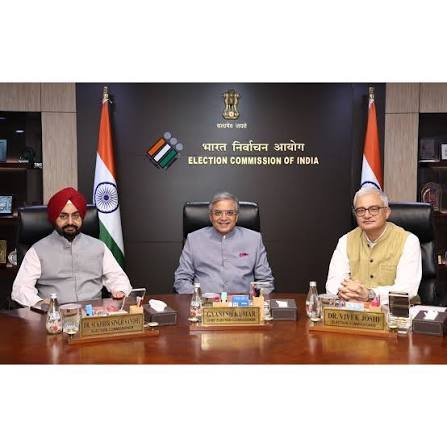
Two Election Commissioners, Sukhbir Singh Sandhu and Vivek Joshi, separately approached Cabinet Secretary T.V. Somanathan in July, alleging that a senior Election Commission official had unilaterally reshuffled responsibilities without consultation, an RTI reply has revealed.
BY PC Bureau
New Delhi/ October 23: A dispute over administrative authority within the Election Commission of India escalated beyond its corridors, with two Election Commissioners separately approaching the Cabinet Secretary to complain against a senior officer and seek action over changes to the allocation of work., according to an RTI reply.
Correspondence released under the Right to Information (RTI) Act shows that Dr. Sukhbir Singh Sandhu and Dr. Vivek Joshi wrote to Cabinet Secretary T.V. Somanathan on July 29, 2026, alleging that Senior Deputy Election Commissioner Maneesh Garg had acted unilaterally and disregarded established procedures.
The controversy arose after Garg was assigned temporary charge of the Commission’s Administration Division on July 28, during the leave of Deputy Election Commissioner Bhanu Prakash Yeturu. Soon after taking charge, Garg issued an order revising the distribution of responsibilities among senior officers. Both commissioners objected that the reshuffle had been carried out without prior consultation with the Commission or even informing the officers concerned.
The episode adds to reports of disagreements within the poll body over its decision-making processes. The Indian Express reported on September 23 that Sandhu and Joshi had formally objected 14 times over ten months to decisions involving the addition and deletion of voters. The two had also previously approached the Cabinet Secretary over concerns relating to the integrity of electoral rolls. The latest RTI disclosures, however, concern a separate dispute over the allocation of administrative responsibilities.
In his letter, Sandhu said Garg had assumed additional charge as link officer and, within hours, redistributed duties among Senior Deputy Election Commissioners, Deputy Election Commissioners, Directors General and officers of equivalent rank. The revised arrangement, he alleged, was issued without prior discussion with the Commission or information being shared with him.
Sandhu further accused Garg of assigning responsibilities to himself as well as to officers of equal or higher rank. He alleged that this was not the first time Garg had acted in this manner while handling the Administration Division.
Here are two D.O. letters written by Election Commissioners S.S. Sandhu and Vivek Joshi to the Cabinet Secretary, complaining against EC official Maneesh Garg for issuing a work allocation order without consulting them. https://t.co/tMWVO8LIzW
— Paras Nath Singh (@parasnsingh95) October 22, 2026
According to Sandhu, repeated oral and written instructions against unilateral changes had been disregarded. He cited Sections 18(1) and 18(2) of the Chief Election Commissioner and Other Election Commissioners (Appointment, Conditions of Service and Term of Office) Act, 2023, alleging that the order violated the law and seeking “appropriate action” against the officer.
Joshi raised similar concerns in his communication to the Cabinet Secretary. He alleged that the revised allocation of work had been issued without consultation or even basic information being shared with him. When he sought access to the relevant file from the Administration Division, he was denied it, according to his letter.
Joshi also referred to earlier instructions requiring discussion or approval at the Commission level before changes of this nature could be made. He, too, alleged a violation of the 2023 law.
The decision by both commissioners to take their complaints directly to the Cabinet Secretary, rather than resolve the disagreement within the Commission, highlights the seriousness of the administrative dispute. It also raises questions about the internal processes governing the allocation of responsibilities in a constitutional body entrusted with overseeing elections.
A note prepared within the Cabinet Secretariat acknowledged the significance of the complaints but advised against immediate intervention. It pointed out that the letters had been submitted by the two commissioners in their individual capacities and therefore “cannot be seen as a formal communication from the Commission as a whole.”
The note cautioned that intervention at that stage could be interpreted as interference in the functioning of a constitutional body.
READ: Brent Crude Hits Five-Month High as Middle East Tensions Rises
The Secretariat recommended that the Cabinet Secretary acknowledge receipt of the letters and forward copies to the Secretary of the Department of Personnel and Training (DoPT), the Establishment Officer and the Principal Private Secretary to the Chief Election Commissioner. The correspondence could then remain on record for consideration in any future decisions concerning Garg, an IAS officer of the 1996 Himachal Pradesh cadre whose appointment was approved by the Appointments Committee of the Cabinet.
On August 5, Somanathan replied to both commissioners, confirming receipt of their communications. Copies were also marked to senior DoPT officials and the office of the Chief Election Commissioner.
The documents released under the RTI Act do not establish whether an inquiry was initiated or disciplinary action was considered following the complaints.
Official records confirm that Garg held temporary charge of the Administration Division from July 27 to August 9. A separate order redistributing responsibilities among officers of the Commission was issued during this period.
The RTI application was filed on September 24 by retired Commodore Lokesh K. Batra. Following payment of the prescribed fee, the Cabinet Secretariat released 14 pages of correspondence and internal file notings.
The disclosures establish that both commissioners formally raised objections with the Cabinet Secretary and that their letters were acknowledged and circulated to relevant officials. They do not, however, reveal whether the allegations were independently examined, whether Garg was asked to respond, or whether any concrete action followed.