The development comes as Myanmar remains locked in a prolonged civil conflict with no clear resolution in sight.
BY PC Bureau
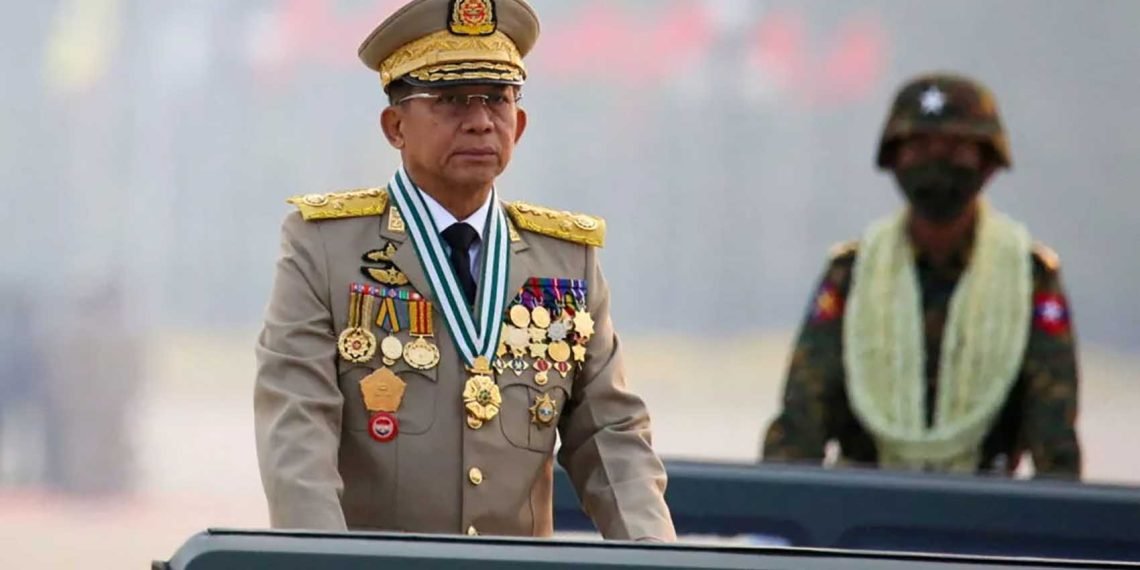
April 3, 2026 — Min Aung Hlaing, the architect of Myanmar’s 2021 coup, has been elected president by the country’s military-dominated parliament, formally consolidating his grip on power five years after overthrowing the elected government of Aung San Suu Kyi.
In a parliamentary vote held Friday, Min Aung Hlaing secured 429 of 584 votes in the combined houses, easily crossing the required threshold in a legislature dominated by military allies. The result, announced by parliamentary speaker Aung Lin Dwe, was widely expected.
The two other candidates — Nyo Saw and Nan Ni Ni Aye — were elected as vice presidents after receiving 126 and 29 votes respectively.
Burma’s military coup-maker/dictator has finally got what he always wanted. The reason he mounted the coup is that the newly-elected gov’t refused to name him president. 5 years later after sham elections, rubber stamp ‘parliament’ elects him president. It only cost 8K+ lives. https://t.co/VS3eNFh88Q
— Agam Tapaktuan (@Agam_T) April 3, 2026
Transition From General to President
Min Aung Hlaing’s elevation follows a controversial general election held between December 2025 and January 2026, in which the military-backed Union Solidarity and Development Party claimed an overwhelming victory, winning over 80% of contested seats.
Major opposition parties, including the National League for Democracy led by Suu Kyi, were barred or excluded, prompting widespread criticism from international observers who dismissed the vote as lacking credibility.
Under Myanmar’s 2008 constitution, the military retains significant power, including control of 25% of parliamentary seats, ensuring its continued dominance regardless of election outcomes.
In a key step ahead of the vote, Min Aung Hlaing stepped down earlier this week as commander-in-chief of the armed forces — a constitutional requirement for assuming the presidency. He handed over the role to General Ye Win Oo, a close ally and former intelligence chief, widely seen as a loyalist who will maintain the military’s alignment with his leadership.
From Coup to Ongoing Conflict
Min Aung Hlaing has led Myanmar’s military since 2011 and seized power in February 2021, alleging fraud in the 2020 election — claims that were never independently verified. The coup led to the arrest of Aung San Suu Kyi and triggered nationwide protests.
A violent crackdown by the military transformed the unrest into a prolonged civil war involving pro-democracy militias, ethnic armed groups, and resistance networks aligned with the ousted civilian leadership.
This week, several resistance factions announced the formation of a new coalition aimed at ending military rule, underscoring the continued instability gripping the country.
READ: Intelligence Reports Trash Trump Narrative on Iran War
Power Consolidation Amid Global Criticism
Analysts view Min Aung Hlaing’s move to the presidency as a calculated effort to consolidate authority while projecting a veneer of civilian governance. By shifting into a formal political role and installing a trusted ally as military chief, he appears to be restructuring power without relinquishing control.
However, critics argue the transition is largely symbolic, with real authority still firmly in the hands of the military establishment. The new administration is expected to face sustained resistance on the ground, even as some regional actors may increase engagement with the regime.
The United Nations and Western governments have repeatedly condemned the junta over alleged human rights abuses, mass displacement, and the detention of political opponents. Min Aung Hlaing himself remains under international sanctions.
His election marks the latest phase in Myanmar’s long history of military dominance, raising fresh doubts about prospects for peace or a genuine democratic transition as conflict continues across large parts of the country.