Poland Prime Minister Donald Tusk says decisive action is necessary to restore judicial independence, while the PiS opposition accuses his government of undermining constitutional procedures.
BY PC Bureau
October 31, 2026: Poland’s bitter battle over judicial reforms erupted into a fresh confrontation on Friday after a senior judge announced the suspension of Constitutional Tribunal President Bogdan Święczkowski and his deputy, triggering an immediate backlash from the court’s leadership and the country’s political opposition.
Anna Korwin-Piotrowska, described as the tribunal’s longest-serving judge, announced on the evening of October 30 that she had suspended the two officials for a month and was taking temporary charge of the court. Święczkowski, appointed under the previous Law and Justice (PiS) government, rejected the move as a “coup d’état”. His deputy was reportedly denied entry to the tribunal building.
The confrontation drew President Karol Nawrocki into the crisis. Nawrocki, an ally of PiS who was elected in 2025, cut short an official visit to Senegal and returned to Warsaw. “At a moment like this, the president must be in Poland,” he said.
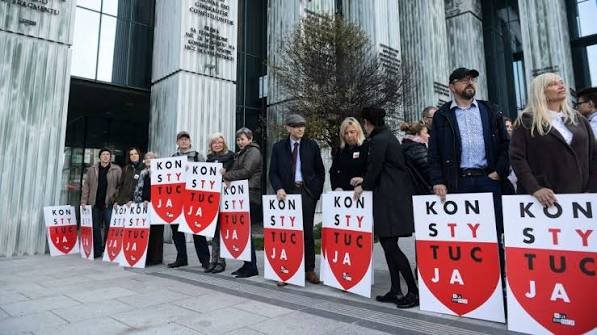
Hundreds of demonstrators gathered outside the tribunal, many carrying Polish flags. Among them was PiS leader Jarosław Kaczyński, who accused the government of attacking the court and pushing Poland towards a “police state”. Police deployed in large numbers as tensions escalated. Reports described objects being thrown at officers, attempts to breach security fencing and several detentions.
READ: Nationwide Planned Rallies for Jewish-Arab Govt to Replace Netanyahu
Conflict over Poland’s Constitutional Tribunal escalates in Warsaw: judge suspends its leadership and president cuts short Africa trip
A de facto power struggle has erupted within one of Poland’s most important state institutions in Warsaw today. For now, the outcome of this confrontation remains uncertain.
Judge Anna Korwin-Piotrowska called the police to the grounds of the Constitutional Tribunal, citing a potential threat to the safety of judges and staff.
Police did not enter the building, but a significant number of officers have been deployed in the surrounding area.
Korwin-Piotrowska suspended Tribunal President Bogdan Święczkowski and his deputy, Bartłomiej Sochański, for one month, temporarily taking charge of the institution herself.
Jarosław Kaczyński, leader of the opposition Law and Justice (PiS) party, called the developments a “coup” and urged Polish President Karol Nawrocki to intervene.
Nawrocki has cut short his visit to Senegal and is returning to Poland.
The conflict stems from a deep division over the composition of the court. Donald Tusk’s government refuses to recognise the Tribunal’s rulings because of judges appointed under the previous PiS government.
Meanwhile, Nawrocki and Święczkowski refuse to recognise judges elected by the Sejm in 2026.
Korwin-Piotrowska is among them: the president refused to accept her oath of office, while Święczkowski had previously prevented her from participating in court proceedings.
— NEXTA (@nexta_tv) October 30, 2026
Prime Minister Donald Tusk defended the action as part of his government’s effort to restore judicial independence after years of controversy under PiS.
“Restoring the rule of law is our duty. After years of PiS lawlessness, it’s a difficult, sometimes painful process that requires decisive action. There is no other way,” Tusk said.
Justice Minister and Prosecutor General Waldemar Żurek said he had sought the lifting of immunity for Święczkowski and his deputy, paving the way for possible criminal proceedings. He accused the suspended tribunal president of treating the institution as a “private fiefdom”.
The latest confrontation is rooted in a judicial dispute that has shaped Polish politics and strained relations with the European Union for more than a decade.
How the right-wing regime reset Poland’s judiciary
When PiS came to power in 2015, it moved to reshape the Constitutional Tribunal, which has the authority to review legislation and strike down laws. The party’s critics accused it of filling the institution with political loyalists through appointments that violated established procedures. The controversy centred partly on three judicial positions that, critics argued, had already been lawfully filled by the previous parliament.
European courts subsequently questioned the tribunal’s independence and impartiality. The European Court of Human Rights and the Court of Justice of the European Union delivered rulings challenging the legality of its composition. Under PiS, the tribunal also upheld a near-total abortion ban and issued decisions that challenged the primacy of EU law, deepening the confrontation with Brussels.
The European Commission responded with rule-of-law proceedings and withheld access to billions of euros in recovery funding over concerns about judicial independence.
Tusk’s centrist-to-left coalition won the 2023 parliamentary elections on a promise to reverse the judicial changes and restore Poland’s relationship with the EU. But its efforts have encountered persistent resistance from presidents aligned with the opposition.
Former president Andrzej Duda and his successor Nawrocki have used presidential powers to obstruct parts of the government’s judicial agenda. Nawrocki has declined to administer the oath of office to several judges elected by parliament this year, citing procedural objections. Some of the judges subsequently took their oaths in parliament, but Święczkowski refused to allow them to participate in the tribunal’s proceedings.
The government, meanwhile, has refused to publish several tribunal rulings, arguing that decisions delivered by an institution whose composition has been questioned by European courts cannot be treated as legitimate.
The two camps offer sharply different interpretations of the latest developments. The Tusk government says it is correcting years of political interference and trying to restore the independence of the judiciary. PiS and its supporters describe the suspension of the tribunal’s leadership as an unlawful attempt to take control of a constitutional institution.
The dispute has been further complicated by legislation passed by the Sejm, Poland’s lower house of parliament, seeking to regulate the status of judges appointed under changes to the National Council of the Judiciary introduced by the previous government. The law has added another contentious issue to an already fractured legal system.
The standoff comes as Poland moves towards parliamentary elections scheduled for 2027, with the judiciary emerging as one of the central battlegrounds between the ruling coalition and the opposition.
For Tusk, restoring the rule of law is essential to ending institutional paralysis and rebuilding Poland’s credibility within the European Union. For PiS, the government’s actions represent an attempt to dismantle the previous administration’s judicial legacy through questionable legal and political manoeuvres.
The immediate fate of Święczkowski’s suspension, the status of the newly elected judges and the tribunal’s ability to function remain uncertain. What is increasingly clear is that the effort to reverse PiS-era judicial reforms has opened a new front in Poland’s constitutional crisis.
The country remains caught between rival claims to legal authority, with the legitimacy of its highest constitutional court contested and political confrontation spilling onto the streets.