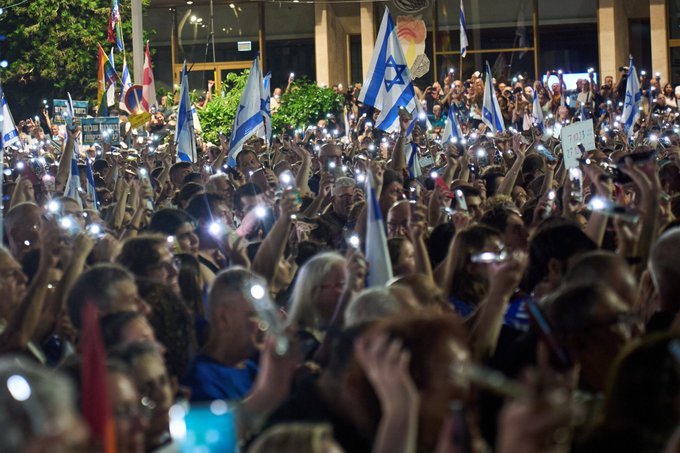
Organised by the Standing Together movement, the rallies will pressure opposition leaders to include Arab parties in a Israel governing alliance and translate the electoral verdict into a change of government.
BY PC Bureau
October 31, 2026: Demonstrations are planned across Israel on Saturday evening demanding the formation of a Jewish-Arab government, as Prime Minister Benjamin Netanyahu’s coalition reels from an electoral setback and opposition parties struggle to translate their combined parliamentary strength into a governing majority.
Organised by the Standing Together movement, the rallies are scheduled for 7:30 pm at Tel Aviv’s Habima Square, Jerusalem’s Paris Square, and in Beersheba, Haifa and Tayibe. The organisers are calling on opposition leaders to recognise the electoral mandate for change and form a government in partnership with Arab political parties.
The demonstrations come four days after Israel’s October 27 general election, which left Netanyahu’s governing bloc with 53 seats in the 120-member Knesset, against a combined 67 seats for the opposition and Arab-led parties. The results have weakened Netanyahu’s grip on power but have not yet produced a clear alternative government.
“The Jewish-Arab majority that voted for change must also be reflected in the next government,” Standing Together said in a statement, arguing that the election should lead to a political partnership between Jewish and Arab citizens rather than another government dependent on the existing right-wing alliance.
“Arab votes are worth exactly as much as Jewish votes, and Arab citizens must be full partners in shaping the country’s future,” the organisers said.
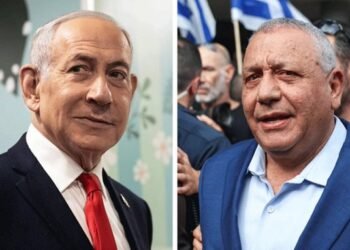
The next Prime Minister, Gadi Eisenkot, in a special statement: “Likud and Netanyahu have embarked on an orchestrated and organized campaign to delegitimize the election results. I will not allow even a centimeter’s deviation from the Knesset swearing-in as planned.”
My friends, in just a week or ten days, a new Knesset will be sworn in in the State of Israel. In the bloc of life, revival, and change, there will be 67 Knesset members, including 19 Arab Knesset members; on the other side, there will be 53 Knesset members, including 14 draft-dodging anti-Zionist Knesset members—all the rest with them are messianists, corrupt, and just plain lunatics.
So let’s return to smiling, humanity, morality, sanity, and love for humankind—may they return to the Israeli parliament, as well as to all our lives ❤️🙏
@gadi_eisenkot
@Ellulos
@TuckerCarlson
@piersmorgan https://t.co/Fa1SVtU2a7— the truth (@truthmagnified) October 29, 2026
Netanyahu’s coalition loses ground
The election has dealt a significant blow to Netanyahu, whose Likud party remains the largest single party with 27 seats but whose broader coalition has fallen well short of the 61 required for a parliamentary majority.
Former military chief Gadi Eisenkot’s Yashar party won 21 seats, making it the largest party in the opposition camp. Naftali Bennett’s B’Yachad secured 12 seats, while the Joint List won 11. The Democrats and Ra’am secured eight seats each, and Avigdor Lieberman’s Yisrael Beytenu won seven.
The pro-Netanyahu bloc, comprising Likud and its right-wing and ultra-Orthodox allies, has 53 seats. The Jewish-led opposition parties have 48, while Arab-led parties account for the remaining 19.
Arab parties hold the key in Israel
The 19 seats won by Arab-led parties, the Joint List and Ra’am, have emerged as the decisive factor in government formation.
If the 48-seat Jewish-led opposition joins hands with the Arab parties, it could command 67 seats, comfortably above the 61-seat threshold.
However, the arithmetic is easier than the politics. Several Jewish opposition leaders had ruled out forming a government with Arab parties during the election campaign. Avigdor Lieberman has reiterated his opposition to such an arrangement, while other leaders face the prospect of reconsidering their campaign commitments.
The situation has put Eisenkot under particular pressure. His party has emerged as the largest opposition formation, making him central to negotiations over a possible alternative government.
One option would be a formal Jewish-Arab coalition. Another would be a minority government in which Arab parties support an opposition administration from outside the coalition, allowing it to survive parliamentary confidence votes and pass legislation.
Both options face political resistance, and the Arab parties may also seek policy commitments in return for their support.
READ: Days After Pasighat Violence, Five Minors Still in Police Custody
Former Israel defence minister backs Arab participation
The campaign for Jewish-Arab cooperation has received an endorsement from former Israeli defence minister Moshe Ya’alon, who has urged opposition leaders to include Ra’am chairman Mansour Abbas in the next government.
Ya’alon described Abbas as a courageous Arab Israeli leader and argued that he should be offered a ministerial position. His intervention has added weight to demands that opposition parties reconsider their reluctance to work with Arab representatives.
Abbas, whose party won eight seats, has previously demonstrated that an Arab party can play a direct role in an Israeli governing coalition. Ra’am participated in the Bennett-Lapid coalition formed in 2021, which ended Netanyahu’s then 12-year continuous tenure as prime minister.
Netanyahu not yet out of power
Despite the electoral setback, Netanyahu remains prime minister while negotiations over the next Israel overnment take place. The election results do not automatically remove him from office.
President Isaac Herzog is expected to receive the final results and consult political parties before assigning a candidate the task of forming a government. The new Knesset is scheduled to convene on November 10.
If opposition leaders fail to overcome their differences, a unity arrangement involving some parties currently outside Netanyahu’s coalition could emerge. Another possibility is a prolonged political deadlock followed by fresh elections in Israel.
Netanyahu’s opponents therefore face a test of their own: whether they can overcome ideological differences and agree on a government, or whether their combined electoral strength will remain merely parliamentary arithmetic without a political outcome.
Saturday’s demonstrations are intended to increase pressure on them to make that choice.
The election has weakened Netanyahu’s parliamentary position, but whether it ends his tenure as prime minister will depend on whether the opposition can turn its 67-seat electoral advantage into a workable governing alliance.