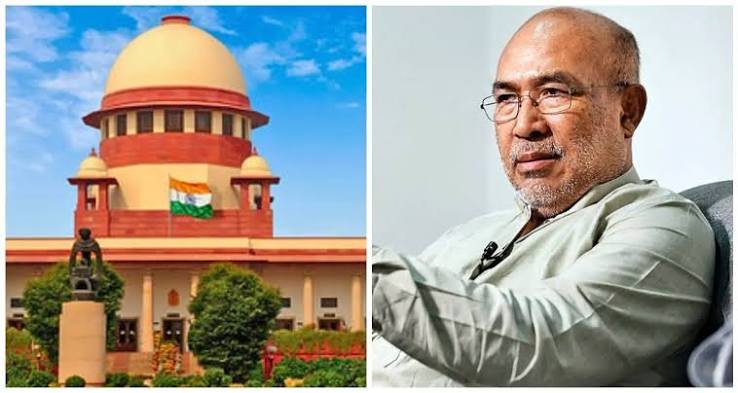
Conflicting forensic findings over audio tapes allegedly linking former Manipur Chief Minister N. Biren Singh to the 2023 violence have put the Supreme Court before a difficult question: how can the recordings be authenticated beyond political or institutional suspicion?
By Navin Upadhyay
New Delhi, August 8: The Supreme Court’s hearing on August 7, 2026, has once again spotlighted a deep and troubling conflict over the authenticity of audio recordings allegedly linking former Manipur Chief Minister N. Biren Singh to the ethnic violence that erupted in the state in 2023.
Additional Solicitor General Aishwarya Bhati placed before a Bench of Justices Sanjay Kumar and Sanjeev Sachdeva a National Forensic Sciences University (NFSU) report concluding that the examined clips—including what was described as a first-generation whistleblower copy spanning more than two hours—had been altered, with multiple modifications and gaps that rendered reliable authentication and voice comparison impossible. The Centre urged dismissal of the petition filed by the Kuki Organisation for Human Rights Trust.
Advocate Prashant Bhushan, appearing for the petitioners, strongly contested these findings. He pointed to an earlier analysis by Truth Labs, a private forensic laboratory, which reportedly found a 93 per cent probability that the voice in the recordings matched the comparison sample attributed to Biren Singh. The Supreme Court directed that the NFSU report be shared with the parties in sealed cover while maintaining strict confidentiality, and the matter remains pending.
This is not merely a technical disagreement between two laboratories. It goes to the heart of public trust in institutions entrusted with uncovering the truth in cases of the gravest seriousness. The alleged tapes, if authenticated, raise explosive questions about the role of political leadership during the violence that claimed hundreds of lives and displaced tens of thousands. In such circumstances, sharply divergent forensic conclusions demand the highest standard of independent scrutiny.
There is, however, an important distinction that must be maintained. A finding that a recording contains an identifiable voice is not necessarily the same as establishing that the recording itself is authentic or that the statements attributed to the speaker were made in the precise circumstances alleged. Likewise, a finding that a copy has been edited or modified does not, by itself, establish that the underlying allegations are false. The questions of voice identity, recording authenticity, possible manipulation and the truth of the statements are related but distinct.
That distinction makes the forensic disagreement all the more significant.
Truth Labs is no ordinary private forensic outfit. Established in 2007, it has undertaken forensic work for courts, law-enforcement agencies, government departments and private parties. Its reported examination of the disputed recordings produced a 93 per cent probability of voice similarity with the comparison sample attributed to Biren Singh.
That finding should neither be treated as conclusive proof nor casually dismissed. A 93 per cent probability is not the same as an unequivocal identification, and voice comparison alone cannot establish the authenticity or context of an audio recording. But when an earlier examination reports such a high probability while a subsequent government-linked forensic examination says the available material is too compromised for reliable comparison, the divergence warrants an examination capable of resolving the disagreement.
The central question should therefore be simple: Can the original recording, source device, authenticated voice samples and complete chain of custody still be examined independently?
If they can, the Supreme Court should consider doing so.
The credibility question
The controversy arises against a broader backdrop of declining public confidence in government-controlled investigative institutions. That does not mean that official forensic institutions are inherently unreliable. India has highly capable forensic scientists and laboratories, and their conclusions cannot be rejected merely because they are government institutions.
But in cases carrying extraordinary political sensitivity, forensic science must not only be independent; it must also be demonstrably independent.
That distinction matters.
A scientifically sound finding can still become the subject of suspicion if one side believes the institution conducting the examination has an institutional interest in the outcome. The answer to such suspicion is not to prejudge the laboratory. It is to create a process whose independence is so evident that neither side can reasonably claim that the forensic exercise was designed to produce a predetermined result.
The alleged Biren Singh recordings are precisely such a case.
The wider record of investigative controversies
The controversy also needs to be viewed against the backdrop of several high-profile cases involving central investigative agencies and opposition politicians.
Consider the National Herald case. For years, the Enforcement Directorate pursued proceedings against Congress leaders, including Sonia Gandhi and Rahul Gandhi, over allegations concerning money laundering linked to the properties and affairs of Associated Journals Limited.
In December 2025, a Delhi court declined to take cognisance of the ED’s prosecution complaint, finding that the complaint was not maintainable in the circumstances before it. The order represented a significant setback for the prosecution, although it did not amount to a judicial finding that the entire investigation had been politically motivated.
Similar controversies have surrounded investigations involving opposition leaders such as Arvind Kejriwal and Manish Sisodia. Both were arrested in connection with the Delhi excise-policy investigation. Courts subsequently granted them relief, and in February 2026 a trial court discharged Kejriwal, Sisodia and other accused in the CBI corruption case relating to the excise policy, holding that the material before it did not justify proceeding with the charges at that stage. The prosecution has challenged aspects of the ruling.
Hemant Soren’s case followed a different legal trajectory, involving allegations of money laundering and a separate investigation. He was arrested by the Enforcement Directorate and subsequently secured bail after the Court ruled that there was no evidence against him.
None of these developments, taken individually, proves that the Enforcement Directorate or CBI acted with political motives. Nor would it be fair to suggest that every case investigated by a central agency is politically driven.
But repeated legal setbacks in politically sensitive cases inevitably raise questions about whether investigative processes have sometimes moved faster than the evidence ultimately capable of surviving judicial scrutiny.
That perception matters.
Why the Manipur case is different
The alleged Biren Singh recordings concern an extraordinary human tragedy.
The Manipur violence involved widespread killing, destruction, displacement and profound communal and ethnic suffering. The allegations surrounding the recordings concern the conduct and possible role of the state’s political leadership during that period.
Those allegations remain allegations. They cannot be converted into established facts merely through repetition.
At the same time, neither can the public reasonably be expected to accept a disputed forensic conclusion as the final answer when another professional examination has reached a materially different result and questions remain about the underlying evidence.
The only credible solution is therefore to maximise the independence and scientific quality of the examination.
Why a foreign laboratory could be the answer
The Supreme Court should consider referring the original recordings and all relevant forensic material to a highly regarded foreign laboratory with no institutional connection to the Indian political system.
Such a move would not represent a vote of no confidence in Indian forensic science.
It would recognise the exceptional circumstances of this particular case.
A foreign institution selected for its technical expertise, independence and lack of any stake in Indian political outcomes could provide a valuable neutral reference point. Its examination could be conducted under the direct supervision of the Supreme Court, with the methodology, evidentiary material and chain of custody clearly defined.
The laboratory should ideally receive the best available original material, rather than repeatedly examining degraded or copied versions. Where possible, this should include the original recording device, source files, metadata, admitted voice samples and every available generation of the recording.
The forensic questions should also be precisely framed.
Was the recording manipulated? If so, when and how? Can the original content be recovered or reconstructed? Does the voice reliably match Biren Singh’s authenticated voice sample? Are there signs of splicing, deletion, insertion or other forms of editing? Can the laboratory establish whether the recording represents a continuous conversation or an assembled sequence?
Answers to those questions would be far more valuable than another general conclusion about whether one laboratory or another should be believed.
Independence is as important as expertise
There is a broader principle at stake.
Justice must not only be done; in cases of extraordinary public sensitivity, the process must also inspire confidence that it has been done without political influence.
A foreign laboratory would not automatically be superior to an Indian institution. Nor should foreign origin itself become a substitute for scientific competence.
The justification for such an examination would lie in independence, neutrality and public confidence.
If the foreign laboratory concludes that the recordings cannot be authenticated, that conclusion would help settle the controversy. If it establishes that the recordings are genuine and the voice belongs to Biren Singh, that conclusion would carry significant evidentiary weight. If manipulation is detected but the underlying conversation can still be reconstructed reliably, that too would provide an important answer.
Most importantly, the examination could establish the limits of what can and cannot be scientifically proved.
Manipur Tape Case: Prashant Bhushan Alleges ‘Mala Fides’ In NFSU Report; SC Orders Sealed Disclosure https://t.co/Ip8DGrPiC3
— POWER CORRIDORS (@power_corridors) August 7, 2026
READ: MP’s Biggest Cyber Fraud Case; BJP Leader Arrested
The Supreme Court should not allow uncertainty to become permanent
The Supreme Court has already demonstrated its willingness to seek further forensic examination when earlier efforts have failed to provide satisfactory answers.
The latest NFSU findings should therefore not necessarily mark the end of the road.
If the problem is that the available copy has been altered or is technically inadequate, the obvious next step is to determine whether the original material can be located and examined. If it cannot, the court should establish precisely what evidence remains available and what conclusions can legitimately be drawn from it.
What should be avoided is an endless cycle in which one forensic examination contradicts another without ever resolving the underlying evidentiary question.
That would serve neither the petitioners nor Biren Singh.
Indeed, an independent examination could protect both sides.
If the tapes are found to be unreliable, Biren Singh would have a stronger basis to challenge the allegations. If they are authenticated, the petitioners and victims of the Manipur violence would have a stronger basis for demanding accountability.
Either way, certainty is preferable to suspicion.
The victims deserve an answer they can trust
The ultimate concern should not be the political fortunes of any individual.
It should be the victims of Manipur.
Hundreds died. Tens of thousands were displaced. Communities were torn apart. Thousands of families continue to live with the consequences of the violence.
In such circumstances, allegations concerning the conduct of the state’s political leadership cannot be left indefinitely suspended between competing forensic interpretations.
Nor should anyone be convicted in the court of public opinion based on an unverified recording.
The only legitimate path is an examination rigorous enough to withstand scrutiny from every side.
The Supreme Court therefore has an opportunity to establish a standard that could extend beyond this particular controversy. It can make clear that when forensic evidence of extraordinary political and human significance produces conflicting conclusions, the answer is not to choose the laboratory whose finding is politically convenient.
The answer is to seek the most independent, technically robust examination available.
If the original tape and associated evidence can still be subjected to such an examination, the Supreme Court should consider sending them to a foreign forensic laboratory of unquestioned professional standing and independence.
That would not prejudge the outcome.
It would simply ensure that the outcome—whatever it may be—is reached through a process that commands the maximum possible confidence.
In the end, the question is not whether the government laboratory or the private laboratory should win.
It is whether the truth can be established.
For the sake of the victims of Manipur, for the credibility of India’s institutions and for the protection of every person accused based on disputed evidence, the Supreme Court should leave no reasonable avenue unexplored.
Where the stakes are this high, the search for truth deserves nothing less than the most independent forensic scrutiny available.