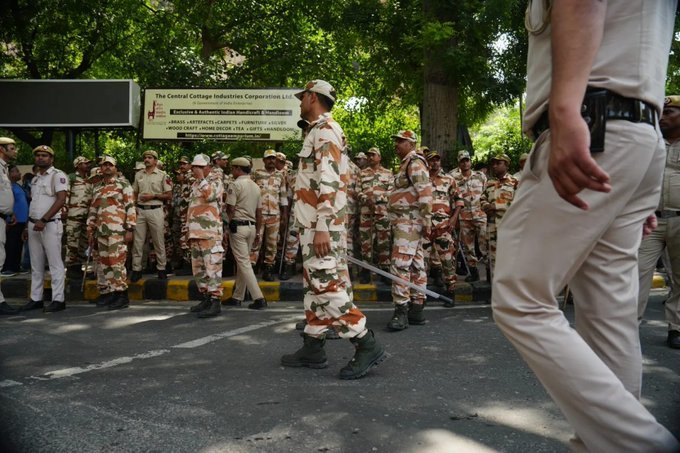
Jantar Mantar has long been recognised as a designated space for demonstrations in Delhi. But with prohibitory orders keeping protesters away and repeated detentions of those trying to reach the site, a difficult constitutional question is emerging: if citizens cannot protest there, where can they exercise their right to peaceful assembly?
By Navin Upadhyay
October 4: If citizens cannot protest at Jantar Mantar, the place long earmarked by the authorities for demonstrations, should they now go to the Supreme Court to demand that the constitutional right to protest be made meaningful again?
It is an uncomfortable question, but the continuing restrictions around Jantar Mantar have made it unavoidable.
The Supreme Court has already made the constitutional position clear. In Mazdoor Kisan Shakti Sangathan v. Union of India, the Court recognised that peaceful protest and demonstration are fundamental rights protected by Articles 19(1)(a) and 19(1)(b). It also recognised that Jantar Mantar had long been chosen and earmarked by the authorities as a place for demonstrations. The Court did not grant protesters an unlimited right to occupy the area; it required a balance between the rights of protesters and those of residents, commuters and the wider public. Crucially, it rejected the idea that protecting one set of rights could result in the total extinction of another.
Delhi police committing brutality without wearing name plates at Jantar Mantar, protest, detaining, peaceful protestors without giving any solid reason. https://t.co/sJ9rC37YNm
— Neha Bora (@NehaAisa) October 3, 2026
That principle now faces a direct test in Delhi.
On October 2, Gandhi Jayanti, Delhi Police imposed prohibitory orders across the New Delhi district ahead of a proposed demonstration demanding the resignation of Chief Election Commissioner Gyanesh Kumar over the Special Intensive Revision of electoral rolls. Access to Jantar Mantar was barricaded, several metro stations were shut or restricted, and hundreds of people attempting to reach the protest site were detained. Reports put the number detained that day at around 550 to 700, depending on the stage and location of detention.
The restrictions did not end there. On October 3, protesters again attempted to march towards Jantar Mantar. Among those detained were senior advocate Kapil Sibal, lawyer and activist Prashant Bhushan, Swaraj India member Yogendra Yadav and AISA president Neha Bora. Delhi Police said permission had not been granted and that prohibitory orders remained in force. Three FIRs were subsequently registered in connection with the October 2 demonstrations.
This is where the protesters’ constitutional objection becomes difficult to dismiss.
Nobody seriously disputes that the police can regulate demonstrations. Nobody disputes that public order matters. Nobody disputes that the right to assemble peacefully is subject to reasonable restrictions. A protest cannot become a licence to block every road, intimidate residents or prevent others from going about their lives.
But regulation is not the same thing as prohibition.
If the authorities say that citizens may protest only after obtaining permission, and then refuse permission; if they impose prohibitory orders across the district; if they barricade the approaches to the designated protest area; and if people attempting to reach that area are detained before they can assemble, then the constitutional question is no longer merely whether the police have the power to regulate the demonstration.
It is whether the right to demonstrate has been rendered practically impossible to exercise.
That distinction matters enormously.
The Supreme Court’s 2018 judgment did not say that Jantar Mantar must remain open regardless of circumstances. It did, however, make clear that constitutional balancing cannot mean that one right is protected by extinguishing another. The Court specifically noted that Jantar Mantar had been earmarked for demonstrations and rejected “total extinction” as a form of balancing.
So what happens when the authorities impose restrictions that effectively empty that designated space of its constitutional purpose?
That is the question protesters are now entitled to ask.
And there is another uncomfortable element. The current restrictions are not being imposed against a demonstration whose demands are being adjudicated by the police. The protesters are seeking to express a political and constitutional grievance against the Election Commission and the Chief Election Commissioner. Whether their allegations concerning the SIR are right or wrong is ultimately a matter for evidence, institutions and courts. The right to voice those allegations does not depend on the government agreeing with them.
Indeed, that is precisely why protest rights exist.
READ: Journalist Alleges Groping by Delhi Police ACP at Jantar Mantar, FIR Delay Triggers Protest
READ: Kerala Reopens 2006 Vigilance Probe Linked to Gyanesh Kumar
A government cannot reasonably say: You may protest, provided we approve the subject, the timing, the size and the location. The permission mechanism is supposed to facilitate orderly exercise of the right, not transform a constitutional freedom into a privilege granted at the discretion of the executive.
The authorities may have legitimate reasons for restricting a particular demonstration. But when restrictions continue indefinitely, the burden becomes heavier: why is the restriction still necessary, why can less restrictive conditions not be imposed, and where can citizens lawfully assemble instead?
That last question has received too little attention.
If Jantar Mantar is unavailable, where should the protesters go?
Speaking from the protest site, senior advocate and Rajya Sabha MP Kapil Sibal(@KapilSibal) called on citizens to participate in peaceful protests, invoking Mahatma Gandhi and his history of protest marches.
Sibal argues that citizens must make their voices heard and repeatedly stresses taking to the streets peacefully. His remarks come amid protests over the functioning of the Election Commission and the Special Intensive Revision (SIR) of electoral rolls, with demonstrators demanding the resignation of Chief Election Commissioner Gyanesh Kumar.
In Delhi, police had denied permission for the October 2 demonstration at Jantar Mantar, where protesters nevertheless attempted to gather and hundreds were detained.
Watch this till the end and follow DeKoder for more.
#JantarMantar #Protest #GyaneshKumar #ElectionCommission #CEC #ECI #SIR #ElectionCommission #KapilSibal #CJP #India #Democracy #VoterLists #VotingRights #ChiefElectionCommissioner
— DeKoder (@DeKoderAI) October 3, 2026
If they cannot assemble there, should they march to another public space? If they do, will they again be stopped? If they gather in smaller numbers, will they be detained? If they seek permission, will it be granted? And if the answer to each of these questions is effectively no, what remains of the right recognised by the Constitution?
The answer cannot simply be that protesters should remain at home.
The Supreme Court is, of course, not a protest ground. Protesters should not obstruct its functioning or treat its premises as an alternative Jantar Mantar. But there is a legitimate constitutional irony in asking whether citizens may have to bring the issue to the very institution that recognised the right in the first place.
If Jantar Mantar is closed, should the protesters’ next destination be the Supreme Court to ask the Court why a right it recognised has become impossible to exercise at the place earmarked for exercising it?
That is not a call for confrontation with the judiciary. It is a demand for constitutional accountability.
Jantar Mantar was never supposed to be a guarantee that every protest would be permitted without conditions. But it was meant to provide a lawful, regulated space in which citizens could make themselves heard.
If citizens can be prevented from reaching that space whenever the administration does not want a particular protest to take place, then the question is no longer where they are allowed to protest. The question is whether they are being allowed to protest at all.
And that brings us back to the question that the present confrontation has made impossible to avoid:
If not Jantar Mantar, then should people protest at the Supreme Court to wake it up to allow protest?