As protests intensify in Imphal, the Centre must balance concerns over illegal migration and demographic change in Manipur against the need to preserve the uniformity of the nationwide Census exercise.
BY Navin Upadhyay
August 26, 2026: The demand by 14 civil society organisations in Manipur to defer the Census until an updated National Register of Citizens (NRC) is completed has gained fresh political urgency, with Chief Minister Yumnam Khemchand Singh travelling to New Delhi on Tuesday following a call from the Centre.
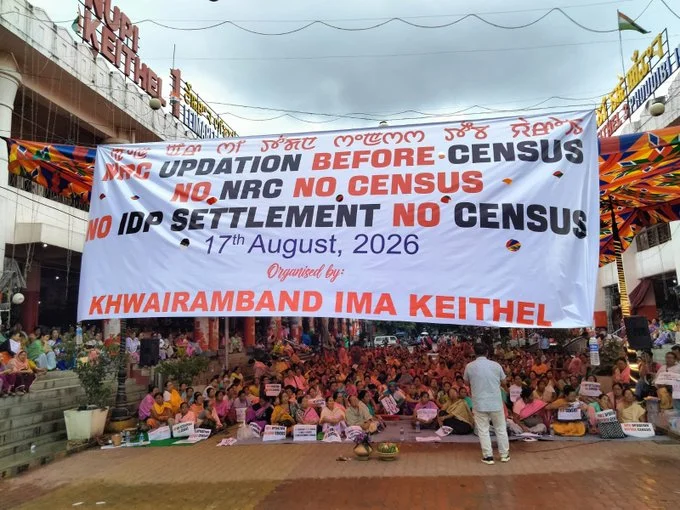
The move comes amid mounting protests in the state, where the organisations are pressing for the NRC to be updated before the Census, raising wider questions about the feasibility, political implications and national precedent of such a demand.
The organisations, representing Meitei and Naga communities among others, have urged the Centre to halt the Census exercise and first prepare an NRC using 1951 as the cut-off year. Their demand is rooted in genuine concerns over demographic change and the continuing consequences of the ethnic violence that erupted in 2023. Large protests have been held in Imphal, while a delegation of leaders has travelled to New Delhi to press the demand before central authorities.
These concerns cannot simply be dismissed. Manipur shares a long and porous border with Myanmar, and the state’s demographic anxieties have intensified sharply since the outbreak of violence. The displacement of tens of thousands of people, disputed settlement patterns and allegations of illegal immigration have added another layer to an already deeply polarised situation.
Yet accepting an NRC-before-Census formula would create serious practical and political difficulties.
READ: US Sanctions 4 Indian Firms. 3 Nationals Over Iran Oil Trade
House-listing for Census 2027 is scheduled to begin in Manipur on September 1. Suspending the exercise in one state while the rest of India proceeds would disrupt a uniform national process whose data is essential for welfare planning, development programmes and, eventually, the delimitation of constituencies.
An NRC based on a 1951 cut-off would be an enormous undertaking. Assam’s experience showed how complicated citizenship verification can become, involving years of documentation, scrutiny, appeals and litigation. Even after an exhaustive exercise, questions over inclusion and exclusion remained.
Manipur presents additional complications. Large numbers of people have been displaced by the conflict. Historical records are incomplete, village boundaries and settlement histories are contested, and families that have lived in the state for generations may not possess documents dating back to 1951. A rigid documentary test could therefore create uncertainty for people whose Indian citizenship has never previously been questioned.
But the biggest problem may lie beyond Manipur.
If the Centre accepts the principle that a state can demand completion of an NRC before participating in a national Census, other states and regions could seek similar concessions. Border states with their own histories of migration could make comparable demands. The Census, which is meant to be a uniform national exercise, could gradually become subject to state-level political conditions.
That is where the Pandora’s box opens.
The political timing makes the Centre’s dilemma even sharper. Assembly elections are due in early 2027. Significant Meitei and Naga organisations have rallied behind the NRC demand, while Kuki-Zo organisations oppose it. The BJP-led state government cannot ignore the political weight of the demand, but endorsing it could further deepen the ethnic fault lines that the Centre has been trying to ease.
The government therefore needs a response that acknowledges legitimate security and demographic concerns without turning the Census into an open-ended citizenship verification exercise.
There are other instruments available. Border management can be strengthened. Recent settlements can be subjected to targeted verification where there is credible evidence of irregular migration. Existing laws governing detection, documentation and deportation can be enforced more effectively. Better coordination between central and state agencies can also improve monitoring of the international border.
None of these measures will satisfy everyone. But they can address genuine concerns without making completion of an NRC a prerequisite for the national Census.
The anxieties in Manipur are real and deserve a serious response. But an NRC-before-Census arrangement would carry consequences far beyond the state. The Centre must therefore resist the temptation of a politically convenient short-term solution that could establish a precedent difficult to contain later.
Manipur needs credible action on demographic and security concerns. India, however, also needs a Census that remains a national exercise rather than a collection of state-level political bargains.