An emotional Lionel Messi fought back tears after Argentina’s defeat, prompting a heartfelt tribute from the Argentine Football Association, while Spain celebrated a historic World Cup-Euros double under Luis de la Fuente.
BY PC Bureau
July 20, 2026: Lionel Messi’s quest to end his glittering international career with consecutive FIFA World Cup titles ended in heartbreaking fashion on Sunday as Spain produced a tactical masterclass to defeat defending champions Argentina 1-0 after extra time, reclaiming football’s biggest prize and ushering in a new era of Spanish dominance.
For more than 100 minutes, Argentina clung to hope through sheer resilience and the brilliance of goalkeeper Emiliano Martínez. But Spain’s relentless pressing, technical superiority and complete control of possession eventually broke the resistance, with substitute Ferran Torres firing home the decisive goal in the 106th minute to hand La Roja their second World Cup crown, 16 years after their triumph in South Africa.
The defeat marked a poignant conclusion to what is widely expected to be Messi’s final appearance on football’s grandest stage. The 39-year-old captain, who had inspired Argentina to World Cup glory in Qatar in 2022 and led the Albiceleste to Copa América titles in 2021 and 2024, was left watching Spain celebrate as his dream of becoming the first captain since Cafu to retain the World Cup slipped away.
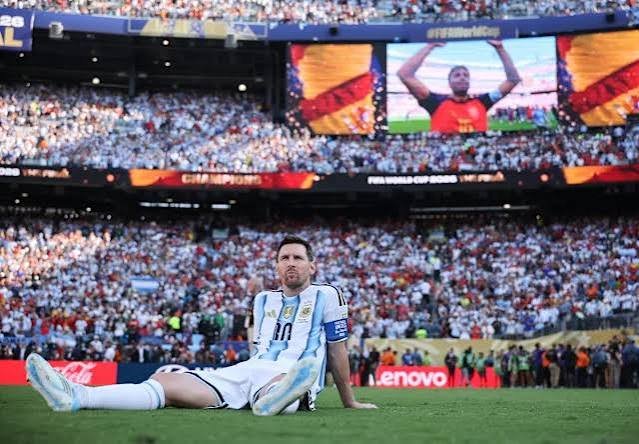
As the final whistle echoed around the New York New Jersey Stadium, an emotional Messi stood motionless before collecting his runners-up medal. Television cameras captured the Argentine legend wiping away tears and staring into the stands, while teammates attempted to console him after another remarkable World Cup campaign ended one step short of history.
The emotional scenes quickly went viral across social media, with millions of fans paying tribute to one of football’s greatest icons.
AFA Pays Emotional Tribute
The Argentine Football Association (AFA) posted a heartfelt message shortly after the match, thanking its captain for more than two decades of unforgettable service.
“Your tears are our tears, Captain. You gave us the greatest joys of our lives. Thank you for the dedication, for the magic, and for giving it your all until the very last second. We love you forever, Leo!”
The tribute resonated with supporters across Argentina, many of whom described Messi’s reaction as one of the most emotional moments of the tournament.
Although Sunday’s defeat denied him another World Cup, Messi leaves international football having transformed Argentina’s fortunes. After years of heartbreak, he finally delivered the country’s third World Cup title in Qatar and restored Argentina to the summit of world football, cementing his place alongside Diego Maradona in the nation’s sporting folklore.
Spain’s Tactical Blueprint Overwhelms Argentina
While the scoreline suggested a closely fought contest, Spain’s dominance was evident throughout the evening.
Luis de la Fuente’s side executed one of the finest tactical performances seen in a World Cup final, suffocating Argentina through relentless pressing, intelligent positioning and near-flawless ball retention.
Spain finished with well over 65 percent possession and completed almost twice as many passes as Argentina, rarely allowing Lionel Scaloni’s side to establish any sustained rhythm. Every Argentine attempt to build from the back was met by coordinated pressure from Spain’s front line, forcing hurried clearances and repeated turnovers.
Rodri once again dictated the tempo from midfield, constantly making himself available to receive possession before switching play with remarkable precision. Alongside him, Pedri and Fabián Ruiz controlled central areas, ensuring Argentina spent long periods chasing the ball rather than creating opportunities.
Spain’s tactical structure also neutralised Messi.
Rather than assigning a single marker, they crowded the spaces around the Argentine captain whenever he dropped into midfield. As soon as Messi received possession, two or even three Spanish players closed him down, cutting off passing lanes and forcing him away from dangerous areas.
The strategy effectively isolated Argentina’s forwards.
Julián Álvarez was starved of service, while the wing-backs struggled to advance under Spain’s relentless pressure. By limiting Messi’s influence between the lines, Spain removed Argentina’s primary creative outlet.
READ: Torres Breaks Argentina Hearts as Spain Lift 2nd World Cup
Width and Rotation Stretch Argentina
Spain’s attacking width proved equally decisive.
Teenage sensation Lamine Yamal and Nico Williams remained high and wide throughout the match, forcing Argentina’s full-backs into uncomfortable one-on-one situations and preventing them from supporting attacks.
Their movement constantly stretched Argentina’s defensive shape.
Whenever one winger drifted inside, the opposite flank remained occupied, creating spaces for overlapping runs from Pedro Porro and Marc Cucurella. The constant rotations exhausted Argentina’s defenders, who were forced to shift laterally for more than 100 minutes.
Although Spain failed to convert several early chances, the pressure never relented.
Emiliano Martínez produced a remarkable display, making a series of outstanding saves that prevented Spain from taking the lead long before extra time. His reflex stops from Pedri, Rodri and Nico Williams kept Argentina alive and ensured the match remained goalless after 90 minutes.
Messi Sat and said Goodbye While Crying#ESPARG pic.twitter.com/r3HyOwj9MY
— Bello Toheeb Tejumola (@BigBheLlo) July 19, 2026
Red Card Tilts the Balance
Argentina’s hopes suffered a major setback late in regulation time when Enzo Fernández was sent off after receiving his second yellow card for a reckless challenge.
Reduced to ten men for the entirety of extra time, the defending champions were forced into survival mode.
Spain immediately increased the tempo.
With the extra numerical advantage, Rodri and Pedri found even more space to dictate play, while the Spanish full-backs pushed higher, pinning Argentina deep inside their own half.
The decisive breakthrough finally arrived just 37 seconds into the second period of extra time.
Pedro Porro curled a deep cross into the penalty area, Nico Williams intelligently headed the ball back across goal, and substitute Ferran Torres reacted quickest, smashing a powerful left-footed volley into the roof of the net beyond the helpless Martínez.
It was the culmination of more than 100 minutes of sustained Spanish pressure.
A New Spanish Golden Generation
Spain’s triumph highlighted the remarkable evolution of a squad blending youthful brilliance with experienced leadership.
Rodri controlled the midfield with authority, Pedri orchestrated attacks with elegance, Yamal and Williams terrorised Argentina’s defence with pace and creativity, while the substitutes injected fresh energy precisely when it was needed.
Luis de la Fuente also deserves enormous credit.
His decision to maintain Spain’s possession-based identity while incorporating modern high-intensity pressing has transformed La Roja into arguably the most complete international side in world football.
Having already guided Spain to the UEFA European Championship in 2024, he has now added the FIFA World Cup to his growing list of achievements, becoming one of the country’s most successful managers.
The victory also completed a historic European Championship-World Cup double and announced the arrival of Spain’s new golden generation—a team capable of dominating international football for years to come.
For Argentina, the pain will linger, particularly for Messi, whose extraordinary World Cup journey ended not with another trophy, but with tears.
For Spain, however, the night belonged to a team whose tactical intelligence, relentless energy and collective brilliance proved too much for even the defending champions to withstand.