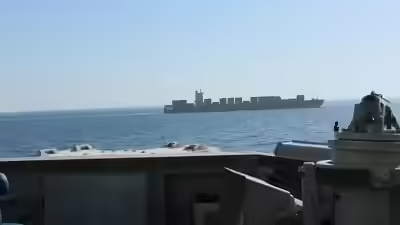
The IRGC Navy said the updated framework establishes new “equations” for managing the region, signalling a stronger assertion of Iranian control over one of the world’s most critical energy transit routes.
BY PC Bureau
May 3, 2026 — The Islamic Revolutionary Guard Corps (IRGC) has announced a new set of maritime rules governing Iran’s coastline along the Persian Gulf and the Strait of Hormuz, signalling a significant shift in the country’s regional security posture.
In a statement issued on Friday, the IRGC Navy said the new framework for managing the waters was drawn up following a directive from Supreme Leader Seyed Mojtaba Khamenei. The force said the “equations and rules” governing the Persian Gulf would now be enforced under what it described as a historic mandate.
The announcement follows remarks by Khamenei a day earlier, in which he warned that foreign actors with “ominous” intentions had no place in the Persian Gulf “except at the bottom of its waters.” He also called for the implementation of a “new management” structure for the Strait of Hormuz, one of the world’s most strategically vital shipping lanes.
Leader of the Islamic Revolution Ayatollah Seyyed Mojtaba Khamenei has announced that Iran will implement new management rules over the Strait of Hormuz following the joint US-Israeli war against the country that began on February 28.https://t.co/qyEpaxWIn7
— Tehran Times (@TehranTimes79) May 2, 2026
READ: 14 IRGC Men Killed in Blast During Cleanup in Iran’s Zanjan
Iranian officials say the measures are aimed at strengthening the country’s sovereign control over its roughly 2,000-kilometre coastline and enhancing regional security without foreign intervention. The IRGC Navy added that it would continue to play a central role in safeguarding the waters and ensuring stability.
According to the statement, the new maritime policy seeks to transform the Persian Gulf into a source of economic strength and livelihood for Iran, while contributing to broader regional prosperity among neighbouring states.
The move comes amid heightened geopolitical sensitivities in the Gulf, through which a significant portion of global energy supplies passes, making any shift in security arrangements closely watched by international stakeholders.
Analysts say the announcement could further complicate already tense relations between Iran and Western powers, particularly the United States, which maintains a naval presence in the region to secure international shipping lanes. Any attempt by Tehran to unilaterally redefine maritime rules may raise concerns over freedom of navigation and the potential for miscalculation in the congested waters of the Strait of Hormuz.
Regional observers also note that the emphasis on excluding foreign forces aligns with Iran’s long-standing position that Gulf security should be managed by littoral states alone. However, the practical implications of the new rules remain unclear, including how they will be enforced and whether they will affect commercial shipping or international energy flows passing through one of the world’s busiest maritime chokepoints.