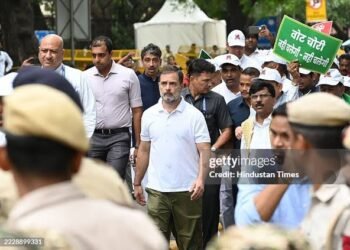
Farmer leaders accused the Haryana and Punjab governments of denying them their democratic right to protest, alleging selective restrictions after farmers from Haryana were allowed to proceed towards Delhi while Punjab convoys were stopped.
BY PC Bureau
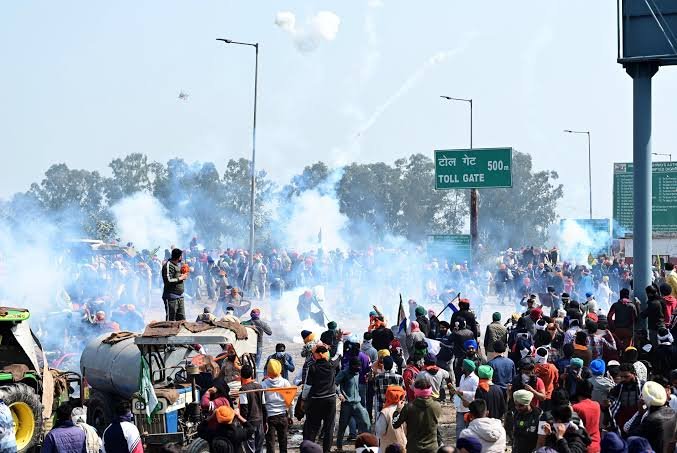
Shambhu (Punjab), July 21: A fresh standoff unfolded at the Punjab-Haryana border on Tuesday after hundreds of farmers heading to Delhi for a Kisan Mahapanchayat against the proposed India-US trade agreement were stopped at the Shambhu border, triggering a tense confrontation with security forces.
Denied permission to enter Haryana, the farmers turned the Shambhu crossing into a makeshift protest site, raising slogans against the Centre and accusing both the Haryana and Punjab governments of suppressing their democratic right to hold a peaceful demonstration in the national capital.
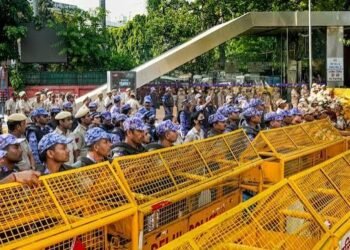
The border was sealed with multiple layers of barricades, closely resembling the heavily fortified arrangements seen during the 2024 farmers’ agitation, when concrete blocks, iron spikes and heavy police deployment effectively cut off the Delhi route.
Bharatiya Kisan Union (Shaheed Bhagat Singh) leader Tezveer Singh alleged that Haryana Police had erected barricades inside Punjab territory itself and criticised the Punjab government for remaining a “silent spectator” instead of opposing the restrictions.
While convoys of farmers from Punjab were prevented from crossing into Haryana, farmers from districts such as Ambala, Kurukshetra and other parts of Haryana were reportedly allowed to continue towards Delhi, drawing allegations of selective enforcement.
Mahapanchayat Targets Proposed India-US Trade Pact
The protest has been organised under the banner of the Desh Bachao Morcha, bringing together farmer organisations from Punjab, Haryana and Himachal Pradesh.
At the centre of the agitation is the demand that the Union government abandon the proposed India-US Bilateral Trade Agreement (BTA), which farmer groups fear could expose India’s agriculture and dairy sectors to an influx of subsidised American products.
Kisan Mazdoor Sangharsh Committee (KMSC) leader Sarwan Singh Pandher said convoys belonging to KMSC, Kisan Mazdoor Morcha, Azaad Kisan Morcha and BKU Ekta Sangharsh had begun travelling from different parts of Punjab before being intercepted at the Shambhu border.
READ: Massive Crowds Return to Jantar Mantar as CJP Vows to Continue Protest
Thousands of Punjab farmers are marching to Delhi opposing the US-India trade deal. Haryana Police closed the Shambhu Border using heavy cement blocks and JCB machines to block them. pic.twitter.com/SjdT5LLQn2
— VIZHPUNEET (@vizhpuneet) July 21, 2026
Why Farmers Oppose the Trade Deal
Farmer leaders pointed to the India-US Joint Statement issued in February 2026, under which both countries agreed to negotiate the first phase of a comprehensive bilateral trade agreement by the fall of 2026.
According to the protesting organisations, the proposed agreement extends well beyond conventional tariff reductions and could cover agriculture, dairy, industry, digital trade, e-commerce, government procurement, investment, services and intellectual property rights.
They argue that successive US trade reports have consistently sought greater access to India’s agricultural markets for products including soybeans, maize, cotton, ethanol, apples, almonds, dairy products, poultry and fisheries through lower tariffs and fewer import restrictions.
Farmer unions contend that opening Indian markets to heavily subsidised American farm and dairy products would make it impossible for millions of India’s small and marginal farmers to compete.
They also criticised the government for allegedly conducting negotiations without adequate public consultation, saying the details of the proposed agreement have not been disclosed.
Fears Over Rural Economy
The protesting groups warned that the impact would extend beyond farmers.
They noted that India’s dairy industry supports nearly 80 million rural families, and any reduction in domestic market protection could affect dairy producers, transporters, food processors, small traders, agri-based industries and rural micro-enterprises.
The Desh Bachao Morcha has demanded that the Centre immediately release all documents related to the proposed trade agreement and initiate consultations with farmers, dairy cooperatives, labour organisations, traders and other stakeholders before signing any pact.
With farmers refusing to disperse and security remaining tight at the Shambhu border, the protest is expected to intensify in the coming days, reviving memories of the prolonged farmers’ movements that previously brought Delhi’s borders to a standstill.