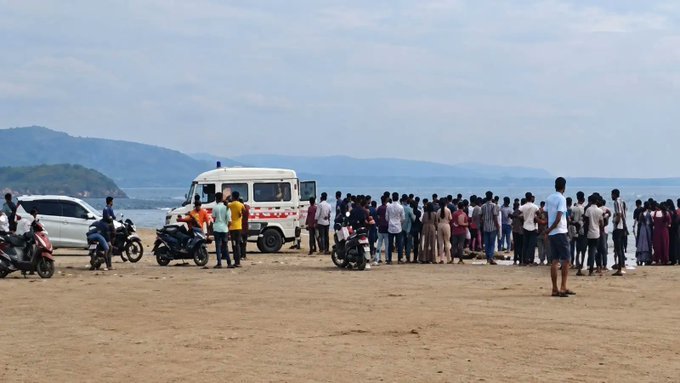
A local water-sports operator of Raigad and his team launched an immediate rescue effort, while police and villagers later shifted the bodies to Borli Panchatan Primary Health Centre for post-mortem procedures.
BY PC Bureau
Raigad, October 1: Eight 16-year-old students from Pune drowned at Diveagar beach in Maharashtra’s Raigad district on Thursday after they were swept away by strong currents. Police said all eight bodies have been recovered.
The students were part of a group of 48 — 25 boys, 17 girls and six teachers — from Winners’ Academy, a private coaching centre in Alandi, Pune district. The group had travelled to Diveagar, about 157 km from Pune, and arrived at around 5.30 pm.
According to police, eight students entered the sea but misjudged the depth of the water and the strength of the current. They were swept away before they could return to shore.
Bhau Salunkhe, who runs Bhau Maruti Salunkhe Mahakali Water Sports at Diveagar, and his team immediately began a rescue operation. They recovered all eight bodies and brought them back to the beach.
READ: India to Expand Full-Body Airport Scanning After Flydubai Cockpit Attack
Assistant Police Inspector Santosh Awati of Dighi Sagari Borli Panchatan Police Station and his team reached the spot after receiving the alert. With the help of local villagers, police took charge of the bodies and shifted them to the Primary Health Centre at Borli Panchatan for post-mortem examinations and other legal procedures.
The deceased have been identified as Tanmay Dattatray Vahile, Sumit Bharat Ahire, Pranav Ramdas Bansode, Kaivalya Satish Wasankar, Rajveer Yuvraj Vahile, Yash Kiran Wankhede, Soham Tukaram Bhandwalkar and Kaustubh Sandeep Daund.
रायगड जिल्ह्यातील दिवेआगर समुद्रात आठ विद्यार्थी बुडाल्याची दुर्दैवी घटना; 8 विद्यार्थ्यांचा मृत्यू झाल्याची माहिती.@mataonline @ParagKMT @ShreedharLoniMT @suneetMT pic.twitter.com/bP2VN2dC4U
— Swapnil Shinde (@swapnilshindeMT) October 1, 2026
Why Ocean Currents Can Be Dangerous
A beach can appear calm while water beneath the surface is moving strongly. Currents can pull swimmers away from the shore, particularly around channels, sandbars and areas where waves are breaking unevenly.
The most important rule is not to fight a strong current by swimming directly against it. If caught in a current pulling away from the beach, swimmers should try to remain calm, stay afloat and, where possible, move parallel to the shoreline until they are clear of the current before attempting to return to shore. Calling or signalling for help is important if returning becomes difficult.
For children and inexperienced swimmers, entering the sea should be avoided when currents or waves are strong, even if other parts of the beach appear safe. Swimming in designated areas under lifeguard supervision is safer than entering the water at an unsupervised stretch.
रायगड जिल्ह्यातील दिवेआगर समुद्रात आठ विद्यार्थी बुडाल्याची दुर्दैवी घटना; 8 विद्यार्थ्यांचा मृत्यू झाल्याची माहिती.@mataonline @ParagKMT @ShreedharLoniMT @suneetMT pic.twitter.com/bP2VN2dC4U
— Swapnil Shinde (@swapnilshindeMT) October 1, 2026
Safety at Raigad’s Beaches
Raigad is a major tourism destination, with beaches including Diveagar, Kashid and Murud attracting visitors from Mumbai and Pune. Maharashtra Tourism lists Diveagar as a popular coastal destination and identifies October to March as the preferred period for visiting. It also specifically advises visitors to avoid swimming during the monsoon because of stronger waves.
The state’s coastal-tourism plans identify lifeguard stations and watchtowers, warning signs, first-aid facilities and clear zoning of bathing and water-sports areas as important beach infrastructure. Diveagar is among the Raigad beaches identified for such coastal-tourism interventions.
The Diveagar tragedy highlights the danger of assuming that a familiar-looking beach is automatically safe for swimming. Water conditions can change with tides, currents, waves and weather, and visitors unfamiliar with the local sea may not recognise dangerous conditions until they are already in the water.