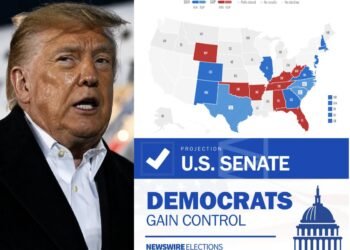
The Democratic gains in traditional Republican strongholds suggest that Trump’s appeal is facing challenges beyond the opposition’s traditional support base.
By PC Bureau
November 4, 2026: Donald Trump did not have his name on the ballot on November 3. But the American president was the central figure in an election that turned into a referendum on his leadership, economic policies and handling of foreign affairs. The verdict was damaging. Democrats captured both chambers of Congress, breaking the Republican grip on Washington and setting the stage for a turbulent final two years of Trump’s second term.
The scale of the Democratic victory matters. The party did not merely consolidate its traditional support base. It made inroads into Republican strongholds, defeated candidates backed by Trump and overturned majorities in states where Democrats had struggled for decades.
The result exposes a political vulnerability that Trump has repeatedly sought to dismiss: his ability to mobilise his core supporters does not necessarily translate into broader electoral support for his party. The midterms suggest that a section of voters who backed him in 2024 was no longer willing to give his administration the benefit of the doubt.
But the defeat is about more than Trump’s personal popularity. It reflects the growing gap between the administration’s political messaging and the everyday concerns of American households.
READ: Manipur: Four Killed in Gunfight Between ZUF(J) and NSCN-IM
The Economy Became Trump’s Achilles’ Heel
The cost of living was among the strongest factors shaping the election. Inflation, fuel prices, groceries, healthcare and household expenses dominated voters’ concerns.
The political problem for Trump was not simply that prices remained high. It was that voters increasingly held his administration responsible for their economic difficulties.
Polling indicated that nearly nine in 10 voters considered inflation and everyday expenses important to their decisions. Around two-thirds blamed Trump for high prices. About 44 per cent said their financial position had worsened over the previous two years, compared with 18 per cent who reported an improvement.
🇺🇸 Democrats have won control of BOTH chambers of the U.S. Congress in the 2026 midterm elections, securing majorities in the Senate and House of Representatives.
The party is projected to have won 53 Senate seats and 220 House seats, surpassing the respective majority thresholds of 51 and 218.
The result would end Republican control of Congress and leave President Donald Trump facing a Democratic majority in both chambers for the remaining two years of his presidency.
That would give Democrats control over congressional committees, investigations and the legislative agenda, while significantly restricting Trump’s ability to advance his domestic policies.
Source: Anadolu Agency / Writer: Mhedi
— Mario Nawfal (@MarioNawfal) November 4, 2026
These figures point to a basic political reality: voters judge an administration less by its claims of economic success than by what they experience at the checkout counter, petrol station and household budget.
Trump’s political strategy has relied heavily on projecting strength and presenting himself as the leader capable of restoring American economic power. But that message becomes less persuasive when households feel financially squeezed.
His tariff policies also added to uncertainty over prices and trade. For voters concerned about affordability, the distinction between a government’s long-term economic strategy and its immediate impact can be difficult to sustain.
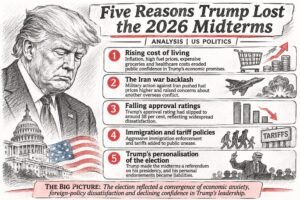
Trump’s Iran War Added to the Political Costs
The military action against Iran in February 2026 created another problem for the White House.
Trump’s decision to use military force had consequences beyond foreign policy. The conflict contributed to higher fuel prices and raised concerns about the financial and strategic costs of American involvement.
The administration faced a difficult political equation. It had to defend its military action while dealing with voters increasingly concerned about its economic consequences.
Foreign policy does not always determine the outcome of midterm elections. But when an overseas conflict affects domestic prices and creates uncertainty, it becomes an electoral issue.
The Iran war also complicated Trump’s promise to put American interests first and avoid costly foreign entanglements. Voters who expected a focus on domestic priorities had another reason to question the administration’s direction.
The Democratic Victory Was More Than a Congressional Numbers Game
The geographical spread of the Democratic gains makes the result particularly significant.
In Texas, James Talarico defeated Ken Paxton, while Gina Hinojosa defeated incumbent Governor Greg Abbott. Kansas elected Adam Hamilton to the Senate, ending a long gap in Democratic victories in statewide Senate contests. In South Carolina, Annie Andrews secured a Democratic Senate breakthrough.
Democrats also gained ground in Iowa, North Carolina, Ohio and Maine. Their victories in Republican-leaning territory suggest that dissatisfaction with Trump was not confined to traditionally Democratic constituencies.
The defeat of several Trump-backed candidates is also significant. It raises questions about whether his e