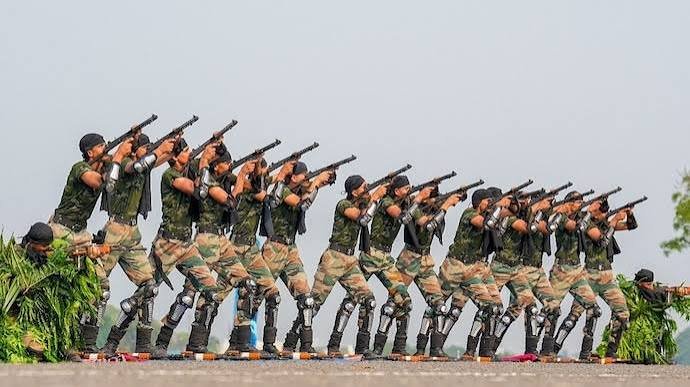
With the Navy’s first Agniveer batch exiting on 21 November, followed by the Air Force and Army, the Centre is expected to announce changes soon. The two-year extension reflects positive feedback on Agniveers’ performance and supports a younger, more flexible force while addressing operational needs.
BY PC Bureau
New Delhi, November 4: In a major change to the Agnipath recruitment framework, the government has approved a two-year extension for Agniveers in the Indian Army, allowing them to serve for six years instead of the existing four.
Chief of Defence Staff General NS Raja Subramani announced the Cabinet decision at a press conference on Wednesday. He said the 75 per cent of Agniveers who were originally scheduled to leave after completing four years would now be offered an additional two-year engagement.
After completing the extended tenure, they will be able to apply for enrolment in the regular armed forces, subject to prescribed eligibility and selection criteria.
Subramani described the decision as a significant development for the armed forces and Agniveers. He said the move followed four years of performance assessments, which had generated positive feedback from the services.
READ: Manipur: Four Killed in Gunfight Between ZUF(J) and NSCN-IM
“The Cabinet has created a pathway for all Agniveers to be absorbed into the Indian Army,” he said.
The CDS recalled that the Agnipath scheme, introduced on June 14, 2022, had envisaged continuous performance evaluation and periodic reviews.
Under the original arrangement, 25 per cent of Agniveers could be selected for permanent enrolment in the regular forces on merit and according to organisational requirements. The remaining 75 per cent were to complete their four-year tenure and return to civilian life.
The revised arrangement gives this second group an opportunity to serve for another two years before applying for further enrolment.
Delhi: Chief of Defence Staff (CDS) General N.S. Raja Subramani says, “Today, the Cabinet has created a pathway for all Agniveers to be absorbed into the Indian Armed Forces… The four-year service period of the first batch of Agniveers is now nearing completion. During these four years, we have evaluated their performance and received very positive feedback. As you know, 25% of Agniveers are enrolled in the regular forces based on merit. Earlier, the remaining 75% were to exit the service and join society as disciplined and motivated youth. However, under the revised scheme, the remaining 75% of Agniveers will be offered an additional engagement period of two years. After completing this two-year engagement period, all willing Agniveers will be enrolled in the Armed Forces, subject to objective selection criteria…”
— IANS (@ians_india) November 4, 2026
What Changes Under the Revised Scheme
The decision creates three broad categories of Agniveers:
- Those selected for permanent enrolment in the regular forces after four years.
- Those offered an additional two-year engagement, taking their service period to six years.
- Those who complete the extended tenure and apply for further enrolment, subject to selection criteria.
The additional engagement does not guarantee permanent absorption. Candidates will have to meet the prescribed eligibility and selection requirements.
Agnipath Scheme and the First Exit Cycle
The Union Cabinet approved the Agnipath scheme on June 14, 2022. It introduced fixed-term recruitment for personnel below officer rank in the Army, Navy and Air Force.
Under the original framework, recruits, known as Agniveers, serve for four years, including training. At the end of their tenure, up to 25 per cent of each batch can be selected for permanent enrolment in the regular cadre.
Those selected can serve for a further period of approximately 15 years, subject to service conditions. The remaining personnel leave with a one-time Seva Nidhi package of around Rs 11.71 lakh, which is tax-free.
They do not receive a regular military pension or full ex-serviceman status under the original arrangement.
The government introduced the scheme with the stated objectives of reducing the average age of the armed forces, lowering long-term salary and pension commitments, and providing military training and skills to young people entering civilian life.
The first batch of approximately 24,400 Agniveers was inducted in 2022. Their four-year engagements are now approaching completion.
The Cabinet’s decision changes the original four-year engagement model and provides a longer service opportunity to Agniveers who would otherwise have left the Army after their initial tenure.