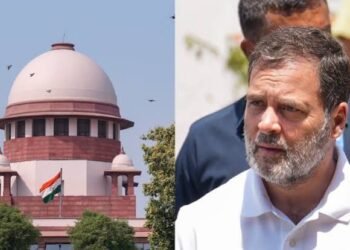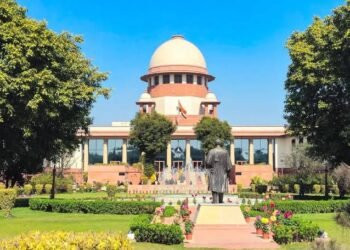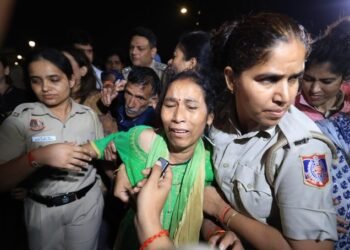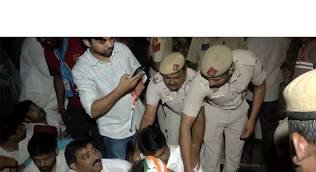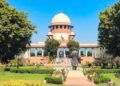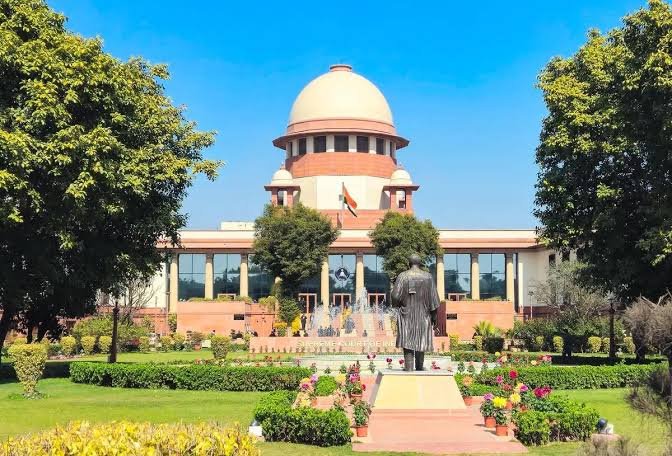
Union Home Secretary Govind Mohan has tendered an unconditional and unqualified apology to the Supreme Court in a contempt case over alleged violations of directions concerning Metro and train services during the October 10 CJP protest.
BY PC Bureau
NEW DELHI/ October 15: Detain protesters, rough up students and women, target journalists, disrupt public transport and bring large parts of the national capital to a standstill—and then offer an unconditional apology to the Supreme Court. This is the disturbing sequence of events surrounding the Delhi Police crackdown on the October 10 protest called by the Cockroach Janta Party (CJP), which has now landed senior government officials in a contempt case before the apex court.
Union Home Secretary Govind Mohan and Police Commssioner Anurag Kumar have tendered “unconditional and unqualified apologies” to the Supreme Court over the alleged violation of its directions concerning restrictions on Metro and train services during the protest. But an apology in an affidavit cannot, by itself, answer the larger questions raised by the crackdown: who authorised the sweeping restrictions, whether they were proportionate, why peaceful demonstrators and journalists faced police action, and who will be held accountable for the disruption of ordinary life in Delhi?
The controversy goes beyond the suspension of cellular internet services. It concerns the use of state power to manage political dissent—and the apparent willingness of the authorities to impose sweeping restrictions on citizens before seeking to justify them afterwards.
An apology does not erase the crackdown
In an affidavit before the Supreme Court, Mohan said Delhi Police had requested a one-day suspension of cellular internet services until 10 pm on October 10. The request, he maintained, was processed in accordance with the law and considered proportionate in view of the anticipated situation and the need to maintain public order.
According to the affidavit, cellular internet services were suspended from 10 pm on October 9 until 10 pm on October 10 within a four-kilometre radius of Raisina Hill. Mohan clarified that the restriction did not extend to Wi-Fi, broadband or other non-cellular internet services.
The Home Secretary has also asked the Supreme Court to modify its October 11 order to permit internet suspensions in situations of necessity, subject to statutory requirements and safeguards.
In his separate affidavit, Delhi Police Commissioner Anurag Kumar denied any “wilful or deliberate non-compliance” with the Court’s orders and sought discharge of the contempt notice.
The affidavits defended the police response, maintaining that the measures taken during the protests were limited in scope and that steps had been taken to comply with the Court’s directions.
According to the commissioner, only cellular internet services were suspended, and the restriction was confined to an area within four kilometres of Raisina Hill.
The affidavits also stated that restrictions affecting Delhi Metro services were reduced from 57 to 45 of the network’s 303 stations following the Supreme Court’s October 9 order. Full services were restored by 10 pm on October 10.
Addressing the detention of protesters, the commissioner said those removed from protest sites were released within two to six hours and provided “hot, fresh and good meals”. Political leaders, the affidavits added, were seated in the chambers of station house officers (SHOs).
The police chief further asserted that “no notice was affixed inside the precincts” of the Supreme Court.
In defence of the police response, the affidavits claimed that more than 240 police personnel had been injured during the CJP’s July 20 “Chalo Sansad” march.
The commissioner’s apology and submissions come amid judicial scrutiny of the restrictions imposed during the protests, including curbs on public transport and allegations that demonstrators, journalists and lawyers were detained or prevented from carrying out their professional duties.
While expressing regret through an unconditional and unqualified apology, the police chief maintained that the department had not deliberately disobeyed the Court’s directions. He has asked the Supreme Court to discharge the contempt notice.
These are the government’s explanations. They do not settle the central question: was such a restriction necessary and proportionate in the circumstances, and were the safeguards meant to protect citizens from arbitrary state action actually observed?
The distinction matters. A government cannot invoke public order as a universal justification for curtailing civil liberties. Nor should the mere possibility of a protest becoming inconvenient or politically embarrassing be sufficient to justify extraordinary restrictions on public movement and communication.
The Supreme Court had already raised concerns
On October 11, the Supreme Court observed that the petitioners alleging violations of its directions concerning Metro and train services had made out a prima facie case for contempt. The bench issued notices to Mohan, Delhi Police Commissioner Anurag Kumar and Delhi Metro Rail Corporation chairperson D. Thara.
The proceedings followed the court’s earlier intervention against a complete prohibition on Metro and train services in connection with the CJP protest.
The court’s observations are significant because they challenge the assumption that the executive can impose restrictions first and defend them later without meaningful judicial scrutiny. A prima facie finding is not a final determination of contempt, and the officials concerned must have an opportunity to respond. But the issuance of notices makes clear that the allegations are serious enough to require an explanation.
The Supreme Court must now establish what restrictions were ordered, by whom, on what legal basis and whether the authorities complied with its directions.
An apology may demonstrate contrition. It does not automatically resolve the question of responsibility.
#BREAKING : Delhi Police Commissioner Anurag Kumar tenders “unconditional and unqualified apology” to Supreme Court in contempt case over curbs during Cockroach Janta Party protest.
Two affidavits filed before CJI Surya Kant, Justice Joymalya Bagchi:
• Denies any “wilful or deliberate non-compliance” with Court’s orders
• Only cellular internet suspended, within 4 km of Raisina Hill
• Metro curbs cut from 57 to 45 of 303 stations after Oct 9 order; full services back 10 pm Oct 10
• Those removed released in 2 to 6 hours, given “hot, fresh and good meals”; political leaders seated in SHO chambers
• “No notice was affixed inside the precincts” of Supreme Court
• Claims over 240 police personnel injured in CJP’s July 20 “Chalo Sansad” march
• Seeks discharge of contempt notice
@Cockroachisback #JantarMantar #SupremeCourt @DelhiPolice
— Bar and Bench (@barandbench) October 15, 2026
When dissent is treated as a law-and-order threat
The October 10 protest was called to demand the resignation of Chief Election Commissioner Gyanesh Kumar over allegations of electoral irregularities. Those allegations and the protesters’ demands are matters of political and public debate. Citizens have a constitutional right to assemble peacefully and express their opposition to the conduct of public institutions, subject to lawful and proportionate restrictions.
Yet the response to the protest has raised troubling questions about the government’s approach to dissent.
Reports and accounts of the police action described demonstrators being detained and manhandled, including students, women and journalists. Restrictions on public transport and the suspension of cellular internet services added to the disruption in the capital.
The authorities may argue that they anticipated a major law-and-order challenge. But the burden is on the state to explain why particular restrictions were necessary, whether less restrictive alternatives were available and whether the response was proportionate to the actual threat.
The right to protest does not confer immunity from lawful police action. Equally, the responsibility to maintain public order does not give the police a licence to use force indiscriminately, obstruct journalists performing their professional duties or make it unnecessarily difficult for citizens to travel.
The treatment of journalists is especially concerning. Their role during a protest is not merely to observe events but to document the conduct of both demonstrators and the authorities. If reporters are obstructed, detained or assaulted while covering a public demonstration, the public loses an important means of independently assessing what happened.