From Gen Z revolution to ballot boxes: Bangladesh’s landmark 2026 election could redefine power, accountability, and democratic governance in South Asia.
BY PC Bureau
February 12, 2026: Bangladesh began voting today in its 13th Jatiya Sangsad (parliamentary) elections, marking the country’s first general election since the student-led uprising of August 2024 that ended the 15-year rule of former Prime Minister Sheikh Hasina, who fled into exile amid mass protests.
The high-stakes vote is being conducted under the interim government led by Nobel laureate Muhammad Yunus, and is widely seen as a critical test of Bangladesh’s return to democratic norms following years of political repression, disputed elections, and widespread civil unrest.
Polling began at 7:30 a.m. local time across the country amid heavy security deployment, with the army, police, and paramilitary forces placed on high alert to prevent violence. Early in the day, clashes were reported between supporters of Jamaat-e-Islami and the Bangladesh Nationalist Party (BNP) in Dhaka’s Mirpur-10 constituency, where Jamaat chief Shafiqur Rahman is contesting.
According to local officials, the confrontation erupted shortly after polling opened but was quickly contained following army intervention, with no major injuries reported. Tensions between the two former allies have simmered throughout the campaign, marked by sporadic violence, accusations of intimidation, and allegations of vote-buying.
A Historic Vote Amid Political Upheaval
This election is historic on multiple counts. It is the first without Bangladesh’s two dominant political figures of recent decades—Sheikh Hasina and former Prime Minister Khaleda Zia, who died in December 2025. The Awami League has been barred from contesting, following investigations into its role in suppressing the 2024 mass protests.
With the political landscape dramatically reshaped, the contest is primarily between the BNP, led by Tarique Rahman, and a Jamaat-e-Islami-led alliance of 11 parties, including the National Citizens Party (NCP), a Gen Z-driven formation that emerged from the protest movement.
Rahman, the son of Khaleda Zia and founder Ziaur Rahman, returned from 17 years of exile in December 2025 and has emerged as the frontrunner for the prime ministership, campaigning on promises of democratic restoration, anti-corruption reforms, and balanced foreign relations.
READ: Epstein Link: Cong Confrotns Hardeep Puri with Six Questions
Key Facts: Bangladesh Election 2026
- Polling is taking place in 299 of 300 constituencies. Voting in Sherpur-3 was postponed following the death of a candidate. A simple majority of 151 seats is required to form the government.
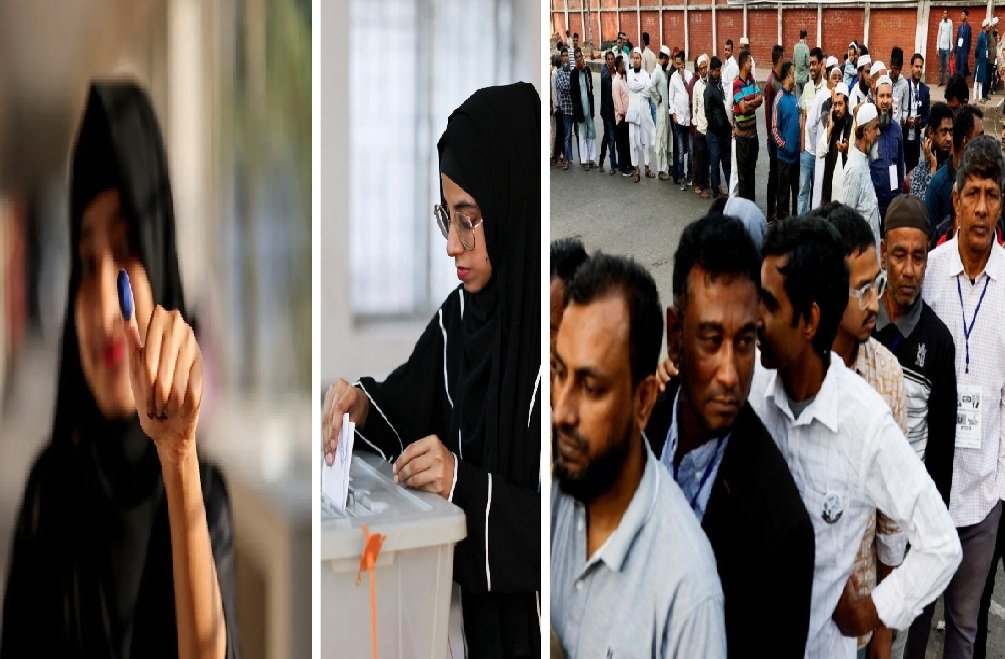
- Bangladesh has over 127.7 million registered voters, including millions of first-time voters, casting ballots at more than 42,000 polling stations nationwide. Polls close at 4:30 p.m., with counting to begin immediately afterward. Preliminary results are expected by February 13.
- The elections follow the first-past-the-post system for 300 direct seats. An additional 50 reserved seats for women will be allocated later through proportional representation.
- Voters are also participating in a national referendum on the July National Charter, a reform blueprint crafted under Yunus’ interim government. Proposed changes include:
- Limiting prime ministers to two terms (10 years total)
- Creating an upper house of parliament
- Restoring a neutral caretaker government system before elections
- Heavy security arrangements are in place nationwide, with international observers from the European Union, Commonwealth, and UN bodies monitoring the process.
Tarique Rahman casts his vote.
If last night’s ballot box stuffing has not altered the outcome already, he is the next Bangladesh PM. pic.twitter.com/PDKyIqP2gO— Deep Halder (@deepscribble) February 12, 2026
Regional Stakes and Foreign Policy Implications
The election outcome is expected to have significant geopolitical consequences. Under Hasina, Bangladesh cultivated close ties with India, though her later years saw increased engagement with China and Pakistan. The BNP is widely regarded as more balanced but generally pro-India, while Jamaat-e-Islami traditionally favors closer alignment with Pakistan and China.
Relations between New Delhi and Yunus’ interim government have remained uneasy, making the election outcome particularly consequential for regional diplomacy, trade, and security cooperation.
A Defining Moment for Democracy
As voters lined up across cities, towns, and rural heartlands, hopes ran high that this election could usher in a new democratic chapter after years of repression, disappearances, media censorship, and authoritarian governance.
“This is not just a vote—it is a verdict on our past and a mandate for our future,” Yunus said in a televised address, urging citizens to vote “joyfully, peacefully, and without fear.” He also appealed for a ‘Yes’ vote in the referendum, calling the reforms essential to prevent the return of autocratic rule.
The election, widely described as the world’s first national poll following a Gen Z-led political revolution, may prove decisive in determining whether Bangladesh can stabilize its fractured polity and institutionalize democratic reform.
Results are expected to begin emerging later tonight and into Friday.