

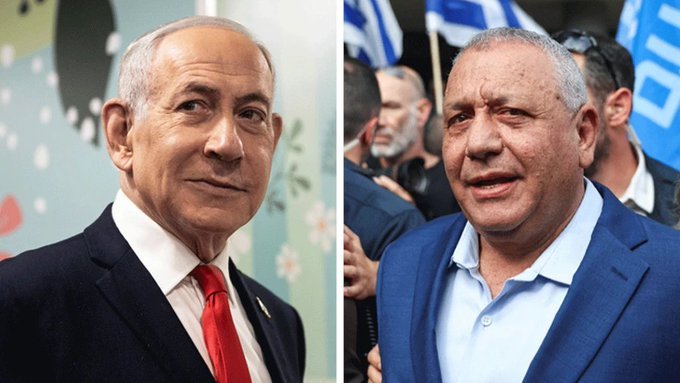
October 29: Israel Prime Minister Benjamin Netanyahu’s bloc has taken the lead in the general election count but remains well short of a parliamentary majority, with 89.8 per cent of ballots counted by Wednesday evening. The opposition alliance led by Yashar party chief Gadi Eisenkot is also short of the 61 seats required to form a government in the 120-member Knesset, leaving Israel facing uncertain coalition negotiations.
The Central Election Committee (CEC) projected Netanyahu’s bloc to win 53 seats against 48 for Eisenkot’s alliance. The two predominantly Arab parties, the Joint List and Ra’am, were on course to secure a combined 19 seats, a record that could give them considerable leverage in determining the next government.
The emerging results contradicted most pre-election opinion polls, which had consistently placed Eisenkot’s bloc ahead, although none had predicted a clear majority for either side. They also overturned the exit polls released by major broadcasters after voting ended at 10 pm on Tuesday, which had given the opposition a lead of two to three seats. As counting progressed overnight and into Wednesday, Netanyahu’s Likud and its allies moved ahead.
Shortly after 9 pm on Wednesday, Israel CEC reported that 89.8 per cent of votes had been counted, covering nearly all regular polling stations. Officials did not expect the outstanding ballots to dramatically alter the overall picture, although the final distribution of seats could still change.
An estimated 430,000 to 480,000 double-envelope ballots remained to be counted. Cast mainly by soldiers, prisoners, diplomats stationed abroad and others unable to vote at their designated polling stations, these ballots are processed separately to ensure that voters have not already voted elsewhere. Counting was scheduled to begin at 1 am on Thursday and was expected to conclude by Thursday evening. The CEC cautioned that the estimate was preliminary, as officials continued to receive and process ballots. The final official results are due on November 4.
With each Knesset seat estimated to represent approximately 40,000 votes, the outstanding ballots could influence the final seat distribution.
According to the CEC’s 2.32 pm update, Likud was the largest single party with 26 seats, followed by Eisenkot’s Yashar with 21.
READ: Soon After PM Modi Mocked Rahul, Cong Stuns BJP in Nagpur
🇮🇱 Israel records 77.7% turnout, highest in 27 years, but no clear winner.
Netanyahu’s bloc wins 53 seats, opposition 48, and Arab parties surge to a record 19.
Neither bloc reaches the 61-seat majority, raising the prospect of another election. https://t.co/2cEcggveZt
— Asia Nexus (@nexusasian) October 28, 2026
Naftali Bennett’s B’Yachad and Yousef Jabareen’s Joint List were each projected to win 12 seats. The Democrats had eight, while the far-right Otzma Yehudit, ultra-Orthodox Shas and United Torah Judaism, Ra’am, and Avigdor Liberman’s Yisrael Beytenu were each projected to secure seven seats. Finance Minister Bezalel Smotrich’s Religious Zionism was on course for six.
Three smaller parties failed to approach the 3.25 per cent electoral threshold. Yoaz Hendel’s Reservists-Economic party had 2.63 per cent of the vote, Ofer Winter’s People of Israel 1.61 per cent, and the ultra-Orthodox Charedi Public party just 0.19 per cent.
The projected outcome represents a significant setback for Netanyahu’s coalition, which currently holds 68 seats. His bloc, comprising Likud, Shas, United Torah Judaism, Otzma Yehudit and Religious Zionism, is projected to lose 15 seats, leaving it eight short of a majority.
Eisenkot’s alliance, comprising Yashar, B’Yachad, the Democrats and Yisrael Beytenu, is projected to secure 48 seats, 13 short of the threshold needed to govern independently.
Arabs Rise in Israel
The 19 seats projected for the Joint List and Ra’am could prove decisive. Their combined strength would be sufficient to help the opposition cross the majority mark if the two Arab-led parties agreed to support it and the opposition alliance accepted their backing. However, most parties in Eisenkot’s bloc, apart from the Democrats, have ruled out cooperating with them.
The result leaves Israel facing a potentially prolonged political deadlock. Neither Netanyahu nor Eisenkot has a clear route to a stable parliamentary majority without support from outside their respective alliances. The coming days are likely to be dominated by coalition calculations and negotiations as both camps seek a viable path to government.