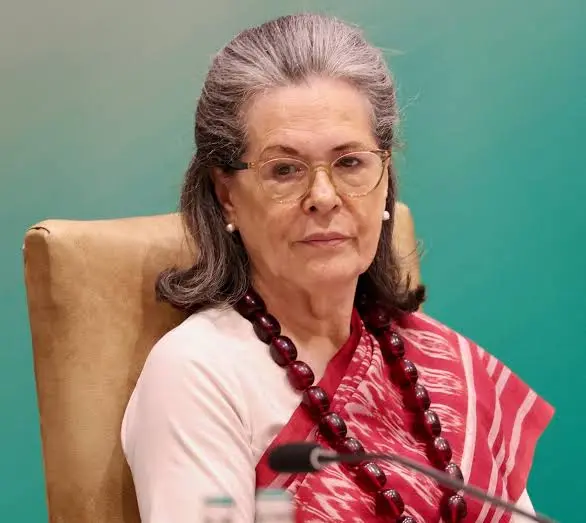
Defending MGNREGA’s legacy, Sonia Gandhi said the scheme empowered gram panchayats and curbed distress migration, accusing the Centre of weakening its core structure.
BY PC Bureau
New Delhi, December 20, 2025: The political battle over rural employment deepened on Saturday as Congress Parliamentary Party chairperson Sonia Gandhi mounted a sharp offensive against the Centre, a day after Parliament passed the Viksit Bharat Guarantee for Rozgar and Ajeevika Mission (Gramin) (VB-G RAM G) Bill to replace MGNREGA. Accusing the government of dismantling a hard-won rights-based law, she said the Modi government had “run a bulldozer over MGNREGA” and hollowed out its core guarantees.
In a video message, Sonia Gandhi argued that the legislation was not a mere renaming exercise but a fundamental reworking of the rural employment framework carried out without consultation or consensus. She alleged that the government had altered the structure and intent of the scheme arbitrarily, sidelining Parliament, stakeholders, and the opposition.
“This move goes far beyond removing Mahatma Gandhi’s name. The form and structure of MGNREGA have been changed without deliberation and without taking anyone into confidence,” she said.
‘A consensus law undone’
Recalling the passage of MGNREGA nearly 20 years ago, Sonia Gandhi said the law was enacted under then Prime Minister Dr. Manmohan Singh with cross-party consensus and was rooted in the constitutional promise of dignity and livelihood for the rural poor. She said the Act granted crores of people a legal right to employment, strengthened gram panchayats, and significantly reduced distress migration.
“MGNREGA was a concrete step towards realising Mahatma Gandhi’s vision of Gram Swaraj,” she said, adding that it empowered villages and gave economic security to farmers, labourers, and the landless.
She accused the Centre of systematically weakening the scheme over the past decade. “For 11 years, the interests of the rural poor have been ignored. By diluting this law, the government has attacked the livelihoods of crores of Indians,” she alleged.
भाई और बहनों.. नमस्कार
मुझे आज भी याद है, 20 साल पहले डॉ. मनमोहन सिंह जी प्रधानमंत्री थे, तब संसद में मनरेगा कानून आम राय से पास किया गया था। यह ऐसा क्रांतिकारी कदम था, जिसका फायदा करोड़ों ग्रामीण परिवारों को मिला था। खासतौर पर वंचित, शोषित, गरीब और अतिगरीब लोगों के लिए… pic.twitter.com/mjH4CfYRVe
— Congress (@INCIndia) December 20, 2025
‘Black law’ to be resisted
Terming the VB-G RAM G law a “black law”, Sonia Gandhi said the Congress would oppose it at every level. She emphasised that MGNREGA was never a party-driven programme but a national commitment to social justice.
“Twenty years ago, I fought for the right to employment for our poor brothers and sisters. Today, I remain committed to fighting against this black law,” she said, adding that lakhs of Congress workers were ready to mobilise against the changes.
READ: Eight Elephants Dead as Rajdhani Exp Derails in Assam Night Collision
READ:Epstein Files: Who’s Who in the Dark Circle of Power & Secrets
Passage amid protests and walkout
The VB-G RAM G Bill was passed by the Rajya Sabha on Friday through a voice vote, hours after its clearance in the Lok Sabha. Opposition parties protested strongly, objecting to the removal of Mahatma Gandhi’s name from the scheme and alleging that the Centre was shifting financial responsibility onto states.
Opposition members staged a walkout from the Upper House and demanded that the Bill be referred to a Select Committee for scrutiny — a demand the government rejected.
Union Agriculture Minister Shivraj Singh Chouhan defended the legislation, saying it would enhance welfare delivery and expand employment opportunities. He accused the Congress of politicising Mahatma Gandhi’s legacy and misleading rural workers.
What the new law provides
Under the new framework, the Bill guarantees 125 days of wage employment per rural household, an increase from the existing 100 days under MGNREGA. Employment will continue to be provided to adult members willing to undertake unskilled manual work.
The Centre–state cost-sharing ratio has been fixed at 60:40, while for Northeastern and Himalayan states and select Union Territories — including Uttarakhand, Himachal Pradesh, and Jammu and Kashmir — it will be 90:10.
Section 6 of the Bill allows state governments to notify in advance up to 60 days in a financial year during peak agricultural seasons such as sowing and harvesting, when work under the scheme may be limited.
While the government has pitched the new law as a reform aimed at efficiency and expanded coverage, the Congress maintains that the changes weaken the rights-based foundation of MGNREGA — setting the stage for a prolonged political confrontation over rural employment and social welfare.