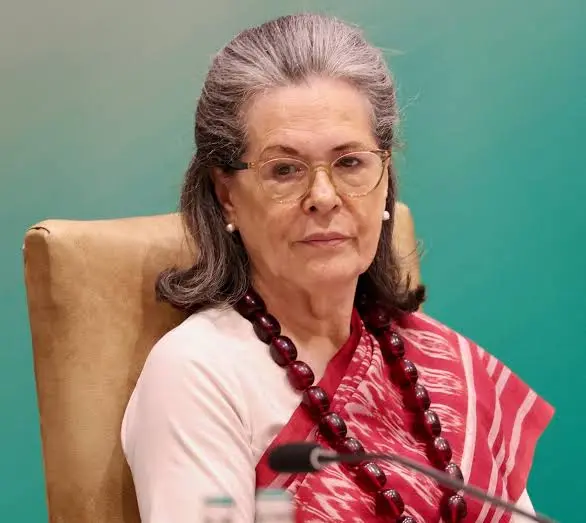
In an editorial, Sonia Gandhi said recent policy changes have diluted MGNREGA’s legal guarantee, weakened local governance, and shifted financial burdens onto states.
BY PC Bureau
New Delhi, December 22: Congress Parliamentary Party chairperson Sonia Gandhi has accused the Narendra Modi-led Union government of systematically weakening the Mahatma Gandhi National Rural Employment Guarantee Act (MGNREGA), warning that recent policy changes amount to a “bulldozed demolition” of one of India’s most significant social security programmes.
In an editorial published in The Hindu on Monday, Gandhi said MGNREGA, which guarantees 100 days of wage employment to rural households, is being eroded through a series of administrative and financial measures that undermine its legal mandate, decentralised structure, and social objectives.
MGNREGA became law in September 2005 during the tenure of Prime Minister Manmohan Singh. Enacted under Article 41 of the Constitution, the scheme provided a rights-based guarantee of employment and was passed unanimously by Parliament. Gandhi described it as one of the world’s largest social security initiatives, with extensive evidence of its transformative impact on the rural poor.
Financial squeeze and reduced guarantees
According to Gandhi, the Modi government has diluted the core idea of a legal employment guarantee by introducing bureaucratic controls and budgetary caps. She pointed out that while MGNREGA was designed as a demand-driven programme with uncapped funding, recent changes have imposed pre-determined state-wise allocations, effectively limiting the number of workdays available to rural households.
The editorial noted that the Union government has also altered the Centre–State cost-sharing pattern. While earlier the Centre bore 90% of the scheme’s cost, states are now required to shoulder a greater financial burden, including expenses beyond the Centre’s allocated limits. This shift, Gandhi argued, discourages states from providing employment and places additional strain on already stressed state finances.
Centralisation and weakening of local governance
Gandhi further criticised the rollback of MGNREGA’s decentralised character. She recalled that under the 73rd Constitutional Amendment, gram sabhas were empowered to plan and implement works under the scheme. However, she said the increasing reliance on centrally designed programmes such as the Panchayat-level Gram Panchayat Development Plan (GPDP) and alignment with national missions has diluted local decision-making.
She also flagged concerns over reduced autonomy of gram sabhas and the curtailment of social audits, which had earlier strengthened transparency and accountability at the grassroots level.
“MGNREGA realised the Mahatma’s vision of Sarvodaya (‘welfare of all’) and enacted the constitutional right to work. Its death is our collective moral failure – one that will have financial and human consequences for crores of India’s working people for years to come. It is… pic.twitter.com/0FTKZ6n35S
— Congress (@INCIndia) December 22, 2025
Impact on wages and rural livelihoods
MGNREGA has played a critical role in raising rural wages, reducing distress migration, and strengthening the bargaining power of landless workers, the editorial said. Gandhi warned that suppressing MGNREGA spending at a time when agricultural employment has risen for the first time in decades contradicts the government’s own employment objectives.
She noted that during the COVID-19 pandemic, MGNREGA served as a crucial lifeline for millions of displaced workers, helping the government reach the poorest and most vulnerable sections of society.
READ: Bomb Threats, Extortion: Imphal Valley Petrol Pumps to Shut
READ: Train Travel Gets Costlier as Railways Revise Passenger Fares
Delayed payments and technological hurdles
The editorial also highlighted persistent delays in wage payments and the increasing use of technology-driven compliance mechanisms, which Gandhi said have excluded genuine beneficiaries. She described these measures as part of a “death by a thousand cuts” strategy aimed at throttling the programme without formally abolishing it.
Broader erosion of rights
Placing MGNREGA within a larger constitutional context, Gandhi argued that the right to work is being undermined alongside other rights-based legislations. She cited changes to the Right to Information Act, the Right to Education Act, forest conservation rules, land acquisition laws, and the National Food Security Act as part of what she described as a broader pattern of weakening citizen protections.
Warning of long-term consequences
Gandhi concluded that dismantling MGNREGA would have “catastrophic consequences” for rural India, affecting livelihoods, wages, food security, and social stability. She urged the government to recognise the programme’s enduring relevance and protect the rights that safeguard India’s working population.