The Congress leader alleged that the India–US trade deal compromises farmers, MSMEs and strategic autonomy, sparking uproar in the Lok Sabha.
BY PC Bureau
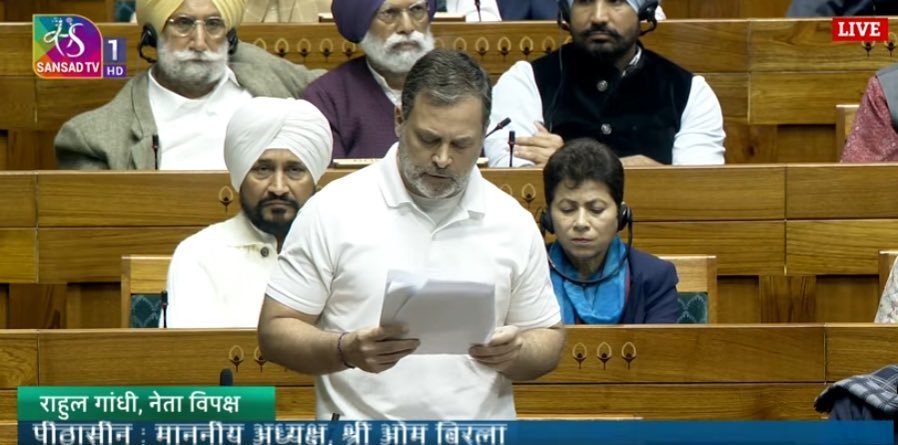
New Delhi, February 11, 2026 — In a high-voltage intervention during the Lok Sabha debate on the Union Budget 2026–27, Leader of Opposition Rahul Gandhi launched a blistering attack on Prime Minister Narendra Modi, accusing him of surrendering India’s sovereignty through the recently concluded India–US trade deal and allowing foreign pressure to dictate national policy.
Speaking amid repeated disruptions and appeals for order from the Chair, Gandhi alleged that the United States exercises a “grip” over India by exerting leverage over Modi, citing the US legal case involving industrialist Gautam Adani and unreleased portions of the Jeffrey Epstein files as key “pressure points.”
Employing a martial arts analogy, Gandhi said, “The foundation of martial arts is grip on the opponent. America has a grip on India today because it has a grip on Narendra Modi. The Epstein files and the Adani case are instruments of pressure.”
He claimed that this leverage forced India into a lopsided trade agreement that compromised national interests, pointing to what he described as steep tariff asymmetries, weakened data localisation norms, and constraints on India’s strategic autonomy in energy procurement, including reduced flexibility to source fuel from Russia.
Are you not ashamed of yourself?
Are you not ashamed of selling India?
Rahul Gandhi ji took Modi govt to the cleaners
He said compromised PM #EpsteinFiles pic.twitter.com/DfsZ4ecqqJ
— Armaan (@Mehboobp1) February 11, 2026
Gandhi repeatedly accused Modi of “selling Bharat Mata,” warning that the agreement would devastate farmers and small producers. “Are you not ashamed of selling India? By signing this deal, you have sold out the blood and sweat of our farmers,” he said, alleging that the pact would leave Indian agriculture and MSMEs exposed to unfair global competition.
Escalating his attack on what he termed “crony capitalism,” Gandhi targeted industrialists Gautam Adani and Anil Ambani, questioning why Adani had not faced comprehensive domestic investigation despite scrutiny abroad, and why Anil Ambani remained outside jail despite what he described as massive financial irregularities. He also named Union Minister Hardeep Singh Puri, alleging selective application of law.
“Two Indias are being created — one where billionaires are protected, and another where ordinary Indians are crushed,” Gandhi said, accusing the government of shielding corporate elites while unemployment, rural distress, MSME closures and declining household savings worsened.
Turning to the Budget, he dismissed it as “blind to real India,” saying it failed to address job creation, inequality, farm distress, youth unemployment, or economic stagnation. Instead, he alleged, it strengthened monopolies and deepened corporate concentration.
READ: Will LS Secretariat Reject Notice Against Speaker Om Birla?
Presiding Deputy Speaker Jagdambika Pal repeatedly intervened to restore order, cautioning Gandhi against making unverified allegations and urging him to confine remarks to the Budget. Treasury bench members frequently protested, leading to brief adjournments and heightened disorder in the House.
Parliamentary Affairs Minister Kiren Rijiju responded sharply, accusing Gandhi of indulging in conspiracy theories, misleading Parliament, and damaging India’s international credibility. He defended both the trade deal and the Budget, calling the Opposition leader’s remarks “reckless, defamatory and irresponsible.”
The confrontation unfolded amid continuing parliamentary deadlock, including protests over speaking time, microphone cut-offs, and broader accusations of institutional bias. Gandhi’s aggressive blend of sovereignty concerns, corporate accountability charges and economic critique signals a sharpened Opposition strategy ahead of key state elections, including West Bengal, as the Budget Session remains mired in volatility.
The government has previously rejected claims linking Indian political leadership to the Epstein files, dismissing them as baseless.