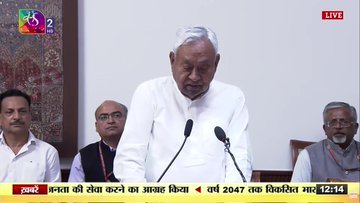
Nitish Kumar took oath as a Rajya Sabha MP, marking a calibrated transition that is set to end his long tenure as Bihar Chief Minister.
BY Navin Upadhyay
April 10, 2026
In a carefully orchestrated political transition, Nitish Kumar took oath as a Rajya Sabha member in New Delhi on Friday, signalling the beginning of the end of his record tenure as Bihar’s longest-serving Chief Minister.
The ceremony, attended by Bihar’s Deputy Chief Ministers Vijay Kumar Sinha and Samrat Choudhary of the BJP, underscored the coordinated transition within the National Democratic Alliance (NDA) and cleared the path for a new government in the state—likely to be headed by a BJP leader for the first time.
Though low-key, the oath-taking carried strong political symbolism. Nitish Kumar, often called “Sushasan Babu,” had already resigned from the Bihar Legislative Council in late March after winning the Rajya Sabha seat. His move to Parliament resolves the constitutional bar on holding positions in both a state legislature and the Union legislature, and signals a planned shift rather than a rupture in governance.
Sources indicate that he is expected to resign as Chief Minister shortly after returning to Patna, possibly around mid-April, paving the way for a new NDA government. A legislature party meeting and cabinet formation are likely to follow quickly, with the swearing-in of a new Chief Minister expected within days.
Nitish Kumar has dominated Bihar politics for over two decades, serving multiple terms since 2005. His tenure was marked by a focus on infrastructure, women’s empowerment, prohibition, and governance reforms, alongside efforts to build social coalitions among Extremely Backward Classes and Mahadalits in a state long grappling with poverty and migration.
At the same time, his career has been defined by frequent political realignments—moving between the BJP and the RJD-led alliances—earning him a reputation as one of India’s most pragmatic and adaptable leaders. His decision to move to the Rajya Sabha at 75 is widely seen as a calculated step to ease into a national role while allowing leadership transition in the state.
READ: Justice Yashwant Varma Resigns Amid Impeachment Heat
#WATCH | Nitish Kumar takes oath as a Member of the Rajya Sabha.
(Video Source: Sansad TV/YouTube) pic.twitter.com/ZFbf761Wrm
— ANI (@ANI) April 10, 2026
The presence of both Deputy Chief Ministers at the oath ceremony reflects the BJP’s growing dominance within the alliance. Samrat Choudhary has emerged as the frontrunner to succeed Nitish, with subtle public signals of support from the outgoing Chief Minister. Vijay Kumar Sinha is expected to play a key role in balancing internal party dynamics.
For the BJP, installing its own Chief Minister in Bihar would mark a significant political milestone, consolidating its position in a state historically shaped by caste-based and socialist politics.
Nitish Kumar’s transition to the Rajya Sabha does not signal a full political exit. He is expected to remain influential within the Janata Dal (United) (JD(U)), potentially continuing as its national president and guiding the new government from the sidelines. However, the party faces the challenge of maintaining relevance as a junior partner in an increasingly BJP-dominated alliance.
The shift marks the end of a defining era in Bihar’s politics. The opposition, led by Tejashwi Yadav, is likely to sharpen its attacks on governance, unemployment, and social justice issues as the political landscape resets.
While the transition appears smooth, Bihar’s volatile political history leaves room for uncertainty. Cabinet formation, caste balance, and governance delivery will be critical in determining whether the new leadership can sustain stability.
Nitish Kumar’s oath, therefore, is more than a procedural step—it is a pivotal moment in Bihar’s political evolution, marking a controlled exit by a leader who reshaped the state’s governance narrative while leaving behind a legacy of both reform and realignment.