A longtime company executive, Kimberley Powell has spent more than 18 years at Nvidia and worked directly under CEO Jensen Huang.
BY PC BUREAU
November 12 – Kimberly Powell, Nvidia’s vice-president of healthcare, has emerged as a central figure in the controversy surrounding chief executive Jensen Huang after a report alleged that the two had an extramarital relationship.
Powell, 48, is among Nvidia’s senior executives and has worked at the semiconductor giant for more than 18 years. She is responsible for the company’s worldwide healthcare business, overseeing the application of artificial intelligence, accelerated computing and visualisation technologies in medical imaging, drug discovery and life sciences.
The New York Times, in a report published on Wednesday, November 11, alleged that Huang, 63, had a relationship with Powell, who reportedly worked directly under him. The newspaper cited five people who had worked at Nvidia, who spoke on condition of anonymity.
The allegation has added to the controversy surrounding Huang, who has already acknowledged being unfaithful to his wife amid separate revelations about his relationship with Chinese businesswoman Alice Huang, who has been accused by US intelligence officials of having links to Chinese intelligence.
The two women are not related.
Who is Kimberly Powell?
Powell is Nvidia’s vice-president of healthcare and life sciences, a business that has become increasingly important as the company expands beyond conventional computing into artificial intelligence-powered medical research and healthcare applications.
According to her official Nvidia biography, she leads the company’s global healthcare business, including hardware and software platforms built around accelerated computing, AI and visualisation.
These technologies are used in several areas, including medical imaging, life sciences, drug discovery, healthcare analytics and the development of advanced medical devices.
Her responsibilities also include developing commercial strategies and partnerships to bring Nvidia’s computing platforms to healthcare companies, research institutions and pharmaceutical businesses around the world.
Powell joined Nvidia in 2008 with a specific mandate: to establish the company’s graphics processing units (GPUs) as accelerator platforms for medical imaging instruments.
Over the years, she helped expand Nvidia’s healthcare operations into a broader technology ecosystem involving medical research, biological computing and artificial intelligence.
From engineering to Nvidia’s healthcare business
Powell’s professional career began in engineering, with a focus on medical imaging technology.
She graduated in electrical engineering, specialising in computer engineering, from Northeastern University.
She subsequently pursued management education at the MIT Sloan School of Management and professional studies at Boston University.
Before joining Nvidia, Powell worked in hardware engineering and product development, including at Planar Systems, where her work focused on diagnostic imaging display systems.
Her experience in medical technology provided a foundation for her subsequent role at Nvidia, where she was tasked with developing business opportunities for the company’s GPU technology in healthcare and higher education.
When she joined Nvidia in 2008, her responsibilities included worldwide business development, market expansion and building strategic partnerships with universities and major healthcare companies.
Her work also involved promoting GPU-based computing among researchers working in areas such as computational chemistry, bioinformatics, machine learning and computer vision.
In March 2016, she was promoted to senior director of artificial intelligence business development, according to her LinkedIn career history.
By October 2017, she had risen to the position of vice-president of healthcare, a role she continues to hold, according to her professional biography.
What does Powell do at Nvidia?
Powell’s division focuses on applying Nvidia’s computing technology to healthcare and biological research.
Medical imaging is one of its major areas of application. Nvidia’s GPUs can accelerate the processing and analysis of complex medical images, helping researchers and developers build advanced imaging systems.
Another important area is drug discovery, where AI-powered computing can help researchers analyse biological data, model molecular structures and investigate potential treatments.
Nvidia has also been expanding its presence in digital biology, genomics, healthcare robotics and AI-assisted clinical applications.
Powell has represented the company at international technology and healthcare conferences, explaining how its computing platforms can transform medical research.
She has also been involved in promoting Nvidia’s healthcare initiatives and partnerships with pharmaceutical companies, hospitals, research institutions and technology start-ups.
Her work has included initiatives such as Nvidia BioNeMo, the company’s platform for AI-driven biological research and drug discovery, and MONAI, an open-source framework for medical imaging AI.
Powell has authored several articles on Nvidia’s corporate blog, covering developments in healthcare AI, medical devices, genomics and drug discovery.
Her position makes her one of the company’s important executives outside its traditional graphics processing and data centre businesses.
What did the New York Times report about Powell and Jensen Huang?
The New York Times reported on November 11 that Huang had an extramarital relationship with Powell, who was among approximately 60 executives reporting directly to him.
The newspaper said five people who had worked at Nvidia provided information about the relationship, which they said had been discussed within the company.
Two of the sources told the newspaper that video footage showed Huang and Powell being affectionate at a hotel in San Jose, California, during Nvidia’s annual GTC developer conference in March.
The New York Times said it had not independently viewed the footage.
According to three people briefed on the incident, a bystander recorded the interaction on a mobile phone. Huang’s security personnel allegedly noticed the recording and took the individual aside before asking the person to sign a non-disclosure agreement.
The newspaper also reported that Powell used cartoon depictions of Huang in a presentation at the GTC conference, where she spoke about the potential of artificial intelligence to accelerate advances in healthcare and biology.
When contacted by telephone on Wednesday and asked about his relationship with Powell, Huang reportedly responded: “I don’t think you should be talking to me directly.”
He then ended the call, according to the newspaper.
Nvidia declined to comment on the allegations, while Powell did not immediately respond to the newspaper’s request for comment.
Neither Powell nor Huang has publicly confirmed the reported relationship.
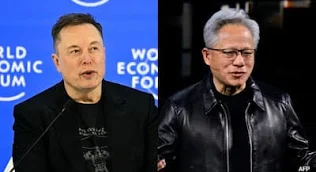
READ: Elon Musk Offers To Hire Jensen Huang If Nvidia Fires CEO Amid Affair Scandal: ‘Would Be An Honour’
Why the alleged relationship has raised Nvidia corporate governance questions
The Powell allegations have raised a potentially serious issue for Nvidia because of her reported position in Huang’s management chain.
According to the New York Times, Powell reported directly to the chief executive.
Nvidia’s code of conduct instructs employees to avoid situations in which their actions could create conflicts of interest, including those involving personal relationships. The company also states that it promptly investigates reports of misconduct.
Relationships between senior executives and employees reporting directly to them can raise concerns about managerial authority, preferential treatment, workplace fairness and conflicts of interest.
The central question is whether the reported relationship violated Nvidia’s internal policies or created circumstances requiring intervention by the company’s board.
There has been no public finding that either Huang or Powell violated company rules.
The controversy is particularly sensitive because Huang occupies the company’s most powerful executive position and has considerable influence over its operations and management structure.
How the Powell controversy is linked to Alice Huang
The latest allegation comes amid a separate controversy involving Alice Huang, a Chinese businesswoman associated with Singapore-based data centre company Megaspeed.
US intelligence officials reportedly suspected Alice Huang of having links to China’s Ministry of State Security, raising concerns that she could have been involved in an intelligence operation targeting the Nvidia chief.
The allegations have not been substantiated through publicly released evidence, and Beijing has rejected the accusations.
The New York Times and other publications have reported on Huang’s association with Alice Huang, whose Chinese name is Huang Le.
Jensen Huang acknowledged being unfaithful to his wife, Lori Huang, in a message to Nvidia employees on November 8.
“I was unfaithful to my wife. My actions hurt her and our children. There is no excuse for what I did. I am deeply sorry,” he wrote.
He did not identify the woman involved in that admission.
Nvidia’s board subsequently initiated an independent investigation into whether Huang had been targeted in a foreign intelligence operation.
The investigation is being led with the assistance of external legal counsel.
The Powell allegations constitute a separate controversy and have brought a new set of questions about Huang’s conduct and Nvidia’s internal governance.
Powell’s public profile amid Nvidia’s crisis
Powell has largely been known within the technology and healthcare industries for her work on AI applications rather than as a public-facing corporate personality.
Her role has nevertheless placed her at the intersection of two rapidly expanding sectors: artificial intelligence and healthcare.
She has spoken at Nvidia’s major developer conferences and international industry events, promoting the use of accelerated computing in medical research and biological sciences.
Her professional profile has also grown alongside Nvidia’s efforts to establish itself as a major technology provider for healthcare companies and research institutions.
The allegations involving Huang have now brought her into the spotlight for reasons unrelated to her professional achievements.
For Nvidia, the controversy presents a particularly difficult challenge. The company must address questions about its chief executive’s personal conduct while protecting its reputation, internal governance standards and position in the fiercely competitive global AI industry.
Neither the reported relationship nor any alleged breach of company policy has been formally established. The responses of Huang, Powell and Nvidia will therefore be important in determining how the controversy develops.