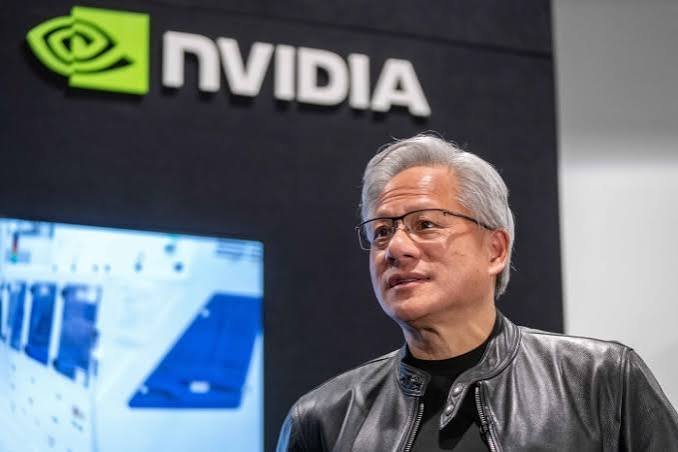
The market capitalisation of Nvidia approached $5 trillion in November before retreating to around $4.2 trillion. Even after the decline, its valuation remained marginally higher than India’s estimated 2026 nominal GDP.
BY PC Bureau
November 12: Nvidia, the American technology company co-founded by Jensen Huang, has grown so valuable that its market capitalisation has overtaken the estimated size of India’s economy, offering a striking measure of the scale of the global artificial intelligence boom.
The chipmaker’s market value touched approximately $4.94 trillion on November 1, 2026, putting it close to the historic $5 trillion milestone. That was significantly higher than India’s projected nominal gross domestic product (GDP) of $4.06 trillion for 2026, according to the International Monetary Fund’s October World Economic Outlook.
NVIDIA’s valuation has since retreated amid a sharp sell-off in its shares. Its market capitalisation stood at around $4.2 trillion on November 11, still marginally above India’s estimated GDP.
The comparison places NVIDIA among a very small group of corporations whose stock market valuations rival the annual economic output of major countries.
There is, however, an important distinction. Market capitalisation represents the stock market’s valuation of a company at a particular point in time. GDP measures the value of goods and services produced by an economy over a year. The two figures are not directly equivalent, even though the comparison illustrates NVIDIA’s extraordinary financial scale.
Jensen Huang: The man behind the AI chip giant
Everyone is talking about Jensen Huang’s affair now. Almost nobody is talking about what he told CBS about the next $15 trillion
In his CBS interview, the Nvidia CEO describes AI factories in one line:
“Energy comes in, intelligence comes out.”
His argument connects the technology to the economy:
0:00 — Electricity gave us the power to run machines
0:46 — The internet made information searchable
1:09 — AI adds software that reasons and uses tools
1:48 — A backyard photo becomes CAD files for builders
2:35 — What an AI factory actually produces
3:44 — Where $15T fits into a $100T global economy
4:49 — Why electricians and builders stand to benefitThe chain is simple:
Energy → AI factories → tokens → intelligence → industry
Data centers are becoming places where businesses produce intelligence, then put it to work.
That creates demand across chips, power, construction and electrical infrastructure.
Who captures more of the opportunity—chipmakers or the people building and powering the factories?
— Ben Stegeman (@BenStegTape) November 10, 2026
At the centre of NVIDIA’s transformation is Jensen Huang, its co-founder, president and chief executive officer.
Born in Taiwan in 1963, Huang moved to the United States as a child. He studied electrical engineering at Oregon State University, where he earned his bachelor’s degree, before completing a master’s degree in electrical engineering at Stanford University.
Before starting NVIDIA, he worked at semiconductor companies LSI Logic and Advanced Micro Devices (AMD).
In 1993, Huang joined hands with fellow engineers Chris Malachowsky and Curtis Priem to establish NVIDIA. The founders initially focused on graphics chips for personal computers and video games.
Huang has remained at the helm since the company’s inception. His decision to expand beyond conventional graphics processing and develop technology for high-performance computing helped transform NVIDIA into one of the most influential companies in the technology industry.
He is known for his trademark black leather jacket and his hands-on approach to product development. His leadership has also made him one of the world’s wealthiest business executives.
Huang holds degrees from Oregon State University and Stanford University. He has received several major industry honours, including the Semiconductor Industry Association’s Robert N. Noyce Award, and was elected to the US National Academy of Engineering.
READ: Meet Kimberly Powell: Nvidia Healthcare Chief Linked To Jensen Huang
NVIDIA: From gaming graphics to artificial intelligence
Founded on April 5, 1993, NVIDIA initially built its business around graphics processing units (GPUs), which enable computers to render images and video, particularly for gaming.
Its introduction of the GPU in 1999 marked a turning point in computer graphics. The technology subsequently found applications well beyond gaming.
A major development came in 2006, when NVIDIA introduced CUDA, a software platform that allowed developers to use GPUs for general-purpose parallel computing.
This opened the door to applications in scientific research, data processing, engineering and artificial intelligence.
The company’s technology gained particular importance after the 2012 breakthrough involving AlexNet, an artificial intelligence system trained using NVIDIA GPUs. The development helped demonstrate the potential of graphics processors in training advanced AI models.
The subsequent boom in generative AI, particularly after the arrival of ChatGPT in 2022, created enormous demand for NVIDIA’s chips.
Today, its products are used by major technology companies and data-centre operators to train and run artificial intelligence systems. Its portfolio includes GPUs, networking equipment, AI computing platforms, software and automotive technologies.
NVIDIA describes itself as a full-stack accelerated-computing and AI infrastructure company rather than merely a chip manufacturer.
The numbers behind NVIDIA’s rise
The company’s financial performance reflects the growing demand for AI infrastructure.
NVIDIA reported revenue of $215.9 billion for the financial year 2026, with net income of approximately $120.1 billion, according to its published company figures.
It employs more than 42,000 people across 38 countries and has built a large ecosystem of developers, technology companies and AI startups.
Its data-centre business has become the principal driver of growth, as companies invest heavily in computing infrastructure to develop and deploy increasingly sophisticated AI models.
NVIDIA’s GPUs have become central to this expansion because of their processing capabilities and the software ecosystem built around them.
NVIDIA’s market value and India’s economy
The comparison with India highlights the extraordinary valuation investors have assigned to companies positioned at the centre of the AI revolution.
The IMF estimates India’s nominal GDP at $4.06 trillion in 2026. NVIDIA’s market capitalisation was approximately $4.94 trillion on November 1, before falling to around $4.2 trillion by November 11.
At its peak, NVIDIA’s valuation was also higher than the projected nominal GDP of Japan, the United Kingdom and India, according to the same IMF estimates.
The company’s market value has been driven by expectations that artificial intelligence will reshape industries ranging from healthcare and finance to manufacturing, transportation and entertainment.
However, the recent volatility in its shares also illustrates the risks attached to such extraordinary valuations. Investors are closely watching AI spending, competition, the sustainability of chip demand and the returns technology companies can generate from their investments.
For now, NVIDIA’s rise under Huang’s leadership remains one of the most consequential corporate transformations of the technology era.