BY PC Bureau
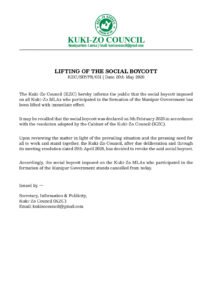
May 20, 2026: A significant political development in Manipur’s ongoing ethnic crisis has emerged with the Kuki-Zo Council (KZC), the apex body representing the Kuki-Zo community, announcing the immediate withdrawal of its social boycott against Kuki-Zo MLAs who joined the state government earlier this year.
The decision is being seen as a potential step toward internal reconciliation within the Kuki-Zo community, even as broader ethnic tensions in the state remain unresolved.
The social boycott was imposed on February 5, 2026, a day after the end of President’s Rule and the swearing-in of the BJP-led government headed by Yumnam Khemchand Singh.
It targeted Kuki-Zo MLAs who were eager to accept ministerial roles, including Nemcha Kipgen, who was appointed Deputy Chief Minister. The KZC had strongly opposed their participation, calling it a violation of the “Lungthu Resolution” adopted on January 13, 2026.
The resolution—endorsed by Suspension of Operations (SoO) groups, Kuki-Zo MLAs, and the Council—had called for political unity and barred participation in any state government without written assurances for a negotiated settlement, including demands for a Union Territory with Legislature under Article 239A.
READ: Special Story: Manipur, Nagaland Top NIA Most-Wanted List
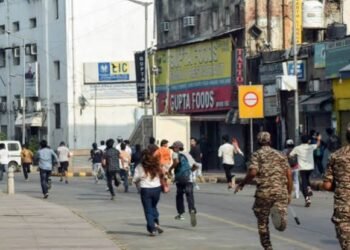
Following the boycott announcement, affected MLAs, who supported the BJP-led government, faced restrictions on public engagement, with the community urged to avoid all social, customary, and religious association with them. The move triggered protests, shutdowns, and tensions, particularly in districts such as Churachandpur.
Why the Boycott Was Withdrawn
In its latest resolution dated April 29, 2026, the KZC said the decision followed a review of the “prevailing situation” and the need for unity and collective action.
The Council noted that continued fragmentation within the community could weaken its political negotiating position amid ongoing dialogue efforts with both state and central authorities.
The KZC has lifted its social boycott call amid ongoing tensions involving reported Kuki-Zo–Naga clashes, incidents of violence in hill districts, and continuing concerns over brutal killings of three Baptist church leaders and abductions and missing civilians. Community sources also allege that several villagers remain unaccounted for in connection with recent episodes of unrest, including cases involving church leaders and civilians in affected areas.
The decision comes at a sensitive time in Manipur’s hill regions, where sporadic violence, mistrust between communities, and unresolved hostage concerns continue to fuel instability.
While the boycott has now been withdrawn, the broader situation on the ground remains volatile, with the Kuki-Zo leadership continuing to push for security assurances and a long-term political settlement.
Political and Peace Process Implications
The lifting of the boycott is expected to ease social pressure on Kuki-Zo MLAs, allowing them greater reintegration into community and political life. It may also improve administrative coordination in the state assembly.
However, core political demands remain unchanged. The Kuki-Zo leadership continues to push for a long-term settlement involving greater autonomy or a Union Territory structure.
Analysts note that the move may reflect pragmatic considerations, including internal fatigue, prolonged displacement, and the need for a unified negotiating front.
At the same time, emerging tensions in parts of the hill districts, including reported Kuki-Naga frictions, underline the complexity of the broader security landscape.