



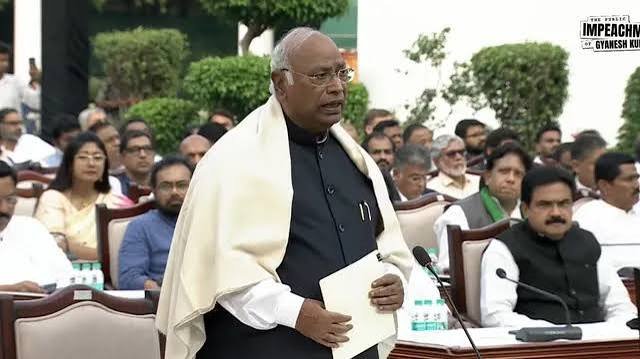
At a symbolic public impeachment proceeding in New Delhi, INDIA bloc leaders renewed allegations of electoral manipulation and accused the Election Commission of undermining voter rights through the Special Intensive Revision of electoral rolls. Kharge sought Gyanesh Kumar tried for treason.
BY PC Bureau
New Delhi, October 31, 2026: The INDIA bloc on Saturday staged a symbolic public impeachment proceeding against Chief Election Commissioner Gyanesh Kumar, with Congress president Mallikarjun Kharge accusing him of undermining the independence of the Election Commission and facilitating what the opposition describes as “vote theft”. Kharge went further, saying the CEC should face a trial for treason over his alleged conduct.
The event, held at Kharge’s residence on Rajaji Marg, was chaired by former Lok Sabha Speaker Meira Kumar. It followed the rejection of formal notices submitted by 193 opposition MPs seeking Kumar’s removal around seven months ago. Kharge alleged that the notices had been dismissed without adequate consideration.
Addressing the gathering, Kharge accused the CEC of functioning under the influence of Prime Minister Narendra Modi and Union Home Minister Amit Shah.
“CEC Gyanesh Kumar is running the Commission under the direct instructions of the Prime Minister and the Home Minister,” he alleged.
Kharge maintained that the symbolic proceedings were not motivated by personal hostility towards the CEC but were intended to defend the credibility of a constitutional institution. He said the Election Commission must function impartially and retain public confidence, particularly when it comes to protecting the voting rights of vulnerable communities, women and young people.
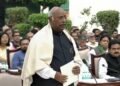
VIDEO | Delhi: At symbolic ‘public impeachment’ of CEC Gyanesh Kumar, Congress president Mallikarjun Kharge says, “Not fighting to protect ‘infiltrators’, we are fighting for genuine voters.”
(Source: Third Party)
(Full video available on PTI Videos – https://t.co/d8jp61yd2p) https://t.co/4JB5TF5CZO
— Press Trust of India (@PTI_News) October 31, 2026
Kharge alleged that genuine voters were being removed from electoral rolls through the Commission’s actions and warned that such deletions could undermine the democratic process.
The Congress president also accused the BJP-led government of using a range of political and institutional measures to retain power since 2014. He cited defections, the use of central investigative agencies and electoral bonds, and alleged that the latest method involved manipulating electoral rolls.
“Since 2014, every possible conspiracy has been hatched to seize and retain power… and now they are stealing votes,” Kharge alleged, claiming that there were hundreds of instances of electoral manipulation.
A major part of his criticism focused on the Chief Election Commissioner and Other Election Commissioners (Appointment, Conditions of Service and Term of Office) Act, 2023. The legislation was passed after the suspension of 145 opposition MPs from Parliament, according to Kharge, who argued that the law had weakened safeguards against political interference in the Election Commission.
Kharge objected particularly to the immunity provisions under the legislation, claiming that Election Commissioners had been given an unusually broad protective shield. Kharge alleged that the law could discourage accountability and enable electoral irregularities to go unchallenged.
READ: Delhi Court Issues Fresh Bailable Warrants Against Dhruv Rathee
The opposition leader also attacked the Election Commission’s ongoing Special Intensive Revision (SIR) of electoral rolls, alleging that the exercise was being used to delete voters considered unfavourable to the BJP. He rejected the government’s emphasis on identifying outsiders and infiltrators, arguing that the priority should be to protect the voting rights of every eligible Indian citizen.
Kharge invoked India’s constitutional history to underline the importance of universal adult franchise. He recalled that India granted voting rights to all adult citizens, irrespective of gender, caste or social background, when the Constitution came into force. Several Western democracies, by contrast, took decades longer to extend equal voting rights to women.
He also alleged that the Rashtriya Swayamsevak Sangh had opposed universal adult franchise during the formative years of independent India.
The mock impeachment was organised as a political protest against the rejection of the opposition’s formal removal notices. It sought to keep pressure on the Election Commission over allegations of bias, electoral roll revisions and the safeguards governing the appointment and functioning of election commissioners.
The charges levelled by Kharge represent the opposition’s political position and have not been established as findings of wrongdoing against the CEC. The larger confrontation, however, reflects the widening dispute between the INDIA bloc and the Election Commission over electoral integrity, the SIR exercise and the independence of the institution responsible for conducting elections.



Comments 1