From Subhash Chandra and Anil Ambani-linked companies to Videocon and Alok Industries, creditors have suffered enormous haircuts in several high-profile insolvency cases. Is the IBC resolving bad debt—or shifting the losses?
BY Navin Upadhyay
August 28: India’s insolvency system was created to rescue viable businesses, maximise the value of distressed assets and ensure that lenders recover as much as possible from failed companies. But a series of extraordinary cases is raising a more uncomfortable question: how much of the cost of corporate failure is ultimately being transferred to banks, shareholders, depositors and, in the case of public-sector lenders, taxpayers?
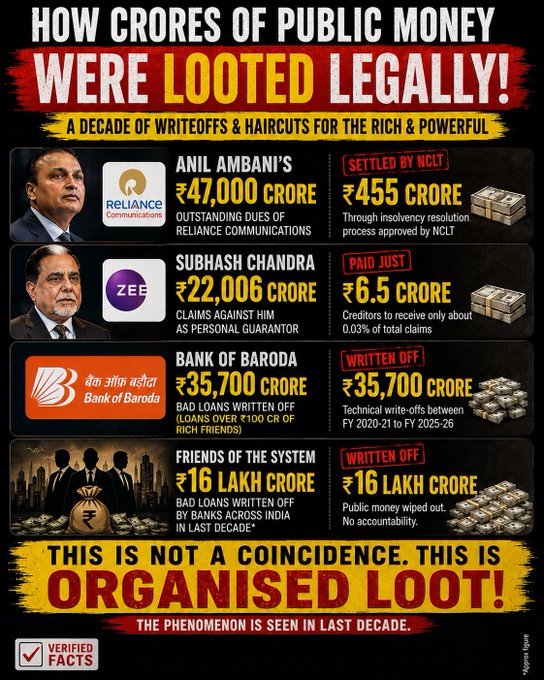
The latest example is the personal insolvency case of Essel Group founder Subhash Chandra. The NCLT has approved a repayment plan under which creditors will receive ₹6.25 crore, with another ₹25 lakh earmarked for insolvency-process costs, against admitted claims of about ₹22,006.57 crore. That amounts to a recovery of roughly 0.03 per cent and a haircut of about 99.97 per cent.
The case is already facing resistance from lenders. HDFC Bank and LIC Housing Finance are considering challenging the order. Creditors opposing the plan had questioned the exceptionally low recovery and the basis on which the repayment proposal was accepted.
There is also an important dispute over the numbers. Chandra has said that media reports have conflated total claims filed with the claims actually relevant to his personal insolvency proceedings, arguing that the latter amounted to about ₹3,992 crore. The ₹22,006.57 crore figure, however, is the amount of admitted claims reflected in the NCLT proceedings and on which the approved plan is based.
Either way, the case exposes the extraordinary gap that can exist between the face value of corporate debt and what creditors ultimately recover.
The Anil Ambani cases raise similar questions
The Subhash Chandra case is not the only recent example of exceptionally large corporate debt being resolved for a small fraction of the claims.
In the insolvency proceedings involving Reliance Communications Infrastructure Ltd (RCIL), an Anil Ambani group company, the NCLT Mumbai Bench approved a resolution plan valued at roughly ₹455.9 crore against admitted claims running into tens of thousands of crores.
If True many congratulations to my friend Subhash.Banks and Government have admitted having recovered Rs 14,100 crores from me against a Judgement debt of Rs 6203 crores. Many more borrowers have settled at a fraction. Indian Debt Resolution Justice I presume. No media questions. pic.twitter.com/5uwxYSAX8H
— Vijay Mallya (@TheVijayMallya) August 26, 2026
The comparison needs some caution because a significant portion of the claims involved corporate guarantees and contingent liabilities rather than straightforward cash loans. Such claims cannot automatically be treated as equivalent to secured cash advances. Nevertheless, the enormous difference between the claims admitted and the value realised illustrates the scale of losses that can arise when highly leveraged corporate structures collapse.
The RCIL case is part of a much wider set of insolvency and personal-guarantee proceedings involving companies associated with the Reliance Anil Dhirubhai Ambani Group.
READ: Heartbreaking. Unforgettable. Human. Standout Videos from the Nepal Disaster
Videocon, Alok Industries and other huge haircuts
The phenomenon predates the latest high-profile cases.
The Videocon group insolvency process involved admitted claims of roughly ₹64,839 crore, while the resolution plan offered about ₹2,962 crore. That represented a recovery of less than 5 per cent and a haircut of about 95.8 per cent.
Alok Industries offers another example. Claims were around ₹29,500-30,000 crore, while the resolution plan involving Reliance Industries and JM Financial Asset Reconstruction Company was worth roughly ₹5,000 crore, resulting in a haircut in the mid-80 per cent range.
In Siva Industries, claims were around ₹4,864 crore while the approved resolution provided only a few hundred crore, resulting in a haircut of more than 90 per cent.
Other cases involving companies such as Deccan Chronicle, Ushdev International, Nagarjuna Oil and various steel and infrastructure companies have also produced recoveries far below the original claims.
The pattern is impossible to ignore: once a large corporate account enters deep distress, the amount finally recovered can be a small fraction of the original lending.
But there is a crucial distinction between saying that and saying that the entire difference is automatically a taxpayer loss.
What the numbers actually tell us
The IBC does not promise creditors recovery of the original loan amount. It attempts to maximise the value that can actually be recovered from a distressed company.
By the time a company reaches insolvency, its assets may have lost value, operations may have collapsed, customers and employees may have disappeared, and litigation may have accumulated. A resolution buyer is therefore purchasing a distressed business, not simply taking over the original loan book.
This is the central argument made by defenders of the system.
A creditor may recover only 10 per cent or 20 per cent of its claim under a resolution plan, but liquidation could theoretically produce even less. The Committee of Creditors is therefore permitted considerable commercial discretion in deciding whether a particular offer represents the best available outcome.
The Supreme Court has repeatedly recognised the commercial wisdom of the CoC, subject to the legal framework governing the insolvency process.
The problem arises when the public is asked to accept enormous haircuts without sufficient information about how the assets were valued, what competing bids were received, what recovery was possible from promoters and guarantors, and why a particular offer represented the best available outcome.
That is where transparency becomes critical.
Bank of Baroda provides a glimpse of the larger problem
Recent data obtained under the RTI Act from Bank of Baroda provides another window into the scale of losses associated with large loan accounts.
Between FY2020-21 and FY2025-26, the state-owned bank technically wrote off ₹35,715 crore relating to borrowers whose outstanding loans were ₹100 crore or more. During the same period, it reported cumulative recoveries of ₹9,946 crore from such accounts.
The bank also disclosed ₹7,817 crore in write-offs or haircuts associated with settlements involving borrowers with dues of ₹100 crore or more.
But here again, terminology matters.
A technical write-off is not the same as a waiver of the debt. It is primarily an accounting treatment under which the loan is removed from the bank’s books after provisions have been made. Recovery action can continue even after a technical write-off. Bank of Baroda itself described the figures in those terms.
That distinction is important because claims that “₹35,715 crore was simply forgiven” would be misleading.
What is nevertheless troubling is the lack of transparency about who the biggest beneficiaries are. Bank of Baroda declined to disclose the identities of the large borrowers, citing exemptions under the RTI Act.
For a public-sector bank, that naturally raises a broader public-interest question: if the banking system has absorbed enormous losses on large accounts, should citizens not be able to know which categories of borrowers generated those losses and how much was subsequently recovered?
The ₹16-lakh-crore write-off claim needs to be handled carefully
There is another claim frequently circulated in political debate: that banks wrote off around ₹16 lakh crore for the Adani group.
That is incorrect.
Banking-system write-offs of roughly that order over a decade refer to all categories of borrowers across the banking system, not one corporate group.
Adani-linked entities have acquired stressed assets through the IBC process, and some of those acquisitions have involved substantial reductions from the claims originally filed by lenders. But those transactions cannot be used to attribute the entire national write-off figure to the Adani group.
The larger and more defensible argument is that large corporate borrowers account for a substantial share of the banking system’s major bad-loan losses, particularly during periods of aggressive corporate lending and infrastructure stress.
Why critics call it an “organised haircut economy”
The phrase “organised loot” is political language, not a legal description. But the criticism behind it deserves examination.
Critics point to four recurring features.
First, the size of the haircuts. In some headline cases, creditors recover less than 1 per cent of the admitted claims.
Second, opacity. Citizens often cannot easily determine which lenders took the losses, who ultimately bought the distressed assets, what competing offers were received and how the final valuation was determined.
Third, valuation questions. When resolution values are close to liquidation values, an obvious question is whether the company was genuinely rescued at the best possible price or whether years of delay had already destroyed most of its economic value.
Fourth, unequal treatment. Ordinary borrowers can face relentless recovery proceedings over relatively modest debts, while a corporate group owing thousands of crores may eventually negotiate a resolution involving an extraordinary reduction in its obligations.
That contrast has obvious political and social consequences.
But is the IBC actually worse than what came before?
Not necessarily.
This is the strongest argument against portraying every haircut as evidence of wrongdoing.
Before the IBC came into force in 2016, India’s bad-loan system was notorious for prolonged litigation, repeated restructuring, evergreening and companies remaining in limbo for years.
The IBC was designed to change that. It shifted the process towards creditors, imposed deadlines and created a mechanism through which distressed businesses could be sold rather than allowed to deteriorate indefinitely.
A 70 per cent haircut accompanied by the preservation of a functioning business and thousands of jobs may therefore be economically preferable to a 100 per cent loss after another decade of litigation.
The real question is not whether haircuts should exist.
It is whether the haircut represents the maximum recovery realistically available or merely the easiest exit from a difficult account.
The bigger issue is accountability
The Subhash Chandra case is particularly striking because the difference between the admitted claims and the proposed repayment is so vast that it inevitably invites scrutiny.
Creditors holding 80.81 per cent of the voting value supported the repayment plan, according to reports.
That fact is central to the defence of the order: the creditors themselves, rather than the tribunal, ultimately backed the commercial proposal.
But it also raises another question.
If creditors representing the overwhelming majority of voting value can approve a recovery of roughly 0.03 per cent, what mechanism ensures that the interests of minority creditors, depositors and ultimately the public are adequately protected when public-sector institutions are among the lenders?
That is the debate India needs.
The IBC was never meant to guarantee that banks would recover every rupee they lent. Nor should every failed business be treated as evidence of fraud or cronyism.
But when ₹22,000 crore-plus in admitted claims can result in a ₹6.5-crore payout, when other large corporate insolvencies produce 90-99 per cent haircuts, and when public-sector banks simultaneously report tens of thousands of crores in technical write-offs, the system owes the public more than a simple assertion that the Committee of Creditors exercised its “commercial wisdom.”
It owes the public transparency about who lent the money, who lost it, who acquired the assets, how those assets were valued, what alternatives were available and why the final recovery was considered the best possible outcome.
That is the line between a functioning insolvency regime and an opaque mechanism for socialising corporate losses.
The numbers do not prove that India has an organised system of corporate loot. But they do establish something less dramatic and perhaps more important: the consequences of large corporate credit failures are repeatedly absorbed by the financial system, while the people responsible for the original borrowing are not necessarily the ones who bear the full economic cost.
That is a problem of accountability worth investigating.