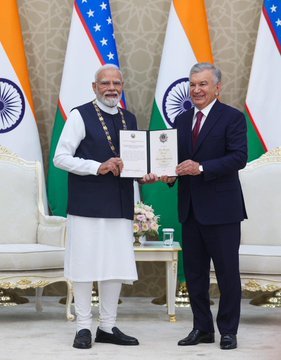
PM Modi’s fourth visit to Uzbekistan brought a major diplomatic honour as President Mirziyoyev conferred the country’s highest state award on the Indian Prime Minister.
BY PC Bureau
August 30: Energy security has emerged as a key pillar of India’s expanding partnership with Uzbekistan, with the two countries agreeing to establish a long-term arrangement for uranium supplies as they elevated their bilateral relationship to a Comprehensive Strategic Partnership on Sunday.
The agreement was reached during Prime Minister Narendra Modi’s talks with Uzbek President Shavkat Mirziyoyev at the Kuksaroy Presidential Palace in Tashkent. The two leaders reviewed the full spectrum of bilateral ties, with energy, trade, urban development and institutional cooperation featuring prominently in their discussions.
Modi said the two sides would put in place a durable framework for uranium supplies, adding a strategic energy dimension to a relationship that has steadily expanded in recent years.
The leaders also formalised three sister-city and sister-state partnerships and called for a clear roadmap to ensure that these arrangements translate into concrete cooperation rather than remain largely symbolic.
Sharing my remarks during the press meet with President Mirziyoyev of Uzbekistan. @president_uz https://t.co/gNUxFDq0Qj
— Narendra Modi (@narendramodi) August 30, 2026
READ: Major Dhyan Chand’s Birthday: From National Celebration to Token Ritual
Urban development was another area of focus. Modi highlighted Uzbekistan’s ambitious New Tashkent project alongside India’s GIFT City in Gujarat as examples of large-scale urban development. He invited an Uzbek delegation to visit Gujarat to study India’s experience in city planning, technology and project implementation.
The visit also carried considerable ceremonial significance. During his fourth visit to Uzbekistan, Modi was conferred the Order of “Oliy Darajali Dustlik”, the country’s highest state honour, by Mirziyoyev. The two leaders embraced after the conferment.
Modi arrived in Tashkent on Saturday and received a ceremonial welcome before travelling with Mirziyoyev from the airport to the presidential palace. The two leaders also held a dinner meeting on Saturday evening.
Beyond uranium and urban development, India and Uzbekistan discussed strengthening institutional mechanisms for bilateral cooperation. These include a foreign-minister-level coordination council, an upgraded joint commission and a joint business summit.
The two sides are also looking to significantly expand economic ties, with a bilateral trade target of $5 billion by 2030 forming part of the broader push to deepen commerce, energy cooperation and connectivity.
The elevation of ties to a Comprehensive Strategic Partnership marks a significant step in India’s engagement with Central Asia, with both sides seeking to give greater institutional depth and long-term direction to their relationship.
For India, the proposed uranium arrangement is particularly significant as New Delhi continues to diversify its nuclear fuel supply sources. For Uzbekistan, closer engagement with India offers opportunities for cooperation in technology, infrastructure, urban development, trade and other sectors.
The agreements reached in Tashkent suggest that the relationship is moving beyond diplomatic engagement towards a more structured economic and strategic partnership.