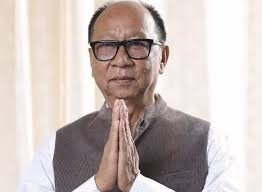
With the KZC agreeing to meet Chief Minister Yumnam Khemchand Singh, Manipur may be witnessing the first cautious step towards dialogue after years of ethnic estrangement and political hostility.
BY PC Bureau
March 20, 2026: In a state scarred by nearly three years of ethnic strife, even a formal invitation can carry unusual political weight.
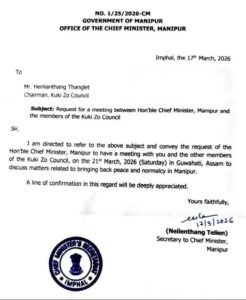
A letter issued from the Office of the Chief Minister of Manipur on March 17, 2026, inviting Chairman Henlianthang Thanglet and members of the Kuki-Zo Council (KZC) for talks in Guwahati on March 21, may appear administrative on the surface. Yet, in the context of Manipur’s prolonged ethnic crisis, it represents something more significant: a cautious but notable attempt by the new state government to open a channel with one of the most influential Kuki-Zo civil bodies.
The proposed meeting, convened “to discuss matters related to bringing back peace and normalcy in Manipur,” comes at a politically sensitive moment. A new BJP-led government under Chief Minister Yumnam Khemchand Singh assumed office in February 2026 after a period of President’s Rule, inheriting a deeply polarised state in which ethnic distrust has hardened into political and geographic separation.
This outreach, therefore, is not merely procedural. It is a test of intent.
The KZC, despite having opposed its MLAs joining the state government, has decided to accept the invitation.
“We had not asked for talks. It is an initiative on the part of the state government. We made it clear that we could not go to Imphal to hold any discussion. So, Guwahati has been decided as a neutral venue,” said KZC spokesperson Ginza Vualzong.
Ginza refused to divulge what might transpire during the talks, but sources said the KZC is expected to place its own set of demands before the Chief Minister and seek his support for the creation of a separate Union Territory for the Kuki-Zo people. The ongoing standoff in Ukhrul between Kukis and Tangkhul Nagas is also expected to figure in the discussions.
However, the KZC may find it difficult to justify holding talks with the Chief Minister. During the last three years, Kuki civil society organisations have not held any direct consultation with the state government. The KZC staged massive protests in February after an MLA from the community — Nemcha Kipgen — joined the government as Deputy Chief Minister.
Speaking to the media at the time, the KZC had said: “The participation of Kuki-Zo MLAs in the formation of the Manipur government is viewed as tantamount to joining the enemy. There is a strong belief that these MLAs have prioritised their political careers over the pain, suffering, and sentiments of their own people.” It described the unrest as public anger “spilling” onto the streets. They also gave call for boycott of the MLAs, who joined the government.
Yet in the recent past, Kuki-Zo leaders, including the MLAs, appear to have moved gradually towards engaging with the state government.
The Chief Minister’s gesture may also be intended to send a message to the Kuki-Zo community that its leaders are beginning to come to terms with political realities and are prepared, at least tactically, to reopen lines of communication.
A conflict far from resolved
Since violence erupted in May 2023, Manipur has remained divided along ethnic lines, with the valley-dominant Meitei community and the hill-based Kuki-Zo tribes locked in a conflict rooted in competing claims over land, identity, political representation, and affirmative action. The result has been devastating: hundreds dead, tens of thousands displaced, and a society fractured in ways that go beyond immediate violence.
What began as communal unrest evolved into a prolonged crisis of governance and legitimacy. Relief camps became semi-permanent, normal movement across ethnic lines collapsed, and the state’s authority came under increasing strain. In that environment, political symbolism began to matter almost as much as policy.
The Kuki Zo Council emerged during this period as a key civil and political voice articulating the Kuki-Zo position, particularly the demand for a separate administrative arrangement in the form of a Union Territory with legislature. That demand hardened after repeated accusations within the community that the state government had failed to protect Kuki-Zo interests or inspire confidence in its neutrality.
Why the invitation matters
The invitation from the Chief Minister’s Office is significant because it acknowledges, at least implicitly, that peace in Manipur cannot be pursued through formal government structures alone. The KZC is not just another organisation on the sidelines; it has become an influential platform capable of shaping public opinion and political direction within the Kuki-Zo community.
By reaching out directly to the KZC chairman, the government appears to be recognising that any meaningful peace process will require engagement with those who command moral and political authority on the ground, not just those who hold office.
Tactical move or genuine shift?
The larger question is whether this outreach marks a substantive shift in the state government’s approach or merely a tactical adjustment. There are reasons for both hope and caution.
READ: Iran Publicly Executes Teen Wrestler, Two Protesters in Qom
On one hand, the new government appears to recognise that exclusionary or one-sided political management cannot stabilise Manipur. Direct engagement with the KZC suggests an awareness that the crisis cannot be contained through administrative order alone.
On the other hand, unless dialogue eventually addresses the deeper political grievances at the heart of the Kuki-Zo position, the invitation may be seen as an attempt to manage unrest rather than resolve it. Peace processes lose credibility when they focus only on restoring calm without confronting the reasons calm collapsed in the first place.
That is the narrow path before the government: it must show enough flexibility to make dialogue meaningful without losing political ground elsewhere in the state.
A small gesture with heavy stakes
This invitation is not a breakthrough. It does not alter the deep fault lines that continue to divide Manipur. It does not guarantee reconciliation, nor does it bridge the gulf between demands for peace and demands for political reorganisation.
Whether the March 21 meeting in Guwahati becomes the start of a more serious peace process or joins the long list of missed opportunities will depend on what follows the handshake, if it happens at all.
For now, Manipur remains suspended between exhaustion and expectation — watching closely to see whether this tentative step leads anywhere firmer.