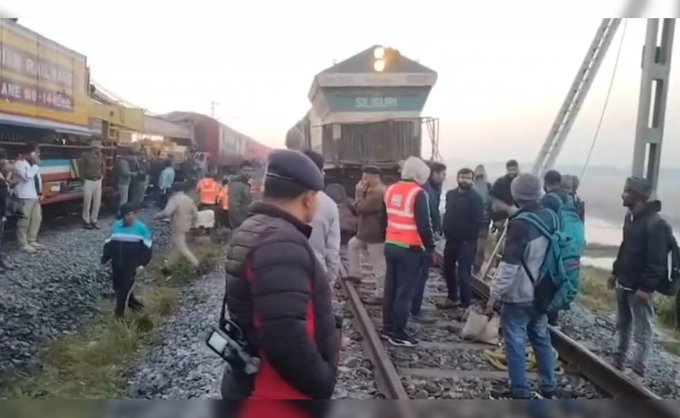
The collision occurred around 2.17 am on a forested stretch not marked as an elephant corridor. Despite emergency braking by the Rajdhani Express pilot, the train struck the herd, disrupting rail traffic across the Northeast.
BY PC Bureau
December 20, 2025: At least eight elephants were killed and one calf injured after a herd collided with the newly-introduced Sairang–New Delhi Rajdhani Express in Assam’s Hojai district early Saturday, triggering the derailment of the locomotive and five coaches and disrupting rail services across the Northeast.
The accident occurred around 2.17 am, officials said. The Rajdhani Express, which connects Sairang near Aizawl in Mizoram to Anand Vihar Terminal in Delhi, struck the herd while passing through a forested stretch approximately 126 km from Guwahati.
Forest officials confirmed that eight elephants died on the spot, while an injured calf was rescued and shifted for treatment. Local residents said the herd comprised around eight to nine animals that suddenly emerged on the tracks in the darkness.
Despite the severity of the collision, no passenger injuries or fatalities were reported, railway authorities said.
READ: Epstein Files Latest: No Indian Link Debunks Social Media Hype
Emergency Braking Failed to Prevent Impact
According to officials, the locomotive pilot spotted the elephants on the track and applied emergency brakes. However, the train could not stop in time, and the animals reportedly ran into the path of the moving train, leading to a powerful impact that caused the engine and five coaches to derail.
Significantly, the accident site is not a designated elephant corridor, raising fresh concerns about elephant movement beyond mapped habitats and the adequacy of early-warning systems on vulnerable railway stretches.
🚨 Assam | Sairang–New Delhi Rajdhani derailed in Hojai after hitting a herd of elephants at 2:17 AM
– 1 loco + 5 coaches derailed
– 8 elephants killed, 1 injured
– No passenger casualties
How many more warnings before wildlife safety is taken seriously? pic.twitter.com/LxukgLtaKJ— The News Drill (@thenewsdrill) December 20, 2025
Rescue, Relief and Rail Disruptions
Following the derailment, accident relief trains, railway officials, forest department teams, and medical staff rushed to the site. Elephant carcasses and debris scattered across the tracks led to the suspension of train services toward Upper Assam and other parts of the Northeast.
Passengers from the affected coaches were temporarily accommodated in vacant berths in other coaches of the train. Railway officials said that once the train reaches Guwahati, additional coaches will be attached to accommodate all passengers before the Rajdhani resumes its onward journey to Delhi.
A Repeating Tragedy
The incident adds to a growing list of human–wildlife conflicts involving railways. Just last month, on November 30, an adult elephant was killed and a calf injured after being hit by a train in Dhupguri, West Bengal’s Jalpaiguri district.
Data presented by the Environment Ministry in Parliament paints a grim picture. At least 79 elephants have been killed in train collisions across India in the last five years (2020–21 to 2024–25), based on reports from states and Union Territories.
In another recent case, three elephants—including a mother and calf—were killed on July 18 after being struck by a speeding express train on the Kharagpur–Tatanagar section in West Bengal’s Paschim Medinipur district.
8 elephants killed after Rajdhani Express dashed a heard of elephants. 5 coaches and engine derailed. pic.twitter.com/s7Q5WzgpDD
— Anand Singh (@Anand_Journ) December 20, 2025
Measures to Prevent Train–Elephant Collisions
The Ministry of Environment, Forest and Climate Change and the Railways have undertaken several joint initiatives to reduce such incidents. These include:
Speed restrictions in known elephant habitats
Seismic and sensor-based detection systems to alert train crews of elephant presence
Construction of underpasses, ramps, fencing, and barriers at vulnerable points
Issuance of eco-friendly infrastructure guidelines by the Wildlife Institute of India
A detailed national study surveyed 127 railway stretches spanning 3,452 km, identifying 77 high-risk stretches across 14 states for priority mitigation.
Capacity-building workshops for railway officials were also conducted in 2023 and 2024 to improve awareness and response mechanisms related to wildlife protection.
Conservationists say Saturday’s tragedy underscores the urgent need for better monitoring of elephant movement, expansion of mitigation measures beyond notified corridors, and real-time warning systems on forest-adjacent railway lines.
As investigations continue, the Assam incident once again highlights the deadly intersection of rapid infrastructure expansion and fragile wildlife habitats—where both animals and humans pay a heavy price.