The Supreme Court has directed authorities to remove barricades across Delhi unless justified by public-order requirements, amid a legal challenge to restrictions imposed during the CJP protest.
BY PC Bureau
New Delhi: The Supreme Court on Sunday directed authorities to review barricades across Delhi and remove those not warranted by law-and-order or traffic requirements, while ordering that Metro and rail services function normally unless restrictions are required to address a genuine public-order situation.
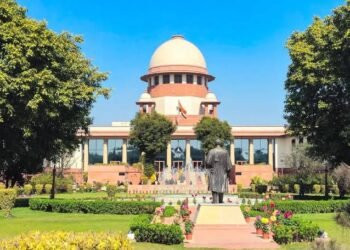
A bench of Justices Joymalya Bagchi and V. Mohana held an urgent Sunday hearing after petitions alleged widespread violations of the court’s October 9 directions during the October 10 protests in Delhi. The petitions alleged that Metro and railway services had been disrupted, internet access suspended, citizens detained and movement restricted well beyond the four-kilometre area around Jantar Mantar.
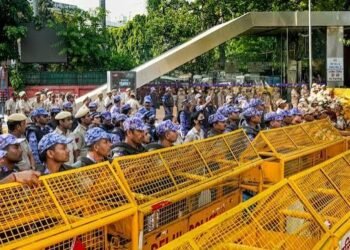
The court directed that free movement of people and traffic in Delhi be permitted, subject to traffic regulations, and that the requirement for barricades be reviewed forthwith in light of law-and-order and traffic conditions. It also directed that Metro and rail facilities continue to function normally unless restrictions became necessary to protect public order under Article 19(2) of the Constitution.
The bench further recorded the Centre’s assurance that internet services had been restored, Metro stations and railway trains were fully functional, and lawyers, journalists and other professionals would not be obstructed in discharging their professional duties.
.READ: Four Right-Wing Goons Arrested Over Assault on Student Protester
Court Seeks Explanation Over Alleged Detentions
The hearing was triggered by urgent applications alleging violations of the Supreme Court’s October 9 order and the illegal detention of a large number of people during Saturday’s protests.
The petitioners told the court that New Delhi and Nizamuddin railway stations had remained closed, Metro services had not functioned normally, extensive traffic restrictions had been imposed and people had allegedly been detained or harassed even outside the area covered by the prohibitory order.
They also alleged a complete internet shutdown and a curfew-like situation in parts of the capital, with transport and movement of people and goods severely affected.
Justice Bagchi said the State would have to satisfy the court on three specific questions in the habeas corpus proceedings: the circumstances in which the alleged detentions took place, the manner in which they were carried out, and the justification for the detentions.
Senior advocates appearing for the petitioners alleged that lawyers, journalists, students and ordinary citizens had been detained. One submission put the number of alleged detentions at around 7,000, while another referred to 45 detention centres. The court, however, did not record these figures as established facts.
Petitioners Allege Violation of Earlier Supreme Court Order
Senior Advocate Gopal Sankaranarayanan alleged that authorities had failed to comply with the court’s October 9 directions, particularly those concerning Metro services, movement and barricades.
He told the bench that barricades remained in place across Delhi and sought their immediate removal, along with restoration of unrestricted movement and Metro services. He also raised concerns about police personnel allegedly operating without identification badges and sought accountability for alleged use of force against protesters and lawyers.
Senior Advocate Shadan Farasat told the court that he had allegedly been assaulted and detained along with other lawyers. He said the issue before the court went beyond lawyers and concerned the broader right of citizens to protest peacefully.
Senior Advocate Menaka Guruswamy argued that the restrictions amounted to a sweeping suspension of constitutional freedoms. She alleged that thousands had been detained, opposition leaders had been picked up and lawyers and others had been prevented from moving freely. She also invoked the constitutional history surrounding the Emergency and the ADM Jabalpur judgment.
Kapil Sibal sought interim directions allowing trains to enter Delhi, preventing detentions and barricades outside the four-kilometre restricted area, and permitting peaceful protest subject to public-order requirements. Justice Bagchi clarified that any such right would remain subject to public order.
Centre Disputes Allegations, Says Metro Ran Normally
Solicitor General Tushar Mehta, appearing for the Centre and Delhi Police, disputed the allegations that Metro services had been shut down.
He told the court that there had been no reduction in the total volume of Metro operations on October 10, with 271 trains inducted according to the standard Saturday schedule and 4,157 train trips operated across the network. However, entry and exit restrictions had been imposed at 45 of the Delhi Metro’s 303 stations, representing about 15% of the network, according to the Centre.
Mehta said the authorities had followed the statutory regime in dealing with detainees and that many people mentioned in the petitions had been picked up around 2 pm and released around 6 pm. He left the question of the legality of individual arrests to the concerned proceedings.
He also told the court that Metro stations and railway services were fully functional by Sunday and that internet connectivity had been restored.
The court nevertheless sought detailed information about the Metro restrictions. Justice Bagchi noted that the authorities had initially proposed closing 57 stations and later restricted access at 45 stations. He directed the government to provide a map showing which stations had remained open and which had been closed so that the court could assess the actual impact on accessibility.
Contempt Notice Issued
The bench also initiated proceedings on the contempt allegations arising from the alleged violation of its October 9 order.
After hearing the submissions, the court directed the alleged contemnors to file affidavits responding to the contempt petition and to submit a compliance report concerning the directions already issued. The other petitions mentioned during the hearing were directed to be served on the Solicitor General’s office.
The court also recalled that its October 9 order had directed authorities to reconsider the proposed closure of 57 Metro stations, stressing that Metro and other rail services could be regulated in appropriate circumstances but should not be prohibited. It had also directed authorities to issue fresh traffic advisories and file a compliance report by October 13.
Metro, Internet and Professional Access
The bench recorded the Centre’s assurance that Metro operations would continue according to the normal schedule, subject to a genuine public-order situation.
Justice Bagchi specifically stressed that lawyers should not be hindered in carrying out their professional duties. The Solicitor General agreed that no advocate could be prevented from performing such duties.
The court also questioned reports that Section 163 of the BNSS had been imposed around the Supreme Court. Justice Bagchi observed that lack of awareness or formal promulgation of such an order could provide grounds to challenge it.
The Supreme Court’s directions leave the government with the ability to impose restrictions where required for public order, but make clear that such measures must be justified. The court is now set to examine the government’s compliance report, including the precise extent of Metro restrictions and the circumstances surrounding the alleged detentions and other curbs imposed during Saturday’s protests.