Withdrawal of support from GPRN/NSCN deepens ZUF Kamson faction’s political and strategic vulnerabilities even as the United Naga Council joined forces with Kuki-Zo leaders, condemning the arsons attack.
By Navin Upadhyay
January 28, 2026: In Manipur’s volatile ethnic landscape—where tensions between Naga and Kuki-Zo communities have simmered for decades—the recent arson attack on a Kuki-Zo village has spectacularly backfired on the Zeliangrong United Front (ZUF), Kamson faction. What was projected as a punitive operation against alleged poppy cultivation in Kuki-Zo areas has instead left the faction politically isolated, publicly condemned by its own Naga brethren, and stripped of critical alliances.
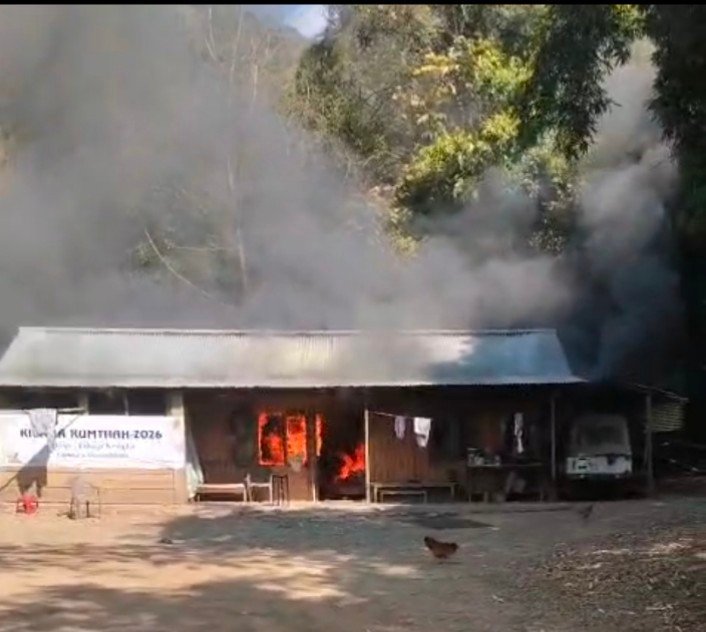
On January 26, 2026—coinciding with India’s Republic Day—ZUF (Kamson) claimed responsibility for torching structures in K. Songlung village of Kangpokpi district, igniting not just flames but a cascading backlash that has exposed the limits of the group’s influence and the costs of its overreach.
The attack, described by ZUF (Kamson) as a “targeted action” against illegal poppy cultivation and alleged encroachment by what it termed “Kuki immigrants,” resulted in the burning of several houses and sheds belonging to Kuki-Zo villagers.
Eyewitness accounts and statements from Kuki organisations painted a far grimmer picture. Armed militants, villagers said, descended on K. Songlung, setting fire to homes and forcing families to flee in a brazen act of violence. The Committee on Tribal Unity (CoTU), a prominent Kuki-Zo civil body, swiftly condemned the incident as a “heinous crime” and issued a 24-hour ultimatum demanding the surrender of those responsible, warning of economic blockades if justice was not delivered.
Kuki-Zo armed groups under Suspension of Operations (SoO) — UPF and KNO — strongly condemned the arson attack on K. Songlung village, warning that ZUF (Kamson) will “reap what it sows” and alleging links to Imphal-based actors.
The United Kuki National Army (UKNA) went further, branding the arson a “cowardly act” and alleging that ZUF (Kamson) was functioning as a proxy force for the National Socialist Council of Nagalim–Isak Muivah (NSCN-IM), a charge that sharply escalated the political stakes.
The incident did not occur in isolation. Manipur’s ethnic fault lines—deepened by the 2023 Meitei–Kuki-Zo clashes—have increasingly drawn Naga groups into overlapping territorial disputes, creating repeated flashpoints for violence. ZUF, formed in 2011 as a splinter from NSCN factions, claims to protect Zeliangrong Naga interests across parts of Manipur, Assam, and Nagaland. Yet persistent internal rifts have weakened the organisation, culminating in the emergence of the Kamson faction under S. Kamson, a leader known for his hardline posture against what he describes as Kuki encroachment.
Kamson’s faction has repeatedly justified its actions under the banner of combating drug cultivation—a genuine and widespread problem in Manipur’s hill districts. Critics, however, argue that the poppy narrative has increasingly been deployed as a convenient pretext for coercive territorial assertion, ethnic intimidation, and forced displacement.
The backlash was swift and multidirectional. The United Naga Council (UNC), the apex representative body of Nagas in Manipur, issued a strong condemnation in a joint statement with the Kuki Inpi Manipur (KIM) on January 27. The statement urged restraint, warned against the spread of inflammatory rumours, and called for dialogue to prevent further escalation.
The peace meeting marked a rare and politically significant convergence between Naga and Kuki leadership, underscoring a shared rejection of violence as a tool of negotiation.
For ZUF (Kamson), the UNC’s stance was a profound setback. The council’s influence over Naga political life is substantial, and its decision to align publicly with Kuki bodies effectively isolated Kamson’s faction as an outlier—portraying it as reckless, unrepresentative, and detrimental to broader Naga interests.
The isolation deepened further when the Government of the People’s Republic of Nagalim / National Socialist Council of Nagaland (GPRN/NSCN) moved decisively to sever ties. On January 27—just a day after the arson—the outfit announced the suspension of all formal agreements with ZUF (Kamson), withdrawing organisational and political support.
In a statement signed by R.M. Lotha and Ato Kilonser N. Kitovi Zhimomi, the group described the arson as incompatible with ongoing peace efforts and a direct threat to Naga unity.
For Kamson’s faction, the rupture is particularly damaging. GPRN/NSCN backing had provided crucial logistical legitimacy amid inter-factional rivalries. Its withdrawal not only cuts off support but also sends a clear signal to other Naga groups: association with ZUF (Kamson) now carries reputational and strategic risk.
Meanwhile, the main ZUF leadership has long disowned the Kamson faction, publicly denying any organisational link to its actions as early as October 2025.
This internal fragmentation within Naga politics underscores how Kamson’s confrontational tactics have alienated not only adversaries but also potential allies within his own ethnic fold.

The fallout carries serious implications for Manipur’s already fragile peace process. Since the eruption of ethnic violence in 2023, more than 200 people have been killed and thousands displaced. Naga groups have often attempted to position themselves as neutral actors or mediators. ZUF (Kamson)’s actions risk dragging Nagas deeper into the conflict, reopening old hostilities with Kuki-Zo armed groups.
Analysts point to historical precedents, including frequent clashes between NSCN-IM and ZUF cadres, where inter-factional violence claimed lives and derailed dialogue efforts.
The latest arson could embolden Kuki armed formations to retaliate, setting off a familiar and dangerous cycle of reprisal.
Local anger has been palpable. In Kangpokpi, civil society groups and residents voiced both outrage and frustration, insisting, “This is not about poppy. This is about driving us out.” Their grievance is understandable: the village is primarily known for orange cultivation, and there is no evidence of poppy terraces or illegal opium cultivation.
Civil society groups and church leaders have urged central intervention, pointing to the failure of state security forces to prevent such attacks despite extensive deployment in sensitive areas.
For S. Kamson and his faction, the episode is a textbook case of biting off more than one can chew. What was intended as a demonstration of strength has instead exposed strategic vulnerability, fractured alliances, and intensified scrutiny. As condemnation from the UNC and the withdrawal of GPRN/NSCN support ripple through Naga political networks, ZUF (Kamson) finds itself increasingly adrift.
In Manipur’s complex ecosystem of insurgency and identity politics, overreach often leads not to dominance but to marginalisation. Whether this episode marks the beginning of the end for the Kamson faction—or forces a recalibration toward restraint and reconciliation—remains uncertain. For now, isolation appears to be the price of its gambit.
The way forward, as underscored by the UNC–KIM dialogue, lies in political engagement rather than provocation. Yet with tempers raw, Manipur remains on edge. The arson at K. Songlung stands as a stark warning: in a landscape shaped by fragile alliances, alienating allies can be more damaging than confronting enemies.