The lynching of a Hindu man, allegedly triggered by accusations of insulting Islam, took place amid rising anti-India sentiment and widespread street violence in Bangladesh, highlighting how political unrest is increasingly spilling over into communal targeting.
BY PC Bureau
December 19, 2025: A Hindu man was lynched and his body set on fire by a mob in Bangladesh’s Mymensingh district on Thursday night, as the country witnessed widespread violence following the death of student leader Sharif Osman Hadi, a prominent figure of the July Uprising and a vocal critic of India.
The victim, identified as Dipu Chandra Das (30), was killed in Bhaluka Upazila after being accused of making derogatory remarks about Islam. According to local media reports, the incident unfolded inside and around the Pioneer Knit Composite Factory, where Das was employed.
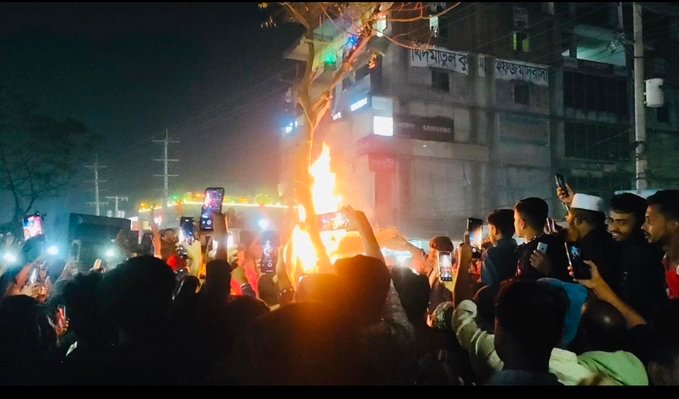
Eyewitness accounts cited by Bangladeshi outlet Barta Bazar said tensions escalated rapidly after the allegation spread among workers and nearby residents. Das was beaten by a mob and died at the spot. In a particularly gruesome turn, the crowd later dragged his body to a nearby bus stand, tied it to a tree, beat it again while chanting slogans, and set it on fire.
A Hindu youth, Dipu Chandra Das, was brutally lynched by Islamists in Dhaka Bangladesh, over alleged blasphemy. After lynching ( STSJ) they hanged him on a tree and then set it on fire…
This is what minorities under threat truly looks like. But there will be no global outrage… pic.twitter.com/1j96QCFO5t
— श्रवण बिश्नोई (किसान/ Hindus) (@SKBishnoi29Rule) December 19, 2025
Reports said the mob then moved the body onto the Dhaka–Mymensingh highway and set it ablaze once more, briefly halting traffic and triggering panic in the area. Authorities later took custody of the body.
READ: Gates’ Epstein Links: Rekindling Scrutiny of Elite Power Circles
READ: From Grief to Rage: Anatomy of Bangladesh’s Anti-India Protests
Confirming the incident, Bhaluka Upazila Executive Officer Md Firoz Hossain said a man had been killed over allegations of insulting the Prophet, adding that police were investigating the matter.
The lynching occurred against the backdrop of escalating unrest across Bangladesh after the death of Hadi, who succumbed to gunshot injuries in Singapore earlier this week. His killing has sparked violent protests, arson, and vandalism in multiple cities, including Dhaka and Chittagong.
Protesters targeted major media houses such as The Daily Star and Prothom Alo, setting parts of their offices on fire, and vandalised symbolic sites linked to Bangladesh’s political history, including the already damaged residence of Sheikh Mujibur Rahman at Dhanmondi 32.
Anti-India sentiment has been a recurring theme in the protests. Demonstrators have accused India of backing former Prime Minister Sheikh Hasina, who was ousted last year and is currently in India. Islamist groups and student collectives, including the Inqilab Moncho, have led rallies denouncing both Hasina and New Delhi.
The Muhammad Yunus-led interim government condemned the lynching, calling it a “heinous crime” and asserting that there was no place for such violence in what it described as a “new Bangladesh.”
“At this critical hour, we urge citizens to honour Hadi’s memory by rejecting violence, hatred, and incitement,” the government said, vowing strict action against those responsible.
The killing of Dipu Chandra Das has heightened concerns over minority safety in Bangladesh, even as authorities struggle to contain the wider political and communal fallout from the ongoing unrest.