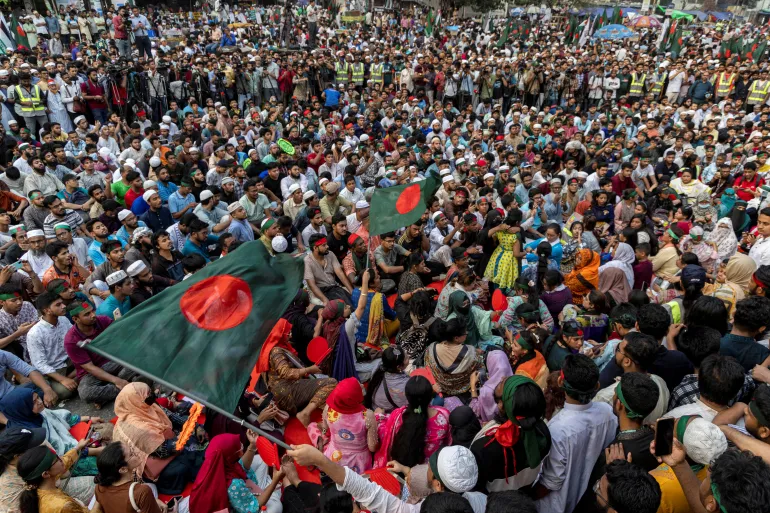
What began as outrage over a political assassination has rapidly escalated into arson, attacks on media houses and assaults on diplomatic premises, highlighting the fragile law-and-order situation during Bangladesh’s political transition.’
BY PC Bureau
The killing of student leader and political activist Sharif Osman Hadi has acted as a catalyst for a wider and more dangerous phenomenon unfolding across Bangladesh: the rapid spread of anti-India protests marked by arson, vandalism and direct attacks on political, media and diplomatic targets. While Hadi’s death was the immediate trigger, the scale and direction of the violence point to deeper political fault lines, unresolved resentments and a volatile transition period in the country.
Hadi was not merely a student leader. He emerged from the July uprising as a symbol of defiance against the old political order and was actively contesting the national elections. His open anti-India rhetoric and sharp criticism of the Awami League had earned him a following among younger, politically mobilised groups who increasingly view India as a decisive external actor in Bangladesh’s internal politics. His shooting during an election campaign and subsequent death in Singapore transformed him into a martyr figure almost overnight.
What followed was not a spontaneous outburst of grief alone. The protests quickly assumed a clear political direction. Demonstrators torched Awami League offices, vandalised major media houses such as Prothom Alo and The Daily Star, and attempted to breach Indian diplomatic premises in Dhaka and Chittagong. The selection of targets suggests a narrative in which domestic power centres and India are portrayed as intertwined forces responsible for political repression and injustice.
🇧🇩 Bangladesh in Turmoil 🇧🇩
National mourning was declared after Osman Hadi’s killing. Flags at half-mast. Violent protests erupt. protesters blame #India. Newspaper offices in #Dhaka and an #Indian diplomatic site in #Chittagong attacked.#OsmanHadi #BangladeshCrisis #Bangla pic.twitter.com/bevVKbXRTD— Rizwan Shah (@rizwan_media) December 19, 2025
The anti-India dimension of the unrest is particularly significant. Relations between New Delhi and Dhaka have been under strain since the flight of former prime minister Sheikh Hasina to India, an episode that opposition groups and protest movements have framed as proof of Indian interference in Bangladesh’s political trajectory. For many protesters, Hadi’s death has become a symbol not only of state violence but also of what they perceive as India’s long-standing influence over Bangladesh’s ruling elite.
This framing has allowed disparate grievances to converge. Student groups, opposition activists and radical street organisations have coalesced under slogans that combine demands for justice with calls for resistance against India. Marches under banners such as “July Oikya” indicate an attempt to revive the momentum of earlier uprisings while giving them a sharper nationalist and anti-India edge.
READ: Hadi Death Sparks Dhaka Riots, Media Offices Torched
READ: Explosive Epstein Photos: Handwritten Messages on Women, Chomsky Link
The violence has also exposed the fragility of Bangladesh’s current law-and-order situation. Attacks on media houses point to an effort to silence or intimidate narratives that do not align with the protest movement’s worldview. Disruption of relief work and attacks on public property further underline how quickly political agitation has slipped into coercive street power, stretching the capacity of security forces already navigating a sensitive transition.
They tried to create problems with India;
Now they themselves is burning!#BangladeshBurning
Media houses, senior journalists, Awami League offices attacked.
Protests erupt after the death of Osman Hadi, the anti-India student leader. pic.twitter.com/2G6Ju0Gsuf— KVS Haridas 🇮🇳 (@keveeyes) December 18, 2025
For India, the developments present a complex challenge. Diplomatic premises have emerged as symbolic targets, even as New Delhi seeks to avoid overt intervention. Any heavy-handed response could reinforce protest narratives, while silence risks emboldening further attacks. For Bangladesh’s interim administration, led by Nobel laureate Muhammad Yunus, the task is even more delicate: to assert authority, ensure accountability for Hadi’s killing, and prevent political grief from hardening into sustained anti-India mobilisation.
The declaration of a day of state mourning may calm tempers temporarily, but it does little to address the underlying drivers of unrest. Unless the investigation into Hadi’s death is seen as credible and the broader political transition gains legitimacy, the protests risk becoming a recurring flashpoint. More critically, the growing tendency to externalise internal political struggles by casting India as an adversary could have long-term consequences for regional stability.
Hadi’s death, therefore, marks more than a tragic end to a young political life. It has exposed how swiftly personal loss can be weaponised into mass mobilisation, and how fragile Bangladesh’s political equilibrium remains at a moment when anti-India sentiment is no longer confined to rhetoric but is increasingly being played out on the streets.