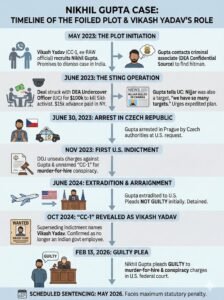
Gupta was arrested in the Czech Republic in June 2023 after unknowingly dealing with DEA operatives and extradited to the US in 2024. The case has sparked international attention, highlighting risks faced by diaspora activists and raising questions about alleged foreign interference.
BY PC Bureau
New Delhi, February 14, 2026— Behind the explosive headlines surrounding Nikhil Gupta’s 2026 guilty plea in Manhattan federal court lies the story of a man whose life navigated the shadowy crossroads of international crime and alleged state-backed operations.
Gupta, 54, an Indian national, pleaded guilty to murder-for-hire, conspiracy to commit murder-for-hire, and conspiracy to commit money laundering in a plot targeting Gurpatwant Singh Pannun, a US-based Sikh activist advocating for Khalistan, a separatist movement seeking a homeland for Sikhs in India. He now faces up to 40 years in prison when sentenced on May 29, 2026.
A Criminal Past and Recruitment
According to unsealed US federal indictments, Gupta—known in encrypted circles as “Nick”—was no diplomat or official. In his own communications, he described himself as an “international narcotics and weapons trafficker.” US authorities say Gupta’s recruitment into the assassination plot was facilitated by legal troubles in India. In early 2023, he faced a criminal robbery case in Gujarat, making him vulnerable to approaches by intelligence operatives.
Prosecutors allege that Gupta was approached by Vikash Yadav, an employee of India’s Cabinet Secretariat, which oversees the Research and Analysis Wing (RAW), India’s foreign intelligence agency. Yadav reportedly offered a “quid pro quo”: help eliminate a high-value target in the US, and his legal troubles in India would be resolved. By May 2023, Gupta had transitioned from narcotics middleman to a logistics manager for a state-linked hit, allegedly brokering a $100,000 contract for Pannun’s assassination and arranging a $15,000 cash advance.
Operational Methods and Ambition
Court documents and intercepted communications portray Gupta as methodical and businesslike. He reportedly provided the purported hitman with Pannun’s GPS coordinates, phone numbers, and daily schedule. Following the murder of Hardeep Singh Nijjar in Canada, Gupta allegedly told an undercover agent, “We have so many targets… now there is no need to wait” to strike in New York.
Gupta also boasted to undercover officers about moving assault rifles and drugs across borders, demonstrating a confidence in his underworld network that would ultimately become his undoing.
Nikhil Gupta pleads guilty to attempted assassination of U.S. citizen at direction of India’s BJP government.https://t.co/WmHqlp0MIE
— @Reasonyourself (@Reasonyourself) February 14, 2026
READ: Indian Man Pleads Guilty to Plotting to Kill US Sikh Activist
Relying on his criminal instincts, Gupta reached out to a contact he believed could supply a professional killer. That contact, however, was a DEA informant, and the hitman he thought he hired was an undercover federal agent. Gupta was arrested in the Czech Republic in June 2023 and extradited to the US in 2024. Since then, he has spent his time in isolation, a stark contrast to his prior life of international movement and illicit operations.
Legal Proceedings and Sentencing
Gupta initially challenged some evidence through a motion to suppress, but ultimately decided to plead guilty to all counts. He now faces up to 40 years in prison:
| Convicted Counts | Maximum Sentence |
|---|---|
| Murder-for-Hire | 10 Years |
| Conspiracy to Commit Murder-for-Hire | 10 Years |
| Money Laundering Conspiracy | 20 Years |
| Total Exposure | 40 Years |
Diplomatic and Global Implications
The case has drawn international attention due to Gupta’s alleged links to an Indian government official. India has denied involvement in the plot against Pannun or in the murder of Nijjar in Canada. Pannun, speaking to the BBC, described Gupta’s guilty plea as “judicial confirmation that India’s Modi government orchestrated a structured murder-for-hire assassination plot on American soil.”
Sikhs constitute roughly 2% of India’s population, and while the Khalistan movement is largely dormant domestically, diaspora communities continue to advocate for Sikh autonomy. The Gupta case underscores the risks faced by political activists abroad, particularly those challenging the Indian government’s position on separatist movements.
From alleged narcotics trafficker to state-linked operative, Nikhil Gupta’s story highlights the murky intersection of international crime, intelligence operations, and geopolitics, and is likely to remain a focal point in US-India diplomatic discussions in the months ahead.