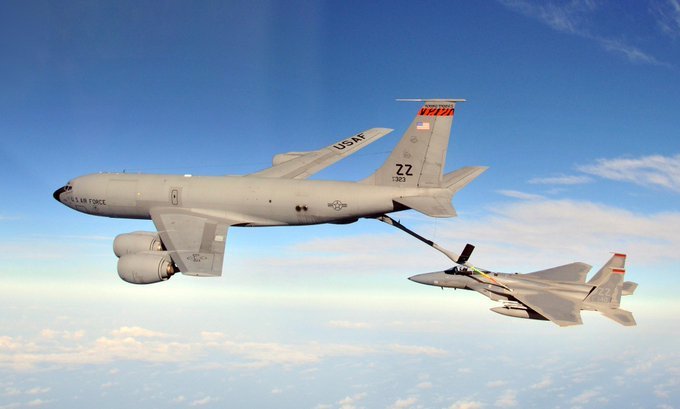
U.S. officials say the tanker was operating alongside another KC-135 during a refueling mission when the aircraft went down in friendly airspace. Authorities stress there is no indication of hostile fire, contradicting claims by Iran-aligned militias.
BY PC Bureau
March 13, 2024: U.S. Central Command (CENTCOM) confirmed late Thursday that a U.S. Air Force KC-135 Stratotanker aerial refueling aircraft crashed in western Iraq while supporting Operation Epic Fury, the ongoing joint U.S.–Israeli military campaign targeting Iranian military infrastructure across the region. Search-and-rescue operations were launched immediately after the incident, though the status of the crew remained unclear early Friday as recovery teams continued combing the crash area.
In a brief statement released late Thursday evening, CENTCOM acknowledged the loss of the aircraft but provided limited details as the investigation remains in its initial phase.
“U.S. Central Command is aware of the loss of a U.S. KC-135 refueling aircraft,” the command said. “The incident occurred in friendly airspace during Operation Epic Fury, and rescue efforts are ongoing.”
Officials stressed that two KC-135 tanker aircraft were operating in coordination at the time of the incident, a common configuration during complex aerial refueling operations that support long-range strike missions. One aircraft went down in western Iraq under circumstances that remain under investigation. The second tanker was able to land safely and has reportedly returned to base. Some aviation tracking data circulating online suggested the aircraft may have diverted to Ben Gurion Airport, though U.S. officials have not formally confirmed the landing location.
Crucially, defense officials emphasized that there is no evidence the crash was caused by hostile fire, either from Iranian forces or from allied units operating in the region. Early assessments instead suggest the loss may have resulted from an operational or mechanical mishap during flight operations.
US refueling aircraft was struck by a missile fired by resistance groups in western Iraq, resulting in a crash that killed everyone onboard.
Video from NAYA reportedly shows two Chinooks searching for six missing US soldiers. pic.twitter.com/cHLuSRjykN
— Ounka (@OunkaOnX) March 13, 2026
A U.S. defense official, speaking on condition of anonymity because the situation is still developing, told reporters that between five and six service members may have been aboard the aircraft when it went down. A standard KC-135 crew typically consists of three personnel—a pilot, co-pilot, and boom operator—but additional aircrew or mission specialists are sometimes present for training exercises, mission oversight, or specialized refueling coordination.
As of Friday morning, no official confirmation of casualties has been released. Rescue teams supported by U.S. military assets in Iraq are continuing recovery operations at the crash site, which lies in a sparsely populated region of western Iraq.
The KC-135 Stratotanker—developed by Boeing and first introduced in the late 1950s—remains one of the most important platforms in the U.S. Air Force’s global power-projection capability. The tanker allows fighter jets, bombers, and reconnaissance aircraft to refuel mid-air, dramatically extending their operational range and enabling sustained strike campaigns far from home bases. Aircraft like the KC-135 have played a crucial logistical role in Operation Epic Fury, which began on February 28 and has involved continuous waves of long-range airstrikes on Iranian missile sites, air defenses, and facilities linked to the Islamic Revolutionary Guard Corps (IRGC).
Shortly after news of the crash began circulating online, Iran-aligned militias operating under the banner of the Islamic Resistance in Iraq claimed responsibility for the incident. In a statement posted on affiliated channels, the group alleged it had used air-defense systems to target and destroy the aircraft in what it described as a response to foreign military activity in Iraqi airspace.
U.S. officials, however, have categorically rejected those claims, stating that current evidence points to an accident rather than hostile action. Defense officials cautioned that militant groups in the region frequently issue rapid claims of responsibility for incidents as part of psychological or information warfare efforts.
If confirmed, the crash would represent at least the fourth U.S. aircraft loss publicly acknowledged since the start of the conflict with Iran. Earlier in the campaign, three F-15E Strike Eagle fighter jets were mistakenly engaged by Kuwaiti air-defense units in a friendly-fire incident. All aircrews were able to eject and were later recovered, though the episode highlighted the dangers of operating in increasingly crowded and volatile regional airspace.
READ: Modi, Iran President Hold First Call Since Middle East War
The broader conflict has already exacted a significant toll on U.S. forces deployed in the region. According to Pentagon figures, seven American service members have been killed in combat-related incidents since the start of hostilities. Six of those deaths occurred when an Iranian drone strike hit an operations center at a Kuwaiti civilian port used by coalition forces. Another service member later died of wounds sustained during an attack near Prince Sultan Air Base.
The Pentagon also reports approximately 140 U.S. personnel wounded during the campaign, including eight who suffered severe injuries.
Despite these losses, Operation Epic Fury continues at a high operational tempo. U.S. and Israeli aircraft have conducted repeated strikes against Iranian missile launch facilities, radar installations, drone bases, and logistics hubs believed to support regional proxy forces. U.S. officials say the campaign has significantly degraded Tehran’s military capabilities, though analysts warn that the conflict is showing little sign of de-escalation.
Tensions have spread beyond the immediate battlefield as well. Iranian-linked groups have launched attacks on shipping in the Strait of Hormuz, raising fears of disruption to global energy supplies and prompting international naval patrols to increase security operations in the vital maritime corridor.
For now, CENTCOM says its priority remains locating the crew of the downed tanker and securing the crash site.
“More information will be made available as the situation develops,” the command said in its statement. “We ask for continued patience while we gather additional details and provide clarity for the families of service members involved.”
No photographs or imagery of the wreckage have been released publicly, as recovery operations are still underway. Military officials indicated that additional updates are expected in the coming hours as investigators reach the site and assess the circumstances of the crash.