Officials say Donald Trump has not approved a ground invasion, with the buildup aimed at deterrence and operational flexibility.
BY PC Bureau
March 29, 2026: The United States is rapidly expanding its military presence in the Middle East, deploying more than 3,500 additional troops and Marines as its conflict with Iran enters a dangerous new phase—raising urgent questions about whether Washington is preparing for ground operations or simply preserving strategic flexibility.
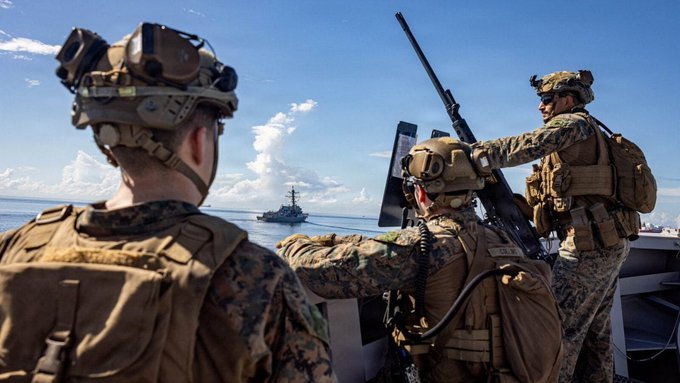
At the center of the buildup is the amphibious assault ship USS Tripoli, now operating in the United States Central Command (CENTCOM) theater with roughly 2,200–2,500 Marines from the 31st Marine Expeditionary Unit. The vessel carries F-35B stealth fighters, V-22 Ospreys, and amphibious assault capabilities, enabling rapid-response missions across land and sea.
Reinforcements are continuing to flow in, including the USS Boxer Amphibious Ready Group—carrying another 2,000+ Marines from the 11th Marine Expeditionary Unit—along with additional naval assets and elements reportedly linked to the U.S. Army’s 82nd Airborne Division. Together, these deployments add thousands of ground-capable forces to an already volatile region.
🚨‼️#Unusual: Two thousand US Marines arrive in the Arabian Sea as part of US military reinforcements in the region pic.twitter.com/hPOEQCKvb1
— MOSCOW NEWS 🇷🇺 (@MOSCOW_EN) March 28, 2026
READ: Iran Threatens Strikes on US-Linked Campuses in Middle East
No Decision on Invasion
Despite the visible surge in firepower, there is no confirmed decision by Donald Trump to launch a ground invasion of Iran.
U.S. officials describe the buildup as a move to enhance deterrence, protect regional bases and allies, secure maritime routes, and enable limited operations if required—not to support a full-scale occupation.
Pentagon Plans: Limited, Not Large-Scale
Recent reporting indicates the Pentagon is preparing contingency plans for weeks-long, limited ground operations. These could involve Marines, special operations forces, or airborne units targeting strategic sites such as coastal positions or key energy infrastructure.
The emphasis, however, is on short-duration raids or precision missions—not a sustained push inland or an attempt to seize major cities.
U.S. Secretary of State Marco Rubio has reinforced that position, stating that Washington can achieve its objectives without deploying ground troops. He said operations are “on or ahead of schedule” and expected to conclude “in a matter of weeks, not months.”
What the Buildup Really Signals
Military analysts say the current troop levels—while significant—are far below what would be required for a full invasion. By comparison, the 2003 Iraq War began with more than 150,000 U.S. troops.
A campaign against Iran would be far more complex, given its size, terrain, population, and remaining missile and drone capabilities.
Frank McKenzie, a former CENTCOM commander, has warned that while such scenarios have long been studied, a ground war would carry substantial risks. Other retired officers have echoed concerns about high casualties and the difficulty of sustaining operations deep داخل Iranian territory.
More hawkish voices, such as Keith Kellogg, have argued for limited “boots on the ground” to seize strategic نقاط like offshore oil hubs or coastal choke points—moves they say could pressure Iran economically without requiring a full invasion.
Invasion vs. Reality
A full-scale invasion of Iran would represent a major escalation, likely requiring hundreds of thousands of troops and carrying severe military and economic risks. Tehran retains the ability to strike regional bases, disrupt global energy flows through the Strait of Hormuz, and activate allied groups across the region.
For now, the U.S. strategy appears focused on air and naval dominance, precision strikes, economic pressure, and maintaining credible ground options without committing to them.
There is no evidence of an imminent U.S. invasion of Iran. Instead, the deployment of the USS Tripoli, USS Boxer, and thousands of Marines signals a calculated effort to expand military options—allowing Washington to respond quickly if the conflict escalates, while stopping short of a full-scale ground war.
Whether this buildup remains a tool of deterrence—or evolves into limited ground action—will likely depend on how the conflict unfolds in the coming weeks.