The French weekly details massive profits from crypto ventures, Mar-a-Lago memberships, real estate licensing, and high-dollar access to Trump’s inner circle.
BY PC Bureau
(Based on the investigative dossier “Donald Trump: Le Grand Braquage,” Le Point, April 2026 edition)
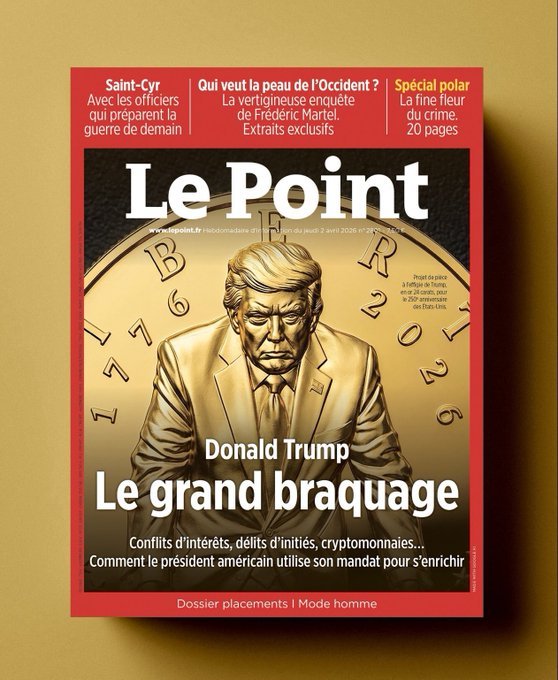
April 6, 2026: In its latest cover story, France’s influential weekly Le Point presents a scathing portrait of Donald Trump’s second presidency. Titled Le Grand Braquage (“The Great Heist”), the eight-page investigation by journalist François Miguet alleges that the American president has orchestrated a systematic enrichment of himself and his inner circle, effectively transforming the White House into what the magazine describes as “a cash machine for the Trump clan.”
Citing political scientists Alexander Cooley and Daniel Nexon, Le Point raises the question of whether the United States is sliding from a plutocracy toward a kleptocracy — a state where public office and foreign policy are subordinated to private fortunes.
Alleged Wealth Accumulation
The dossier estimates that Trump and his family have amassed more than $4 billion across his two terms, drawing on figures reported by The New Yorker. Contrary to conventional practice, the Trump family reportedly did not place assets in a blind trust, and instead allegedly expanded deals in cryptocurrencies, real estate licensing, private clubs, luxury goods, and even high-dollar access to the presidency itself.
Crypto: From Skeptic to Billion-Dollar Player
Once dismissive of cryptocurrencies as “based on thin air,” Trump’s post-election strategy included the creation of Trump and Melania tokens. Sons Eric and Donald Jr. reportedly licensed the family name to American Bitcoin, in exchange for a 30% stake in the company.
A separate venture, World Liberty Financial, allegedly generated over $1 billion, partly leveraging advanced Nvidia chips previously restricted under the Biden administration. Le Point estimates that total crypto earnings for the family could exceed $3 billion, boosted by backing from Gulf monarchies. Though precise figures are hard to verify, the dossier notes that the scale of wealth accumulation is unprecedented for a sitting president.
The lead article in #LePoint from #France (“The Great Heist”)is an extensive investigation into the intersection of Trump’s second term and his and family’s private business interests. The report argues that the White House under Trump has shockingly been transformed into a “cash… pic.twitter.com/Ro1GoVhZRp
— Thomas P (TOM) Logan 🇯🇵 🇺🇸 (@TokyoTom2020) April 5, 2026
READ: Trump threatens to “blow up” Iran, Shruggs off Civilian Deaths
Real Estate, Private Clubs, and Brand Licensing
Mar-a-Lago, Trump’s Florida estate, remains a major revenue generator. Membership fees reportedly rose from $200,000 to $1 million, with $32,000 annual dues, bringing in an estimated $125 million over the past decade. The club hosts billionaires, including Elon Musk and Jeff Bezos, alongside world leaders such as Israeli Prime Minister Benjamin Netanyahu, Ukrainian President Volodymyr Zelensky, and Finland’s Alexander Stubb.
Beyond Florida, the Trump brand is licensed for luxury resorts and golf projects in the Gulf, Vietnam, Romania, and Qatar — often without capital investment by the family. Eric Trump is reportedly expanding operations in Qatar, while Jared Kushner continues high-profile real estate ventures in the Balkans and maintains close ties to Gulf states.
Gifts, Access, and “Patrimonial Power”
The dossier details lavish gifts and paid access that raise conflict-of-interest concerns. Billionaire Herbert Wertheim reportedly paid $2 million for a private White House dinner and tour — officially presented as a charity auction for Florida first responders. Foreign leaders allegedly showered Trump with gold ingots, Rolex watches, a 24-carat sculpture from Apple’s Tim Cook, and even a Boeing 747-8 jet from Qatar valued at $150–180 million, which Trump may keep post-presidency.
Political scientist Francis Fukuyama is quoted describing Trump’s governance style as “patrimonial” — similar to leaders like Vladimir Putin and Recep Tayyip Erdogan — where policy decisions appear to follow gifts and personal influence. One example cited: Switzerland’s tariffs on U.S. goods reportedly dropped sharply after presenting Trump with a gold ingot and Rolex.
Family Empire and Washington “Trumpization”
The dossier also examines the broader Trump-Kushner network. Ivanka Trump and Jared Kushner are portrayed as central figures in both diplomacy and business. Donald Jr. co-manages 1789 Capital, a $3-billion “anti-woke” investment fund whose portfolio companies have already secured over $1 billion in federal contracts.
Consumer products continue to generate revenue: $55 MAGA caps, $86 gold chocolate bars, and $225 sneakers remain in high demand. A companion piece in Le Point explores “the Kushners, or the diplomacy of business,” suggesting that Jared Kushner negotiates Middle East and Ukraine policy from his Miami mansion while family real estate interests expand. The report traces the dynasty’s long-standing practice of turning conflict into profit.
Institutional Rollback
Le Point argues that this enrichment has been enabled by the dismantling of institutional safeguards. Among other measures, Trump allegedly revoked post-presidency lobbying bans, dismissed the head of the Office of Government Ethics, suspended portions of the Foreign Corrupt Practices Act, and issued pardons for previously convicted figures.
Critics quoted anonymously within Republican circles warn that decisions have been “very, very profitable for the families of its members,” and predict that the dynasty may face consequences when the law eventually catches up.
A French Perspective: Warning to America?
While Le Point does not claim to uncover new legal violations, it assembles publicly reported deals, financial estimates, and expert commentary into a mosaic of alleged self-dealing. The magazine concludes that American diplomacy now appears subordinated to the private interests of the president and his circle.
Whether these allegations withstand American legal scrutiny remains to be seen, but the dossier — including on-the-ground reporting from Florida — offers a sobering international view of what Le Point calls the “great heist” unfolding inside the world’s most powerful democracy. The central question is no longer whether Trump is enriching himself, but how much, and at what cost to the republic.