Details of tariff cuts, Russian oil commitments, and market access for US farm goods have triggered sharp political attacks on the Modi government.
BY PC Bureau
New Delhi, February 10: The White House fact sheet detailing the newly announced India–United States trade deal has triggered fresh political trouble for the Modi government, providing ammunition to the Opposition, which has accused New Delhi of sacrificing India’s long-standing strategic ties with Russia to please Washington and compromising farmers’ and domestic industry interests.
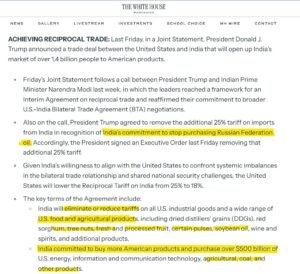
The Donald Trump administration has described the agreement as a “historic” breakthrough that would open India’s 1.4-billion-strong market to American goods. According to the White House, the United States has agreed to reduce the reciprocal tariff on Indian imports from 25 per cent to 18 per cent, while India has committed to a sweeping reduction in tariffs and non-tariff barriers on American products.
READ: Manipur: Internet Cut in Ukhrul Amid Gunfire and Arson in Litan
The fact sheet also brought clarity to President Trump’s dramatic claim that India had agreed to cut “tariffs and non-tariff barriers against the United States to ZERO.” While the statement suggests a phased reduction of duties across multiple sectors rather than an immediate elimination, it confirms that Washington has agreed to remove the additional 25 per cent tariff on Indian goods in return for India halting purchases of Russian oil — a revelation that has sparked sharp political debate.
Key Terms of the Deal
According to the White House, India has agreed to eliminate or substantially reduce tariffs on all US industrial goods and a wide range of agricultural and food products, including dried distillers’ grains (DDGs), red sorghum, tree nuts, fresh and processed fruits, pulses, soybean oil, wine, spirits, and several other items.
New Delhi has also committed to significantly increase purchases of American products, including over $500 billion worth of US energy, information and communication technology, agricultural goods, coal, and other commodities.
The statement further noted that India has agreed to address key non-tariff barriers, particularly in priority trade sectors, and to remove its digital services tax. It has also committed to negotiating comprehensive bilateral digital trade rules that prevent discriminatory practices, restrict customs duties on electronic transmissions, and facilitate cross-border digital commerce.
Additionally, both sides agreed to negotiate rules of origin to ensure that trade benefits primarily accrue to the US and India, while also strengthening economic security cooperation, supply chain resilience, technology collaboration, and investment screening mechanisms.
Political Fallout in India
The revelation that the rollback of US tariffs is linked to India halting Russian oil purchases has intensified Opposition criticism. Opposition leaders argue that the Modi government has compromised India’s strategic autonomy, diluted its long-standing ties with Russia, and conceded too much ground to Washington without adequately safeguarding domestic interests, particularly those of farmers and small producers.
Trump’s initial claim of “zero tariffs” further stoked anxiety among Indian traders and agricultural groups, though the official statement suggests a gradual liberalisation framework rather than a blanket duty elimination.
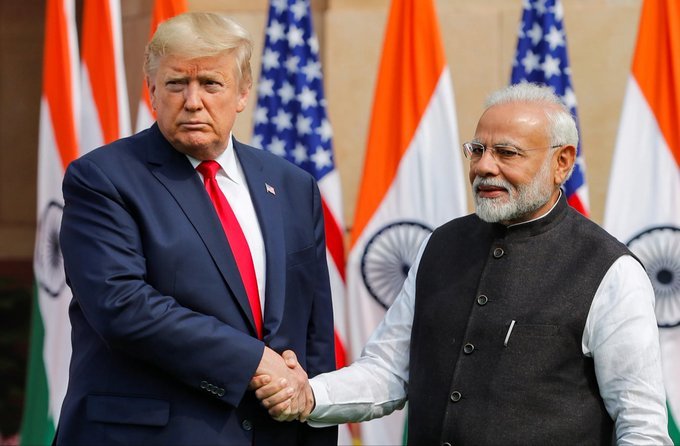
The White House said the framework was finalised following a recent phone conversation between President Trump and Prime Minister Narendra Modi, in which both leaders agreed to pursue an interim reciprocal trade agreement, while reaffirming their commitment to a broader Bilateral Trade Agreement (BTA).
In the coming weeks, both sides are expected to implement the framework and accelerate negotiations aimed at finalising the interim deal, with the stated objective of concluding a comprehensive and mutually beneficial BTA.
Negotiations will continue on remaining tariff barriers, non-tariff barriers, customs procedures, regulatory practices, services and investment, intellectual property rights, labour, environmental standards, government procurement, and trade-distorting practices of state-owned enterprises, the statement said.
As the political debate sharpens, the Modi government now faces the delicate challenge of defending the agreement domestically while balancing strategic autonomy, farmer interests, and geopolitical alignments.