The Singapore Police clarification exposes a growing contrast between legal processes and political messaging, with the Assam government’s high-decibel campaign around the case drawing criticism as the state heads toward an election year.
BY PC Bureau
December 19, 2025: The Singapore Police Force’s assertion that it did not suspect foul play in the death of singer Zubeen Garg has dealt a significant setback to Assam Chief Minister Himanta Biswa Sarma, who has repeatedly and publicly claimed—since the day of the incident—that the popular Assamese artist was “murdered.”
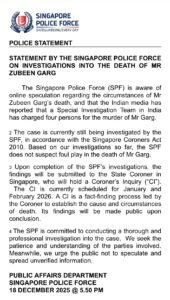
In a statement issued on December 18, Singapore police said investigations conducted so far under the country’s Coroners Act, 2010, have not indicated criminal intent. “Based on our investigations so far, the SPF does not suspect foul play in the death of Garg,” the statement said, adding that a coroner’s inquiry scheduled for January–February 2026 would establish the final cause and circumstances of death.
The clarification undercuts the narrative aggressively pushed by the Assam government over the past three months, with Sarma framing Garg’s death as a conspiracy and promising exemplary punishment for those allegedly responsible. The chief minister’s assertions—made repeatedly at public events and on social media—have helped fuel intense public outrage, turning the singer’s death into a highly emotive political issue in Assam.
Zubeen Garg died on September 19 while swimming in the sea in Singapore, a day before he was to perform at the 4th North East India Festival. Singapore authorities have consistently maintained that the matter is being examined through a legal fact-finding process and have urged restraint against speculation. Garg was declared dead at Singapore General Hospital, with drowning cited as the preliminary cause.
Despite this, the Assam Police’s Special Investigation Team (SIT) last week filed a 12,000-page chargesheet accusing seven people—including Garg’s secretary Siddhartha Sharma and festival organiser Shyamkanu Mahanta—of murder, criminal conspiracy and related offences. The chargesheet alleges that the singer was intoxicated, encouraged to swim without a life jacket, and did not receive timely medical assistance, despite known health conditions.
The sharp contrast between Singapore’s cautious, evidence-based position and the Assam government’s assertive political messaging has drawn growing attention. Critics argue that Sarma’s intervention has gone well beyond routine concern, with the chief minister appearing to mobilise public sentiment around the case in a manner that increasingly resembles a political campaign issue ahead of the 2026 Assam Assembly elections.

From the outset, Sarma has publicly rejected the possibility of an accidental death, often using categorical language that implied guilt before the completion of any judicial or forensic process. The sustained publicity—daily briefings, strong statements, and repeated references to “murder”—has amplified public anger and placed enormous pressure on investigators.
Singapore police, however, have cautioned against such conclusions. In their December 18 statement, authorities emphasised that the coroner’s inquiry is a neutral, fact-finding mechanism and that conclusions would be made public only after the process is completed. They also appealed to the public not to circulate unverified claims.
All seven accused in the case appeared virtually before a Guwahati court earlier this week, with the next hearing scheduled for December 22. Meanwhile, the Bar Association declined to defend the accused, reflecting the charged atmosphere surrounding the case.
As the legal processes unfold in two jurisdictions, the Singapore police position has introduced an uncomfortable counterpoint to the Assam government’s narrative. While the SIT presses ahead with murder charges, the absence of any finding of foul play by Singapore authorities raises questions about whether the case has been shaped as much by political considerations as by evidence.
With the coroner’s inquiry still pending, the divergence between Singapore’s restrained approach and Assam’s high-pitched political messaging is likely to remain under scrutiny—particularly as Assam moves closer to an election year in which emotion, identity and public mobilisation often take centre stage.